

10 Computational EEG Analysis for Hyperscanning …
217
10.2 Hyperlink for Social Perception
Perception of social information is the foundation for human social behaviors. Our
brain has been shown to have highly specified regions for efficiently processing social
information, such as faces and voices [60]. The state-of-the-art findings, however, are
mostly conducted using single-brain approaches and the event-related method has
been the most popular and most widely-used technique. Due to the complicated and
strong noise in neural signals, the event-related method normally requires a highly
controlled experimental environment, with a sufficient number of repetition of the
target social stimuli. These requirements, however, lead to experimental setups that
are quite different from real-world naturalistic social scenarios. In addition, neural
responses in the event-related method are defined by activities significantly different
from a certain pre-selected baseline that is expected to be free of stimulus-related
brain activities. Due to the non-stationarity nature of neural activities [28], these
baselines are suggested to be temporally close to the time of the stimuli, e.g. up to
several hundred milliseconds prior to the onset of the stimuli for EEGs. The stimulusfree baseline periods, again, is not likely to be feasible in real-world situations as
people are always involved in continuous perception of social information.
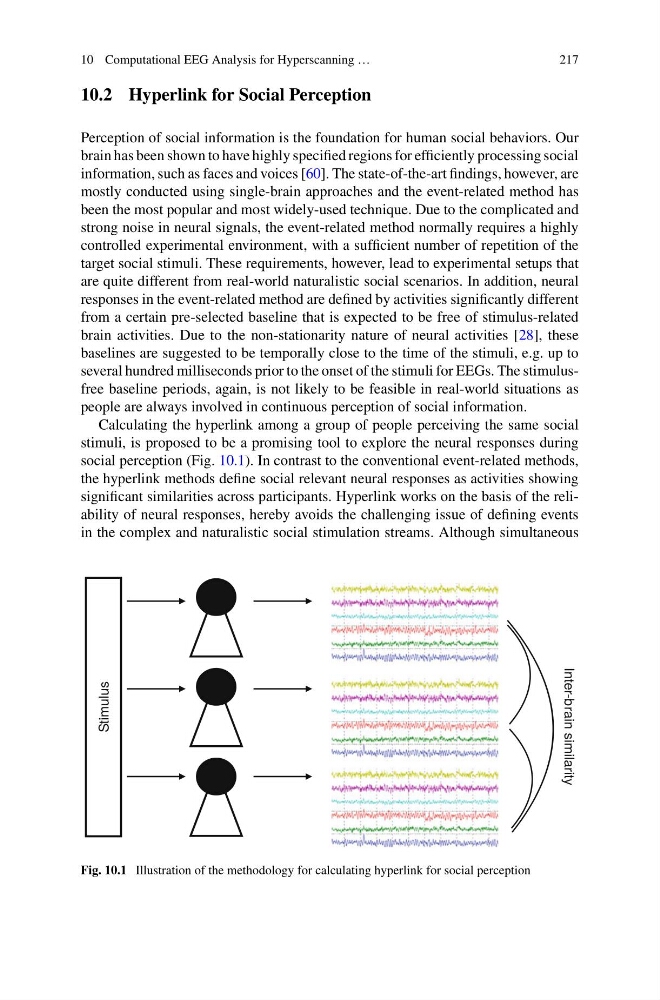
Calculating the hyperlink among a group of people perceiving the same social
stimuli, is proposed to be a promising tool to explore the neural responses during
social perception (Fig. 10.1). In contrast to the conventional event-related methods,
the hyperlink methods define social relevant neural responses as activities showing
significant similarities across participants. Hyperlink works on the basis of the reliability of neural responses, hereby avoids the challenging issue of defining events
in the complex and naturalistic social stimulation streams. Although simultaneous
Fig. 10.1 Illustration of the methodology for calculating hyperlink for social perception
217
10.2 Hyperlink for Social Perception
Perception of social information is the foundation for human social behaviors. Our
brain has been shown to have highly specified regions for efficiently processing social
information, such as faces and voices [60]. The state-of-the-art findings, however, are
mostly conducted using single-brain approaches and the event-related method has
been the most popular and most widely-used technique. Due to the complicated and
strong noise in neural signals, the event-related method normally requires a highly
controlled experimental environment, with a sufficient number of repetition of the
target social stimuli. These requirements, however, lead to experimental setups that
are quite different from real-world naturalistic social scenarios. In addition, neural
responses in the event-related method are defined by activities significantly different
from a certain pre-selected baseline that is expected to be free of stimulus-related
brain activities. Due to the non-stationarity nature of neural activities [28], these
baselines are suggested to be temporally close to the time of the stimuli, e.g. up to
several hundred milliseconds prior to the onset of the stimuli for EEGs. The stimulusfree baseline periods, again, is not likely to be feasible in real-world situations as
people are always involved in continuous perception of social information.
Calculating the hyperlink among a group of people perceiving the same social
stimuli, is proposed to be a promising tool to explore the neural responses during
social perception (Fig. 10.1). In contrast to the conventional event-related methods,
the hyperlink methods define social relevant neural responses as activities showing
significant similarities across participants. Hyperlink works on the basis of the reliability of neural responses, hereby avoids the challenging issue of defining events
in the complex and naturalistic social stimulation streams. Although simultaneous
Fig. 10.1 Illustration of the methodology for calculating hyperlink for social perception