

9 Computational EEG Analysis for Brain-Computer Interfaces
203
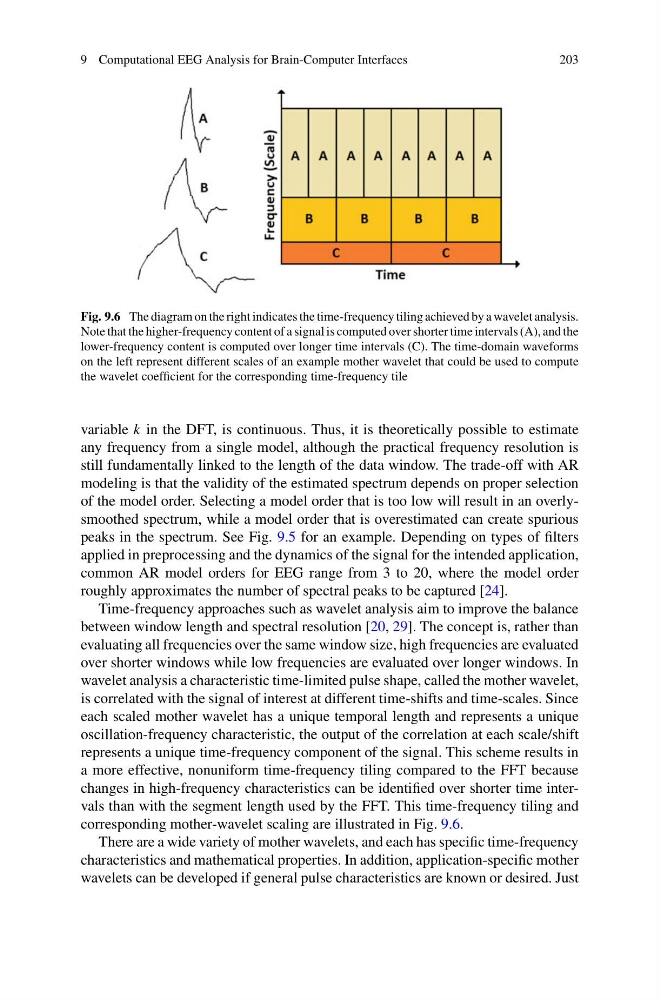
Fig. 9.6 The diagram on the right indicates the time-frequency tiling achieved by a wavelet analysis.
Note that the higher-frequency content of a signal is computed over shorter time intervals (A), and the
lower-frequency content is computed over longer time intervals (C). The time-domain waveforms
on the left represent different scales of an example mother wavelet that could be used to compute
the wavelet coefficient for the corresponding time-frequency tile
variable k in the DFT, is continuous. Thus, it is theoretically possible to estimate
any frequency from a single model, although the practical frequency resolution is
still fundamentally linked to the length of the data window. The trade-off with AR
modeling is that the validity of the estimated spectrum depends on proper selection
of the model order. Selecting a model order that is too low will result in an overlysmoothed spectrum, while a model order that is overestimated can create spurious
peaks in the spectrum. See Fig. 9.5 for an example. Depending on types of filters
applied in preprocessing and the dynamics of the signal for the intended application,
common AR model orders for EEG range from 3 to 20, where the model order
roughly approximates the number of spectral peaks to be captured [24].
Time-frequency approaches such as wavelet analysis aim to improve the balance
between window length and spectral resolution [20, 29]. The concept is, rather than
evaluating all frequencies over the same window size, high frequencies are evaluated
over shorter windows while low frequencies are evaluated over longer windows. In
wavelet analysis a characteristic time-limited pulse shape, called the mother wavelet,
is correlated with the signal of interest at different time-shifts and time-scales. Since
each scaled mother wavelet has a unique temporal length and represents a unique
oscillation-frequency characteristic, the output of the correlation at each scale/shift
represents a unique time-frequency component of the signal. This scheme results in
a more effective, nonuniform time-frequency tiling compared to the FFT because
changes in high-frequency characteristics can be identified over shorter time intervals than with the segment length used by the FFT. This time-frequency tiling and
corresponding mother-wavelet scaling are illustrated in Fig. 9.6.
There are a wide variety of mother wavelets, and each has specific time-frequency
characteristics and mathematical properties. In addition, application-specific mother
wavelets can be developed if general pulse characteristics are known or desired. Just
203
Fig. 9.6 The diagram on the right indicates the time-frequency tiling achieved by a wavelet analysis.
Note that the higher-frequency content of a signal is computed over shorter time intervals (A), and the
lower-frequency content is computed over longer time intervals (C). The time-domain waveforms
on the left represent different scales of an example mother wavelet that could be used to compute
the wavelet coefficient for the corresponding time-frequency tile
variable k in the DFT, is continuous. Thus, it is theoretically possible to estimate
any frequency from a single model, although the practical frequency resolution is
still fundamentally linked to the length of the data window. The trade-off with AR
modeling is that the validity of the estimated spectrum depends on proper selection
of the model order. Selecting a model order that is too low will result in an overlysmoothed spectrum, while a model order that is overestimated can create spurious
peaks in the spectrum. See Fig. 9.5 for an example. Depending on types of filters
applied in preprocessing and the dynamics of the signal for the intended application,
common AR model orders for EEG range from 3 to 20, where the model order
roughly approximates the number of spectral peaks to be captured [24].
Time-frequency approaches such as wavelet analysis aim to improve the balance
between window length and spectral resolution [20, 29]. The concept is, rather than
evaluating all frequencies over the same window size, high frequencies are evaluated
over shorter windows while low frequencies are evaluated over longer windows. In
wavelet analysis a characteristic time-limited pulse shape, called the mother wavelet,
is correlated with the signal of interest at different time-shifts and time-scales. Since
each scaled mother wavelet has a unique temporal length and represents a unique
oscillation-frequency characteristic, the output of the correlation at each scale/shift
represents a unique time-frequency component of the signal. This scheme results in
a more effective, nonuniform time-frequency tiling compared to the FFT because
changes in high-frequency characteristics can be identified over shorter time intervals than with the segment length used by the FFT. This time-frequency tiling and
corresponding mother-wavelet scaling are illustrated in Fig. 9.6.
There are a wide variety of mother wavelets, and each has specific time-frequency
characteristics and mathematical properties. In addition, application-specific mother
wavelets can be developed if general pulse characteristics are known or desired. Just