

198
G. D. Johnson and D. J. Krusienski
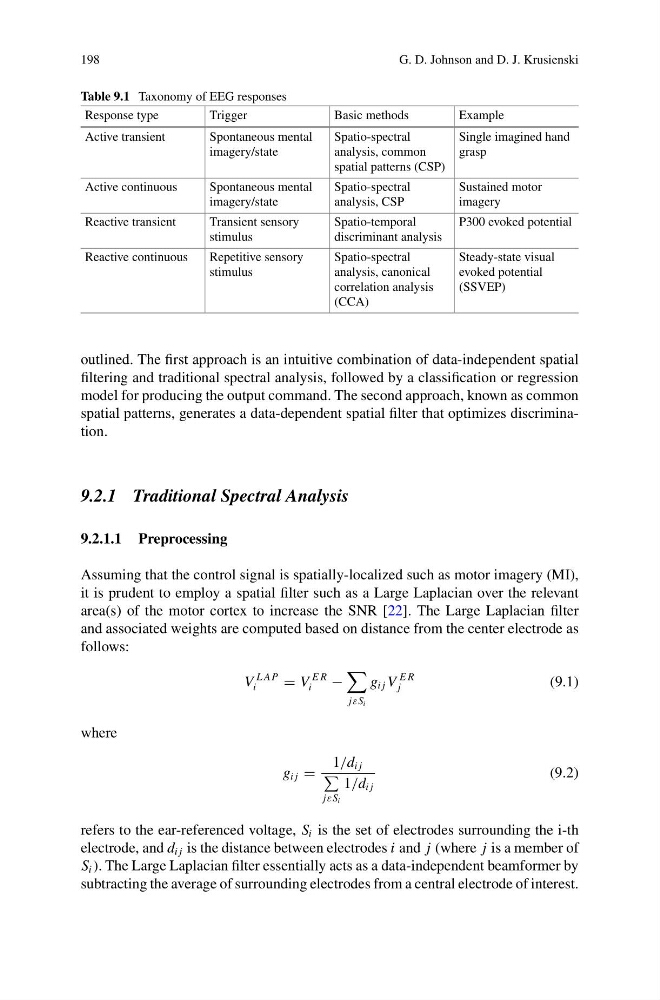
Table 9.1 Taxonomy of EEG responses
Response type
Trigger
Basic methods
Example
Active transient
Spontaneous mental
imagery/state
Spatio-spectral
analysis, common
spatial patterns (CSP)
Single imagined hand
grasp
Active continuous
Spontaneous mental
imagery/state
Spatio-spectral
analysis, CSP
Sustained motor
imagery
Reactive transient
Transient sensory
stimulus
Spatio-temporal
discriminant analysis
P300 evoked potential
Reactive continuous
Repetitive sensory
stimulus
Spatio-spectral
analysis, canonical
correlation analysis
(CCA)
Steady-state visual
evoked potential
(SSVEP)
outlined. The first approach is an intuitive combination of data-independent spatial
filtering and traditional spectral analysis, followed by a classification or regression
model for producing the output command. The second approach, known as common
spatial patterns, generates a data-dependent spatial filter that optimizes discrimination.
9.2.1 Traditional Spectral Analysis
9.2.1.1 Preprocessing
Assuming that the control signal is spatially-localized such as motor imagery (MI),
it is prudent to employ a spatial filter such as a Large Laplacian over the relevant
area(s) of the motor cortex to increase the SNR [22]. The Large Laplacian filter
and associated weights are computed based on distance from the center electrode as
follows:
V
L AP
i
V
E R
i
−
jεS i
g i j V
E R
j
(9.1)
where
g i j
1/d i j
jεS i
1/d i j
(9.2)
refers to the ear-referenced voltage, S i is the set of electrodes surrounding the i-th
electrode, and d i j is the distance between electrodes i and j (where j is a member of
S i ). The Large Laplacian filter essentially acts as a data-independent beamformer by
subtracting the average of surrounding electrodes from a central electrode of interest.
G. D. Johnson and D. J. Krusienski
Table 9.1 Taxonomy of EEG responses
Response type
Trigger
Basic methods
Example
Active transient
Spontaneous mental
imagery/state
Spatio-spectral
analysis, common
spatial patterns (CSP)
Single imagined hand
grasp
Active continuous
Spontaneous mental
imagery/state
Spatio-spectral
analysis, CSP
Sustained motor
imagery
Reactive transient
Transient sensory
stimulus
Spatio-temporal
discriminant analysis
P300 evoked potential
Reactive continuous
Repetitive sensory
stimulus
Spatio-spectral
analysis, canonical
correlation analysis
(CCA)
Steady-state visual
evoked potential
(SSVEP)
outlined. The first approach is an intuitive combination of data-independent spatial
filtering and traditional spectral analysis, followed by a classification or regression
model for producing the output command. The second approach, known as common
spatial patterns, generates a data-dependent spatial filter that optimizes discrimination.
9.2.1 Traditional Spectral Analysis
9.2.1.1 Preprocessing
Assuming that the control signal is spatially-localized such as motor imagery (MI),
it is prudent to employ a spatial filter such as a Large Laplacian over the relevant
area(s) of the motor cortex to increase the SNR [22]. The Large Laplacian filter
and associated weights are computed based on distance from the center electrode as
follows:
V
L AP
i
V
E R
i
−
jεS i
g i j V
E R
j
(9.1)
where
g i j
1/d i j
jεS i
1/d i j
(9.2)
refers to the ear-referenced voltage, S i is the set of electrodes surrounding the i-th
electrode, and d i j is the distance between electrodes i and j (where j is a member of
S i ). The Large Laplacian filter essentially acts as a data-independent beamformer by
subtracting the average of surrounding electrodes from a central electrode of interest.