

156
S.-H. Lee and Y. Park
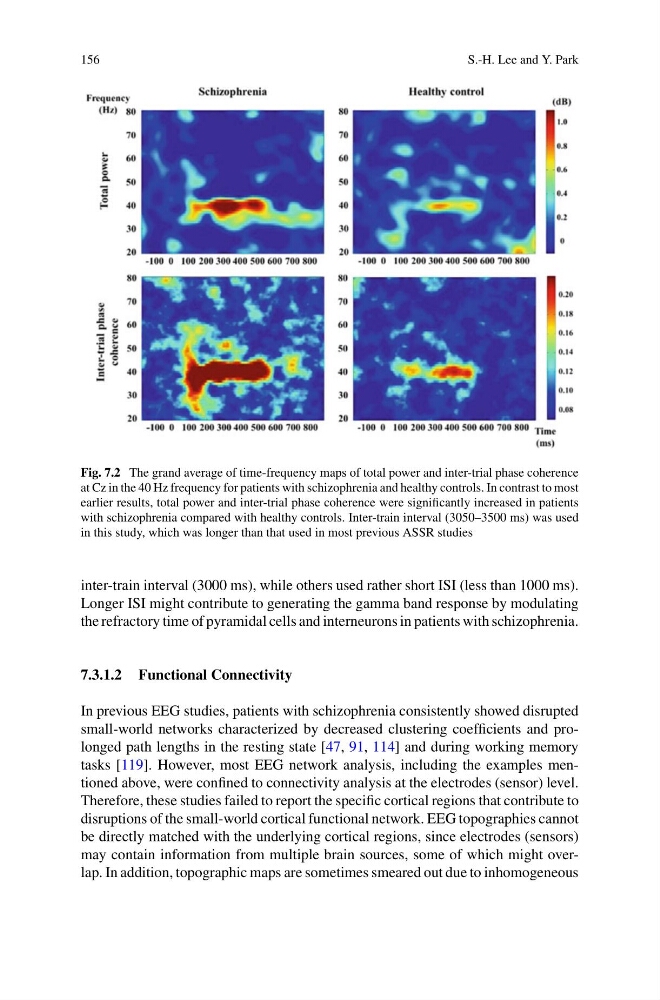
Fig. 7.2 The grand average of time-frequency maps of total power and inter-trial phase coherence
at Cz in the 40 Hz frequency for patients with schizophrenia and healthy controls. In contrast to most
earlier results, total power and inter-trial phase coherence were significantly increased in patients
with schizophrenia compared with healthy controls. Inter-train interval (3050–3500 ms) was used
in this study, which was longer than that used in most previous ASSR studies
inter-train interval (3000 ms), while others used rather short ISI (less than 1000 ms).
Longer ISI might contribute to generating the gamma band response by modulating
the refractory time of pyramidal cells and interneurons in patients with schizophrenia.
7.3.1.2 Functional Connectivity
In previous EEG studies, patients with schizophrenia consistently showed disrupted
small-world networks characterized by decreased clustering coefficients and prolonged path lengths in the resting state [47, 91, 114] and during working memory
tasks [119]. However, most EEG network analysis, including the examples mentioned above, were confined to connectivity analysis at the electrodes (sensor) level.
Therefore, these studies failed to report the specific cortical regions that contribute to
disruptions of the small-world cortical functional network. EEG topographies cannot
be directly matched with the underlying cortical regions, since electrodes (sensors)
may contain information from multiple brain sources, some of which might overlap. In addition, topographic maps are sometimes smeared out due to inhomogeneous
S.-H. Lee and Y. Park
Fig. 7.2 The grand average of time-frequency maps of total power and inter-trial phase coherence
at Cz in the 40 Hz frequency for patients with schizophrenia and healthy controls. In contrast to most
earlier results, total power and inter-trial phase coherence were significantly increased in patients
with schizophrenia compared with healthy controls. Inter-train interval (3050–3500 ms) was used
in this study, which was longer than that used in most previous ASSR studies
inter-train interval (3000 ms), while others used rather short ISI (less than 1000 ms).
Longer ISI might contribute to generating the gamma band response by modulating
the refractory time of pyramidal cells and interneurons in patients with schizophrenia.
7.3.1.2 Functional Connectivity
In previous EEG studies, patients with schizophrenia consistently showed disrupted
small-world networks characterized by decreased clustering coefficients and prolonged path lengths in the resting state [47, 91, 114] and during working memory
tasks [119]. However, most EEG network analysis, including the examples mentioned above, were confined to connectivity analysis at the electrodes (sensor) level.
Therefore, these studies failed to report the specific cortical regions that contribute to
disruptions of the small-world cortical functional network. EEG topographies cannot
be directly matched with the underlying cortical regions, since electrodes (sensors)
may contain information from multiple brain sources, some of which might overlap. In addition, topographic maps are sometimes smeared out due to inhomogeneous