

6 Methods for Functional Connectivity Analysis
133
P DC i→ j ( f )
¯
a i, j ( f )
¯
a
H
j ( f )¯ a j ( f )
,
(6.12)
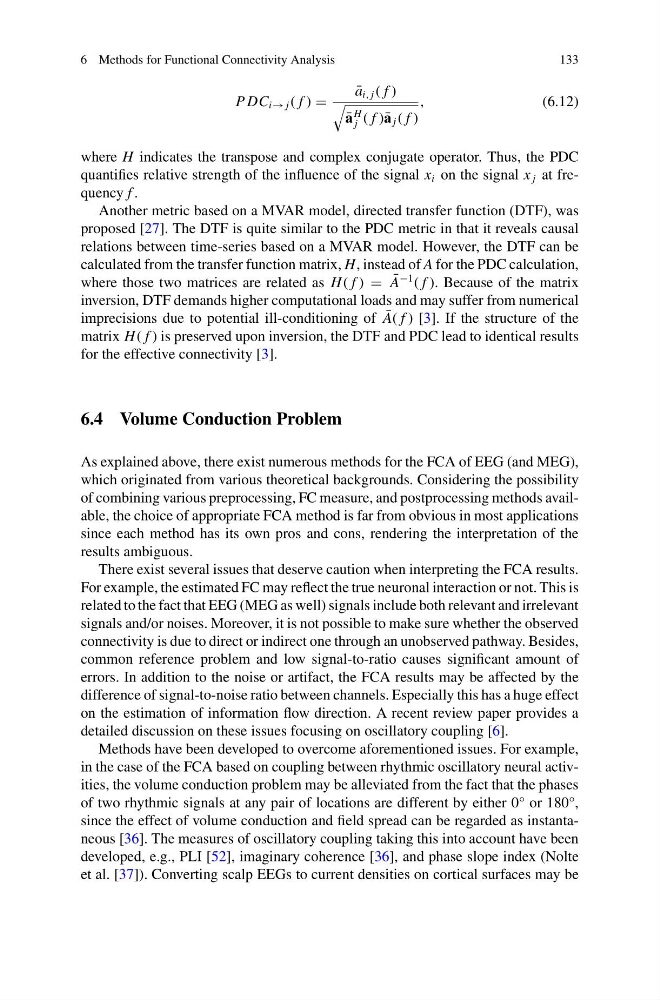
where H indicates the transpose and complex conjugate operator. Thus, the PDC
quantifies relative strength of the influence of the signal x i on the signal x j at frequency f .
Another metric based on a MVAR model, directed transfer function (DTF), was
proposed [27]. The DTF is quite similar to the PDC metric in that it reveals causal
relations between time-series based on a MVAR model. However, the DTF can be
calculated from the transfer function matrix, H, instead of A for the PDC calculation,
where those two matrices are related as H ( f ) ¯
A
−1 ( f ). Because of the matrix
inversion, DTF demands higher computational loads and may suffer from numerical
imprecisions due to potential ill-conditioning of ¯
A( f ) [3]. If the structure of the
matrix H ( f ) is preserved upon inversion, the DTF and PDC lead to identical results
for the effective connectivity [3].
6.4 Volume Conduction Problem
As explained above, there exist numerous methods for the FCA of EEG (and MEG),
which originated from various theoretical backgrounds. Considering the possibility
of combining various preprocessing, FC measure, and postprocessing methods available, the choice of appropriate FCA method is far from obvious in most applications
since each method has its own pros and cons, rendering the interpretation of the
results ambiguous.
There exist several issues that deserve caution when interpreting the FCA results.
For example, the estimated FC may reflect the true neuronal interaction or not. This is
related to the fact that EEG (MEG as well) signals include both relevant and irrelevant
signals and/or noises. Moreover, it is not possible to make sure whether the observed
connectivity is due to direct or indirect one through an unobserved pathway. Besides,
common reference problem and low signal-to-ratio causes significant amount of
errors. In addition to the noise or artifact, the FCA results may be affected by the
difference of signal-to-noise ratio between channels. Especially this has a huge effect
on the estimation of information flow direction. A recent review paper provides a
detailed discussion on these issues focusing on oscillatory coupling [6].
Methods have been developed to overcome aforementioned issues. For example,
in the case of the FCA based on coupling between rhythmic oscillatory neural activities, the volume conduction problem may be alleviated from the fact that the phases
of two rhythmic signals at any pair of locations are different by either 0° or 180°,
since the effect of volume conduction and field spread can be regarded as instantaneous [36]. The measures of oscillatory coupling taking this into account have been
developed, e.g., PLI [52], imaginary coherence [36], and phase slope index (Nolte
et al. [37]). Converting scalp EEGs to current densities on cortical surfaces may be
133
P DC i→ j ( f )
¯
a i, j ( f )
¯
a
H
j ( f )¯ a j ( f )
,
(6.12)
where H indicates the transpose and complex conjugate operator. Thus, the PDC
quantifies relative strength of the influence of the signal x i on the signal x j at frequency f .
Another metric based on a MVAR model, directed transfer function (DTF), was
proposed [27]. The DTF is quite similar to the PDC metric in that it reveals causal
relations between time-series based on a MVAR model. However, the DTF can be
calculated from the transfer function matrix, H, instead of A for the PDC calculation,
where those two matrices are related as H ( f ) ¯
A
−1 ( f ). Because of the matrix
inversion, DTF demands higher computational loads and may suffer from numerical
imprecisions due to potential ill-conditioning of ¯
A( f ) [3]. If the structure of the
matrix H ( f ) is preserved upon inversion, the DTF and PDC lead to identical results
for the effective connectivity [3].
6.4 Volume Conduction Problem
As explained above, there exist numerous methods for the FCA of EEG (and MEG),
which originated from various theoretical backgrounds. Considering the possibility
of combining various preprocessing, FC measure, and postprocessing methods available, the choice of appropriate FCA method is far from obvious in most applications
since each method has its own pros and cons, rendering the interpretation of the
results ambiguous.
There exist several issues that deserve caution when interpreting the FCA results.
For example, the estimated FC may reflect the true neuronal interaction or not. This is
related to the fact that EEG (MEG as well) signals include both relevant and irrelevant
signals and/or noises. Moreover, it is not possible to make sure whether the observed
connectivity is due to direct or indirect one through an unobserved pathway. Besides,
common reference problem and low signal-to-ratio causes significant amount of
errors. In addition to the noise or artifact, the FCA results may be affected by the
difference of signal-to-noise ratio between channels. Especially this has a huge effect
on the estimation of information flow direction. A recent review paper provides a
detailed discussion on these issues focusing on oscillatory coupling [6].
Methods have been developed to overcome aforementioned issues. For example,
in the case of the FCA based on coupling between rhythmic oscillatory neural activities, the volume conduction problem may be alleviated from the fact that the phases
of two rhythmic signals at any pair of locations are different by either 0° or 180°,
since the effect of volume conduction and field spread can be regarded as instantaneous [36]. The measures of oscillatory coupling taking this into account have been
developed, e.g., PLI [52], imaginary coherence [36], and phase slope index (Nolte
et al. [37]). Converting scalp EEGs to current densities on cortical surfaces may be