

5 EEG Source Imaging and Multimodal Neuroimaging
107
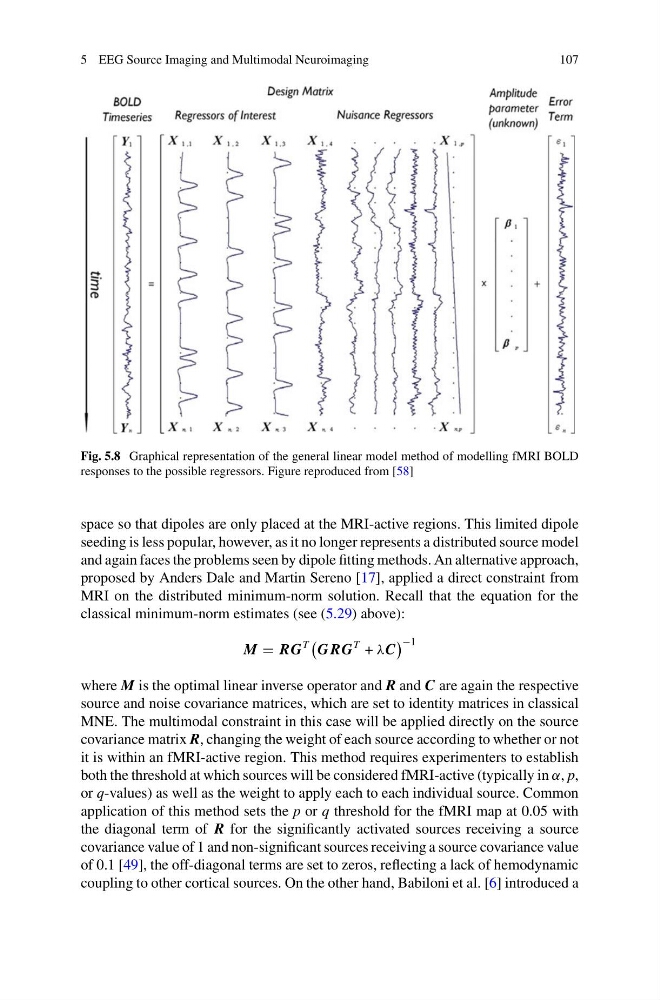
Fig. 5.8 Graphical representation of the general linear model method of modelling fMRI BOLD
responses to the possible regressors. Figure reproduced from [58]
space so that dipoles are only placed at the MRI-active regions. This limited dipole
seeding is less popular, however, as it no longer represents a distributed source model
and again faces the problems seen by dipole fitting methods. An alternative approach,
proposed by Anders Dale and Martin Sereno [17], applied a direct constraint from
MRI on the distributed minimum-norm solution. Recall that the equation for the
classical minimum-norm estimates (see (5.29) above):
M RG
T
G RG
T + λC
−1
where M is the optimal linear inverse operator and R and C are again the respective
source and noise covariance matrices, which are set to identity matrices in classical
MNE. The multimodal constraint in this case will be applied directly on the source
covariance matrix R, changing the weight of each source according to whether or not
it is within an fMRI-active region. This method requires experimenters to establish
both the threshold at which sources will be considered fMRI-active (typically in α, p,
or q-values) as well as the weight to apply each to each individual source. Common
application of this method sets the p or q threshold for the fMRI map at 0.05 with
the diagonal term of R for the significantly activated sources receiving a source
covariance value of 1 and non-significant sources receiving a source covariance value
of 0.1 [49], the off-diagonal terms are set to zeros, reflecting a lack of hemodynamic
coupling to other cortical sources. On the other hand, Babiloni et al. [6] introduced a
107
Fig. 5.8 Graphical representation of the general linear model method of modelling fMRI BOLD
responses to the possible regressors. Figure reproduced from [58]
space so that dipoles are only placed at the MRI-active regions. This limited dipole
seeding is less popular, however, as it no longer represents a distributed source model
and again faces the problems seen by dipole fitting methods. An alternative approach,
proposed by Anders Dale and Martin Sereno [17], applied a direct constraint from
MRI on the distributed minimum-norm solution. Recall that the equation for the
classical minimum-norm estimates (see (5.29) above):
M RG
T
G RG
T + λC
−1
where M is the optimal linear inverse operator and R and C are again the respective
source and noise covariance matrices, which are set to identity matrices in classical
MNE. The multimodal constraint in this case will be applied directly on the source
covariance matrix R, changing the weight of each source according to whether or not
it is within an fMRI-active region. This method requires experimenters to establish
both the threshold at which sources will be considered fMRI-active (typically in α, p,
or q-values) as well as the weight to apply each to each individual source. Common
application of this method sets the p or q threshold for the fMRI map at 0.05 with
the diagonal term of R for the significantly activated sources receiving a source
covariance value of 1 and non-significant sources receiving a source covariance value
of 0.1 [49], the off-diagonal terms are set to zeros, reflecting a lack of hemodynamic
coupling to other cortical sources. On the other hand, Babiloni et al. [6] introduced a