

photosensitizer chlorin e6 (hCe6) into the hydrophobic bilayers and the hydrophilic
hypoxia-activated prodrug AQ4 N into the aqueous cavity of PEG-shelled liposomes. The AQ4 N-hCe6-liposome showed hypoxia-dependent cytotoxicity and
effective photodynamic cell killing.
64 Cu chelation was carried out with
AQ4 N-hCe6-liposome for theranostic PET imaging. Tumor accumulation of
AQ4 N64 Cu-hCe6-liposome was measured to be 4.7% injected dose per gram
(%ID/g).
3.3.3 Gallium-67 and 68
Porphyrins radiolabeled with Gallium-67 and 68 have been employed in various
radiopharmaceutical applications.
67 Ga labeled tetraphenyl porphyrin (
67
Ga-TPP) 5
was employed for biodistribution studies and SPECT imaging in rats [45].
Pharmacokinetic data revealed that most of the complex washed out through
kidneys with low liver uptake. In another study, tissue distribution of 7,12-bis
(1-decyloxyethyl)-Ga(III)-3,8,13,17-tetramethylporphyrin-2,18-dipropionyldiaspartic
acid (ATX-70) 6 was examined in tumor-bearing mice [46]. Roughly 24 h after
administration, high tumor-to-skin and tumor-to-muscle concentration ratios were
observed.
68 Ga-labeled, fluorine substituted 5,10,15,20-tetrakis(pentafluoro-13 phenyl)
porphyrin (
68 Ga-TFPP) 7 was prepared and examined in Swiss mice bearing
fibrosarcoma with biodistribution and SPECT imaging studies (Fig. 3.7d) [47]. The
complex was mostly washed out from circulation through kidneys and liver,
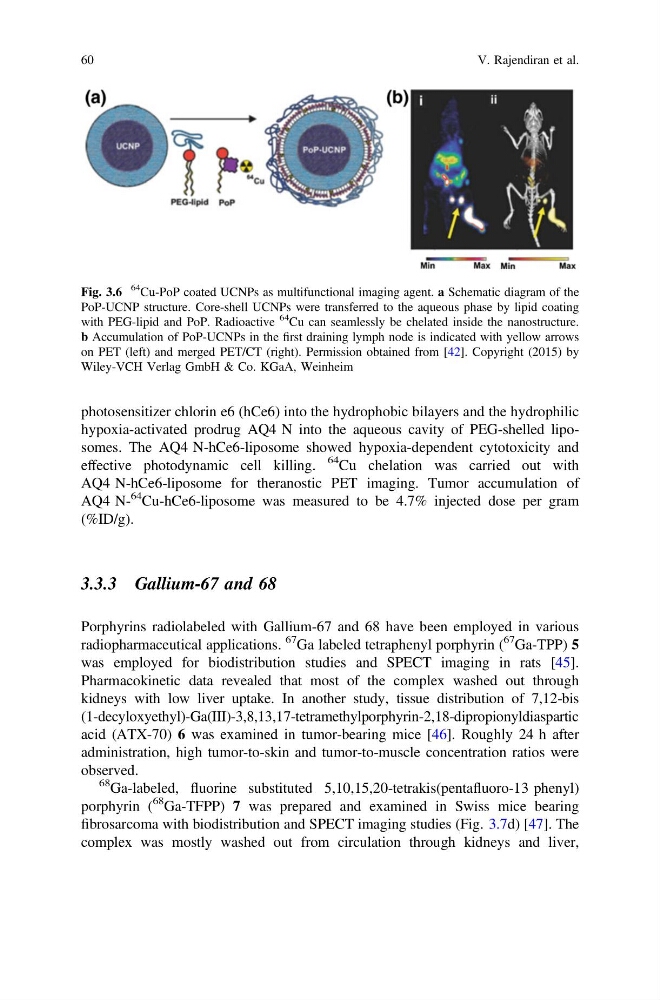
Fig. 3.6
64
Cu-PoP coated UCNPs as multifunctional imaging agent. a Schematic diagram of the
PoP-UCNP structure. Core-shell UCNPs were transferred to the aqueous phase by lipid coating
with PEG-lipid and PoP. Radioactive
64
Cu can seamlessly be chelated inside the nanostructure.
b Accumulation of PoP-UCNPs in the first draining lymph node is indicated with yellow arrows
on PET (left) and merged PET/CT (right). Permission obtained from [42]. Copyright (2015) by
Wiley-VCH Verlag GmbH & Co. KGaA, Weinheim
60
V. Rajendiran et al.
hypoxia-activated prodrug AQ4 N into the aqueous cavity of PEG-shelled liposomes. The AQ4 N-hCe6-liposome showed hypoxia-dependent cytotoxicity and
effective photodynamic cell killing.
64 Cu chelation was carried out with
AQ4 N-hCe6-liposome for theranostic PET imaging. Tumor accumulation of
AQ4 N64 Cu-hCe6-liposome was measured to be 4.7% injected dose per gram
(%ID/g).
3.3.3 Gallium-67 and 68
Porphyrins radiolabeled with Gallium-67 and 68 have been employed in various
radiopharmaceutical applications.
67 Ga labeled tetraphenyl porphyrin (
67
Ga-TPP) 5
was employed for biodistribution studies and SPECT imaging in rats [45].
Pharmacokinetic data revealed that most of the complex washed out through
kidneys with low liver uptake. In another study, tissue distribution of 7,12-bis
(1-decyloxyethyl)-Ga(III)-3,8,13,17-tetramethylporphyrin-2,18-dipropionyldiaspartic
acid (ATX-70) 6 was examined in tumor-bearing mice [46]. Roughly 24 h after
administration, high tumor-to-skin and tumor-to-muscle concentration ratios were
observed.
68 Ga-labeled, fluorine substituted 5,10,15,20-tetrakis(pentafluoro-13 phenyl)
porphyrin (
68 Ga-TFPP) 7 was prepared and examined in Swiss mice bearing
fibrosarcoma with biodistribution and SPECT imaging studies (Fig. 3.7d) [47]. The
complex was mostly washed out from circulation through kidneys and liver,
Fig. 3.6
64
Cu-PoP coated UCNPs as multifunctional imaging agent. a Schematic diagram of the
PoP-UCNP structure. Core-shell UCNPs were transferred to the aqueous phase by lipid coating
with PEG-lipid and PoP. Radioactive
64
Cu can seamlessly be chelated inside the nanostructure.
b Accumulation of PoP-UCNPs in the first draining lymph node is indicated with yellow arrows
on PET (left) and merged PET/CT (right). Permission obtained from [42]. Copyright (2015) by
Wiley-VCH Verlag GmbH & Co. KGaA, Weinheim
60
V. Rajendiran et al.