

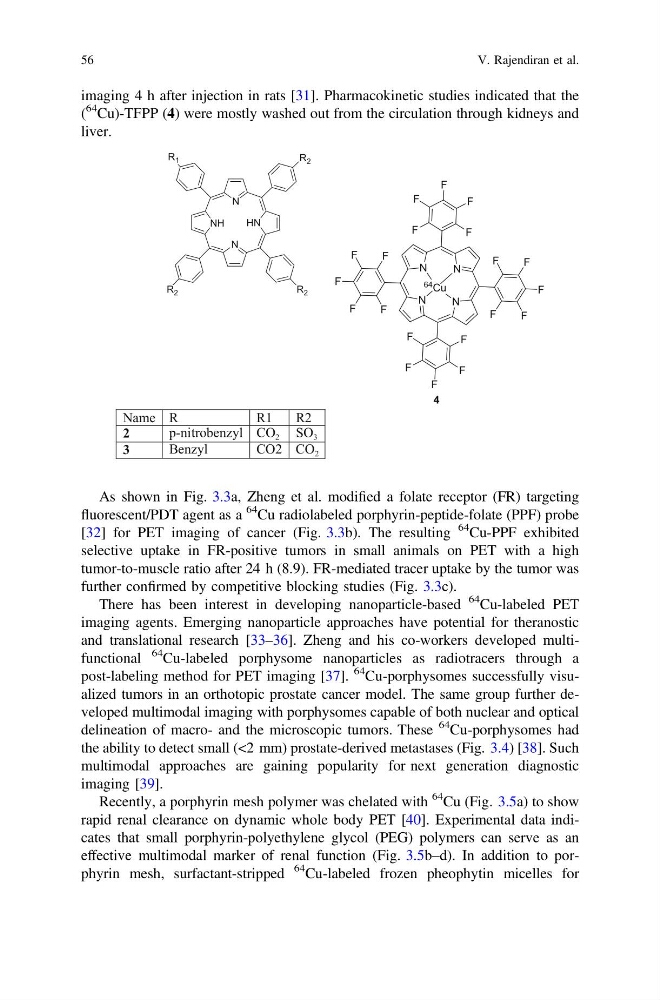
imaging 4 h after injection in rats [31]. Pharmacokinetic studies indicated that the
(
64 Cu)-TFPP (4) were mostly washed out from the circulation through kidneys and
liver.
N
N
N
N
F
F
F
F
F
F
F
F
F
F
F
F
F
F
F
F
F
F
F
F
64 Cu
4
N
HN
N
NH
R 2
R 1
R 2
R 2
Name R
R1
R2
2
p-nitrobenzyl CO 2 SO 3
3
Benzyl
CO2 CO 2
As shown in Fig. 3.3a, Zheng et al. modified a folate receptor (FR) targeting
fluorescent/PDT agent as a
64 Cu radiolabeled porphyrin-peptide-folate (PPF) probe
[32] for PET imaging of cancer (Fig. 3.3b). The resulting
64 Cu-PPF exhibited
selective uptake in FR-positive tumors in small animals on PET with a high
tumor-to-muscle ratio after 24 h (8.9). FR-mediated tracer uptake by the tumor was
further confirmed by competitive blocking studies (Fig. 3.3c).
There has been interest in developing nanoparticle-based
64 Cu-labeled PET
imaging agents. Emerging nanoparticle approaches have potential for theranostic
and translational research [33–36]. Zheng and his co-workers developed multifunctional
64 Cu-labeled porphysome nanoparticles as radiotracers through a
post-labeling method for PET imaging [37].
64 Cu-porphysomes successfully visualized tumors in an orthotopic prostate cancer model. The same group further developed multimodal imaging with porphysomes capable of both nuclear and optical
delineation of macro- and the microscopic tumors. These
64 Cu-porphysomes had
the ability to detect small (<2 mm) prostate-derived metastases (Fig. 3.4) [38]. Such
multimodal approaches are gaining popularity for next generation diagnostic
imaging [39].
Recently, a porphyrin mesh polymer was chelated with
64 Cu (Fig. 3.5a) to show
rapid renal clearance on dynamic whole body PET [40]. Experimental data indicates that small porphyrin-polyethylene glycol (PEG) polymers can serve as an
effective multimodal marker of renal function (Fig. 3.5b–d). In addition to porphyrin mesh, surfactant-stripped
64 Cu-labeled frozen pheophytin micelles for
56
V. Rajendiran et al.
(
64 Cu)-TFPP (4) were mostly washed out from the circulation through kidneys and
liver.
N
N
N
N
F
F
F
F
F
F
F
F
F
F
F
F
F
F
F
F
F
F
F
F
64 Cu
4
N
HN
N
NH
R 2
R 1
R 2
R 2
Name R
R1
R2
2
p-nitrobenzyl CO 2 SO 3
3
Benzyl
CO2 CO 2
As shown in Fig. 3.3a, Zheng et al. modified a folate receptor (FR) targeting
fluorescent/PDT agent as a
64 Cu radiolabeled porphyrin-peptide-folate (PPF) probe
[32] for PET imaging of cancer (Fig. 3.3b). The resulting
64 Cu-PPF exhibited
selective uptake in FR-positive tumors in small animals on PET with a high
tumor-to-muscle ratio after 24 h (8.9). FR-mediated tracer uptake by the tumor was
further confirmed by competitive blocking studies (Fig. 3.3c).
There has been interest in developing nanoparticle-based
64 Cu-labeled PET
imaging agents. Emerging nanoparticle approaches have potential for theranostic
and translational research [33–36]. Zheng and his co-workers developed multifunctional
64 Cu-labeled porphysome nanoparticles as radiotracers through a
post-labeling method for PET imaging [37].
64 Cu-porphysomes successfully visualized tumors in an orthotopic prostate cancer model. The same group further developed multimodal imaging with porphysomes capable of both nuclear and optical
delineation of macro- and the microscopic tumors. These
64 Cu-porphysomes had
the ability to detect small (<2 mm) prostate-derived metastases (Fig. 3.4) [38]. Such
multimodal approaches are gaining popularity for next generation diagnostic
imaging [39].
Recently, a porphyrin mesh polymer was chelated with
64 Cu (Fig. 3.5a) to show
rapid renal clearance on dynamic whole body PET [40]. Experimental data indicates that small porphyrin-polyethylene glycol (PEG) polymers can serve as an
effective multimodal marker of renal function (Fig. 3.5b–d). In addition to porphyrin mesh, surfactant-stripped
64 Cu-labeled frozen pheophytin micelles for
56
V. Rajendiran et al.