

molecules, and (3) in vivo imaging with both high resolution and sensitivity. The
techniques are single-photon emission computed tomography (SPECT) or positron
emission tomography (PET). The main advantages of nuclear molecular imaging
(i.e., SPECT or PET) over other imaging (for example, optical or magnetic resonance imaging [MRI]) are that they are highly sensitive, quantitative, and not
limited in tissue penetration [5].
This chapter focuses on the use of NPs in the field of medicine, including
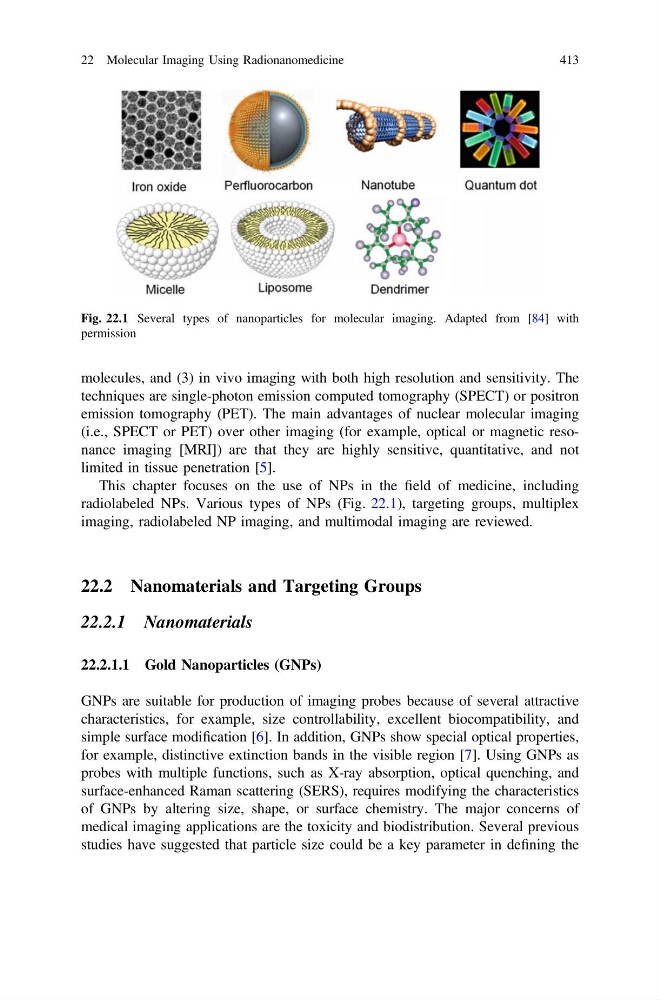
radiolabeled NPs. Various types of NPs (Fig. 22.1), targeting groups, multiplex
imaging, radiolabeled NP imaging, and multimodal imaging are reviewed.
22.2 Nanomaterials and Targeting Groups
22.2.1 Nanomaterials
22.2.1.1 Gold Nanoparticles (GNPs)
GNPs are suitable for production of imaging probes because of several attractive
characteristics, for example, size controllability, excellent biocompatibility, and
simple surface modification [6]. In addition, GNPs show special optical properties,
for example, distinctive extinction bands in the visible region [7]. Using GNPs as
probes with multiple functions, such as X-ray absorption, optical quenching, and
surface-enhanced Raman scattering (SERS), requires modifying the characteristics
of GNPs by altering size, shape, or surface chemistry. The major concerns of
medical imaging applications are the toxicity and biodistribution. Several previous
studies have suggested that particle size could be a key parameter in defining the
Fig. 22.1 Several types of nanoparticles for molecular imaging. Adapted from [84] with
permission
22 Molecular Imaging Using Radionanomedicine
413
techniques are single-photon emission computed tomography (SPECT) or positron
emission tomography (PET). The main advantages of nuclear molecular imaging
(i.e., SPECT or PET) over other imaging (for example, optical or magnetic resonance imaging [MRI]) are that they are highly sensitive, quantitative, and not
limited in tissue penetration [5].
This chapter focuses on the use of NPs in the field of medicine, including
radiolabeled NPs. Various types of NPs (Fig. 22.1), targeting groups, multiplex
imaging, radiolabeled NP imaging, and multimodal imaging are reviewed.
22.2 Nanomaterials and Targeting Groups
22.2.1 Nanomaterials
22.2.1.1 Gold Nanoparticles (GNPs)
GNPs are suitable for production of imaging probes because of several attractive
characteristics, for example, size controllability, excellent biocompatibility, and
simple surface modification [6]. In addition, GNPs show special optical properties,
for example, distinctive extinction bands in the visible region [7]. Using GNPs as
probes with multiple functions, such as X-ray absorption, optical quenching, and
surface-enhanced Raman scattering (SERS), requires modifying the characteristics
of GNPs by altering size, shape, or surface chemistry. The major concerns of
medical imaging applications are the toxicity and biodistribution. Several previous
studies have suggested that particle size could be a key parameter in defining the
Fig. 22.1 Several types of nanoparticles for molecular imaging. Adapted from [84] with
permission
22 Molecular Imaging Using Radionanomedicine
413