

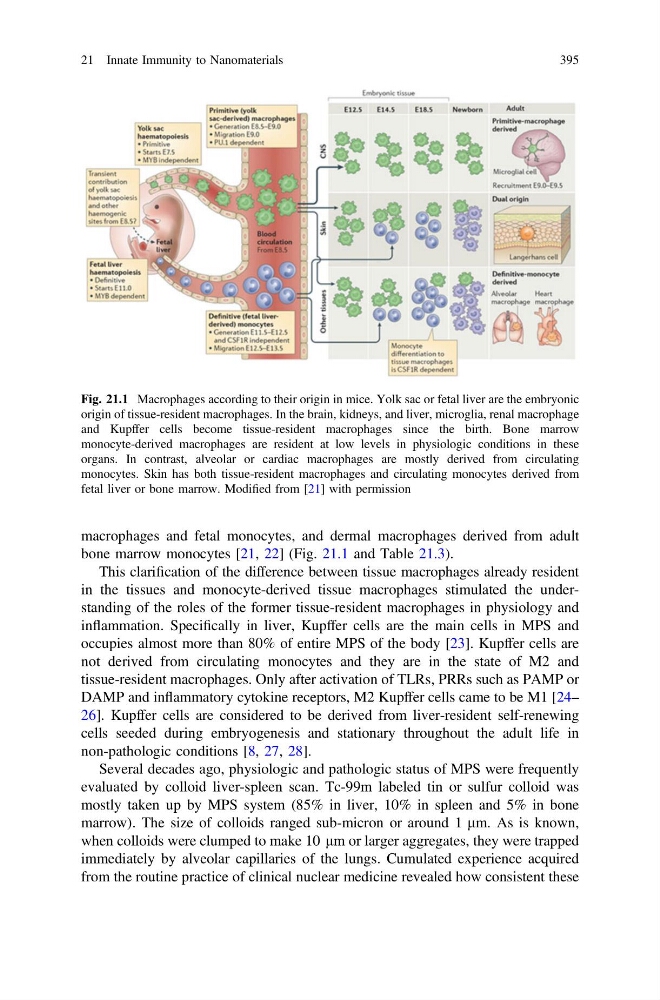
macrophages and fetal monocytes, and dermal macrophages derived from adult
bone marrow monocytes [21, 22] (Fig. 21.1 and Table 21.3).
This clarification of the difference between tissue macrophages already resident
in the tissues and monocyte-derived tissue macrophages stimulated the understanding of the roles of the former tissue-resident macrophages in physiology and
inflammation. Specifically in liver, Kupffer cells are the main cells in MPS and
occupies almost more than 80% of entire MPS of the body [23]. Kupffer cells are
not derived from circulating monocytes and they are in the state of M2 and
tissue-resident macrophages. Only after activation of TLRs, PRRs such as PAMP or
DAMP and inflammatory cytokine receptors, M2 Kupffer cells came to be M1 [24–
26]. Kupffer cells are considered to be derived from liver-resident self-renewing
cells seeded during embryogenesis and stationary throughout the adult life in
non-pathologic conditions [8, 27, 28].
Several decades ago, physiologic and pathologic status of MPS were frequently
evaluated by colloid liver-spleen scan. Tc-99m labeled tin or sulfur colloid was
mostly taken up by MPS system (85% in liver, 10% in spleen and 5% in bone
marrow). The size of colloids ranged sub-micron or around 1 lm. As is known,
when colloids were clumped to make 10 lm or larger aggregates, they were trapped
immediately by alveolar capillaries of the lungs. Cumulated experience acquired
from the routine practice of clinical nuclear medicine revealed how consistent these
Fig. 21.1 Macrophages according to their origin in mice. Yolk sac or fetal liver are the embryonic
origin of tissue-resident macrophages. In the brain, kidneys, and liver, microglia, renal macrophage
and Kupffer cells become tissue-resident macrophages since the birth. Bone marrow
monocyte-derived macrophages are resident at low levels in physiologic conditions in these
organs. In contrast, alveolar or cardiac macrophages are mostly derived from circulating
monocytes. Skin has both tissue-resident macrophages and circulating monocytes derived from
fetal liver or bone marrow. Modified from [21] with permission
21 Innate Immunity to Nanomaterials
395
bone marrow monocytes [21, 22] (Fig. 21.1 and Table 21.3).
This clarification of the difference between tissue macrophages already resident
in the tissues and monocyte-derived tissue macrophages stimulated the understanding of the roles of the former tissue-resident macrophages in physiology and
inflammation. Specifically in liver, Kupffer cells are the main cells in MPS and
occupies almost more than 80% of entire MPS of the body [23]. Kupffer cells are
not derived from circulating monocytes and they are in the state of M2 and
tissue-resident macrophages. Only after activation of TLRs, PRRs such as PAMP or
DAMP and inflammatory cytokine receptors, M2 Kupffer cells came to be M1 [24–
26]. Kupffer cells are considered to be derived from liver-resident self-renewing
cells seeded during embryogenesis and stationary throughout the adult life in
non-pathologic conditions [8, 27, 28].
Several decades ago, physiologic and pathologic status of MPS were frequently
evaluated by colloid liver-spleen scan. Tc-99m labeled tin or sulfur colloid was
mostly taken up by MPS system (85% in liver, 10% in spleen and 5% in bone
marrow). The size of colloids ranged sub-micron or around 1 lm. As is known,
when colloids were clumped to make 10 lm or larger aggregates, they were trapped
immediately by alveolar capillaries of the lungs. Cumulated experience acquired
from the routine practice of clinical nuclear medicine revealed how consistent these
Fig. 21.1 Macrophages according to their origin in mice. Yolk sac or fetal liver are the embryonic
origin of tissue-resident macrophages. In the brain, kidneys, and liver, microglia, renal macrophage
and Kupffer cells become tissue-resident macrophages since the birth. Bone marrow
monocyte-derived macrophages are resident at low levels in physiologic conditions in these
organs. In contrast, alveolar or cardiac macrophages are mostly derived from circulating
monocytes. Skin has both tissue-resident macrophages and circulating monocytes derived from
fetal liver or bone marrow. Modified from [21] with permission
21 Innate Immunity to Nanomaterials
395