

21.3 Innate Immunity and the Relevant Cells
Monocyte/macrophage system is called as a system, as mononuclear phagocytic
system (MPS). Mononuclear phagocytic system was previously called as reticuloendothelial system (RES). Monocytes and macrophages had been categorized as
the same lineage as myeloid (pertaining to bone marrow) or myelogenous (derived
from bone-marrow) and macrophages were assumed to be the committed
tissue-localized monocytes having circulated once in the blood. As expected,
monocytes and macrophages shared the same surface marker of CD14. The difference looked like the subtypes and related surface markers. While monocytes
have subtypes according to the expression level of CD14 and CD16 [12, 17],
macrophages showed greater diversity of cell surface markers [18]. And, recent
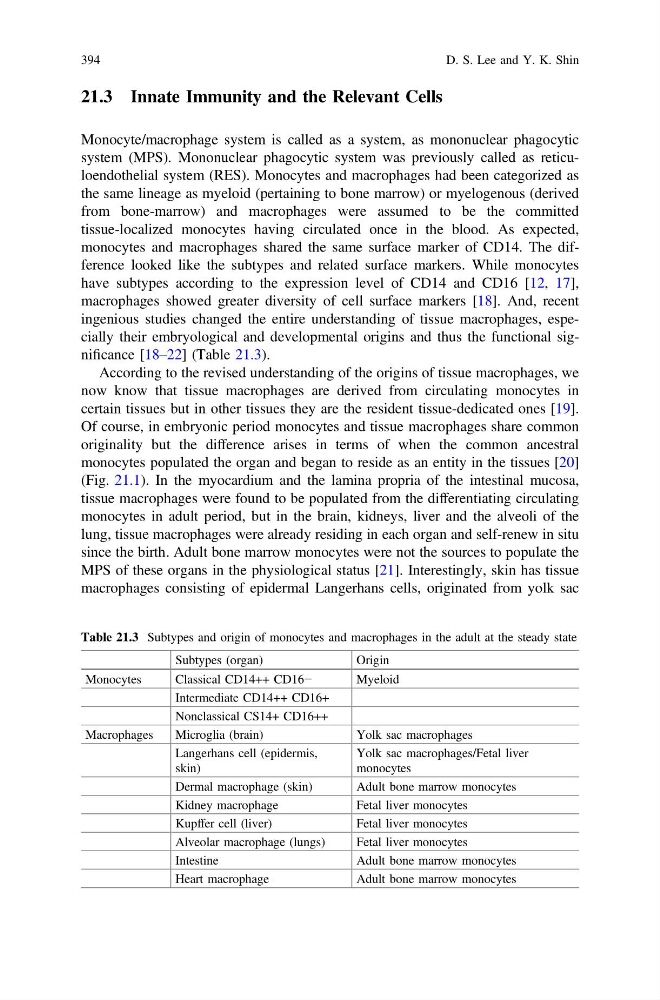
ingenious studies changed the entire understanding of tissue macrophages, especially their embryological and developmental origins and thus the functional significance [18–22] (Table 21.3).
According to the revised understanding of the origins of tissue macrophages, we
now know that tissue macrophages are derived from circulating monocytes in
certain tissues but in other tissues they are the resident tissue-dedicated ones [19].
Of course, in embryonic period monocytes and tissue macrophages share common
originality but the difference arises in terms of when the common ancestral
monocytes populated the organ and began to reside as an entity in the tissues [20]
(Fig. 21.1). In the myocardium and the lamina propria of the intestinal mucosa,
tissue macrophages were found to be populated from the differentiating circulating
monocytes in adult period, but in the brain, kidneys, liver and the alveoli of the
lung, tissue macrophages were already residing in each organ and self-renew in situ
since the birth. Adult bone marrow monocytes were not the sources to populate the
MPS of these organs in the physiological status [21]. Interestingly, skin has tissue
macrophages consisting of epidermal Langerhans cells, originated from yolk sac
Table 21.3 Subtypes and origin of monocytes and macrophages in the adult at the steady state
Subtypes (organ)
Origin
Monocytes
Classical CD14++ CD16−
Myeloid
Intermediate CD14++ CD16+
Nonclassical CS14+ CD16++
Macrophages
Microglia (brain)
Yolk sac macrophages
Langerhans cell (epidermis,
skin)
Yolk sac macrophages/Fetal liver
monocytes
Dermal macrophage (skin)
Adult bone marrow monocytes
Kidney macrophage
Fetal liver monocytes
Kupffer cell (liver)
Fetal liver monocytes
Alveolar macrophage (lungs)
Fetal liver monocytes
Intestine
Adult bone marrow monocytes
Heart macrophage
Adult bone marrow monocytes
394
D. S. Lee and Y. K. Shin
Monocyte/macrophage system is called as a system, as mononuclear phagocytic
system (MPS). Mononuclear phagocytic system was previously called as reticuloendothelial system (RES). Monocytes and macrophages had been categorized as
the same lineage as myeloid (pertaining to bone marrow) or myelogenous (derived
from bone-marrow) and macrophages were assumed to be the committed
tissue-localized monocytes having circulated once in the blood. As expected,
monocytes and macrophages shared the same surface marker of CD14. The difference looked like the subtypes and related surface markers. While monocytes
have subtypes according to the expression level of CD14 and CD16 [12, 17],
macrophages showed greater diversity of cell surface markers [18]. And, recent
ingenious studies changed the entire understanding of tissue macrophages, especially their embryological and developmental origins and thus the functional significance [18–22] (Table 21.3).
According to the revised understanding of the origins of tissue macrophages, we
now know that tissue macrophages are derived from circulating monocytes in
certain tissues but in other tissues they are the resident tissue-dedicated ones [19].
Of course, in embryonic period monocytes and tissue macrophages share common
originality but the difference arises in terms of when the common ancestral
monocytes populated the organ and began to reside as an entity in the tissues [20]
(Fig. 21.1). In the myocardium and the lamina propria of the intestinal mucosa,
tissue macrophages were found to be populated from the differentiating circulating
monocytes in adult period, but in the brain, kidneys, liver and the alveoli of the
lung, tissue macrophages were already residing in each organ and self-renew in situ
since the birth. Adult bone marrow monocytes were not the sources to populate the
MPS of these organs in the physiological status [21]. Interestingly, skin has tissue
macrophages consisting of epidermal Langerhans cells, originated from yolk sac
Table 21.3 Subtypes and origin of monocytes and macrophages in the adult at the steady state
Subtypes (organ)
Origin
Monocytes
Classical CD14++ CD16−
Myeloid
Intermediate CD14++ CD16+
Nonclassical CS14+ CD16++
Macrophages
Microglia (brain)
Yolk sac macrophages
Langerhans cell (epidermis,
skin)
Yolk sac macrophages/Fetal liver
monocytes
Dermal macrophage (skin)
Adult bone marrow monocytes
Kidney macrophage
Fetal liver monocytes
Kupffer cell (liver)
Fetal liver monocytes
Alveolar macrophage (lungs)
Fetal liver monocytes
Intestine
Adult bone marrow monocytes
Heart macrophage
Adult bone marrow monocytes
394
D. S. Lee and Y. K. Shin