

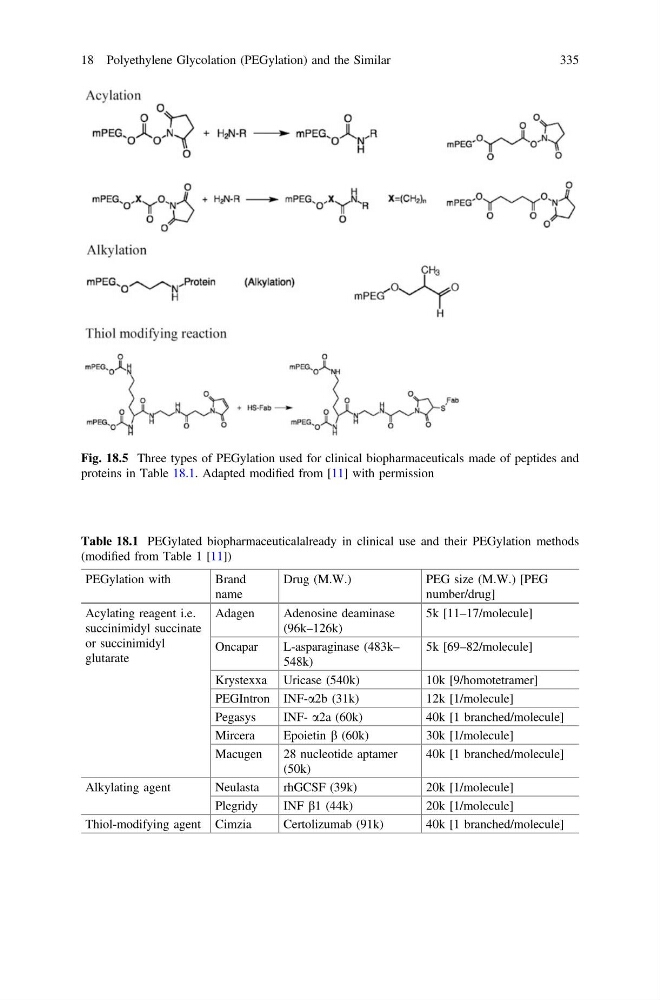
Fig. 18.5 Three types of PEGylation used for clinical biopharmaceuticals made of peptides and
proteins in Table 18.1. Adapted modified from [11] with permission
Table 18.1 PEGylated biopharmaceuticalalready in clinical use and their PEGylation methods
(modified from Table 1 [11])
PEGylation with
Brand
name
Drug (M.W.)
PEG size (M.W.) [PEG
number/drug]
Acylating reagent i.e.
succinimidyl succinate
or succinimidyl
glutarate
Adagen
Adenosine deaminase
(96k–126k)
5k [11–17/molecule]
Oncapar
L-asparaginase (483k–
548k)
5k [69–82/molecule]
Krystexxa Uricase (540k)
10k [9/homotetramer]
PEGIntron INF-a2b (31k)
12k [1/molecule]
Pegasys
INF- a2a (60k)
40k [1 branched/molecule]
Mircera
Epoietin b (60k)
30k [1/molecule]
Macugen
28 nucleotide aptamer
(50k)
40k [1 branched/molecule]
Alkylating agent
Neulasta
rhGCSF (39k)
20k [1/molecule]
Plegridy
INF b1 (44k)
20k [1/molecule]
Thiol-modifying agent Cimzia
Certolizumab (91k)
40k [1 branched/molecule]
18 Polyethylene Glycolation (PEGylation) and the Similar
335
proteins in Table 18.1. Adapted modified from [11] with permission
Table 18.1 PEGylated biopharmaceuticalalready in clinical use and their PEGylation methods
(modified from Table 1 [11])
PEGylation with
Brand
name
Drug (M.W.)
PEG size (M.W.) [PEG
number/drug]
Acylating reagent i.e.
succinimidyl succinate
or succinimidyl
glutarate
Adagen
Adenosine deaminase
(96k–126k)
5k [11–17/molecule]
Oncapar
L-asparaginase (483k–
548k)
5k [69–82/molecule]
Krystexxa Uricase (540k)
10k [9/homotetramer]
PEGIntron INF-a2b (31k)
12k [1/molecule]
Pegasys
INF- a2a (60k)
40k [1 branched/molecule]
Mircera
Epoietin b (60k)
30k [1/molecule]
Macugen
28 nucleotide aptamer
(50k)
40k [1 branched/molecule]
Alkylating agent
Neulasta
rhGCSF (39k)
20k [1/molecule]
Plegridy
INF b1 (44k)
20k [1/molecule]
Thiol-modifying agent Cimzia
Certolizumab (91k)
40k [1 branched/molecule]
18 Polyethylene Glycolation (PEGylation) and the Similar
335