

15.3 Preclinical PET/CT and PET/MR
15.3.1 PET System
Unlike SPECT tracers, PET tracers emit positrons instead of photons (Table 15.1)
[34]. The emitted positron travels a few millimeters (positron range) before it hits an
electron. When the positron hits the electron, they are annihilated and produce two
anti-parallel photons with the energy of 511 keV. This annihilation and consequent
production of two antiparallel photons occur in the same manner for all PET tracer
thus PET does not allow simultaneous imaging of multiple tracers. The antiparallel
photons are detected by a full ring shaped PET detector [35]. Since the antiparallel
photons provide the direction from the source, thus PET scanner does not require a
collimator, which is the most notable hardware difference between PET and SPECT
scanners.
A line between the two points on the PET detector that are hit by two antiparallel
photons within 4–20 ns is called line-of-response (LOR). PET scanner does not
need a collimator thus has a significantly higher sensitivity (two or three orders of
magnitude) than SPECT scanner. However, PET has more intrinsic,
physics-related, limitation regarding spatial resolution than SPECT, which are
positron range and photon non-collinearity (Fig. 15.2b) [36]. The spatial resolution
of PET scanner is around 4 mm in clinical systems and 1 mm in dedicated preclinical scanners.
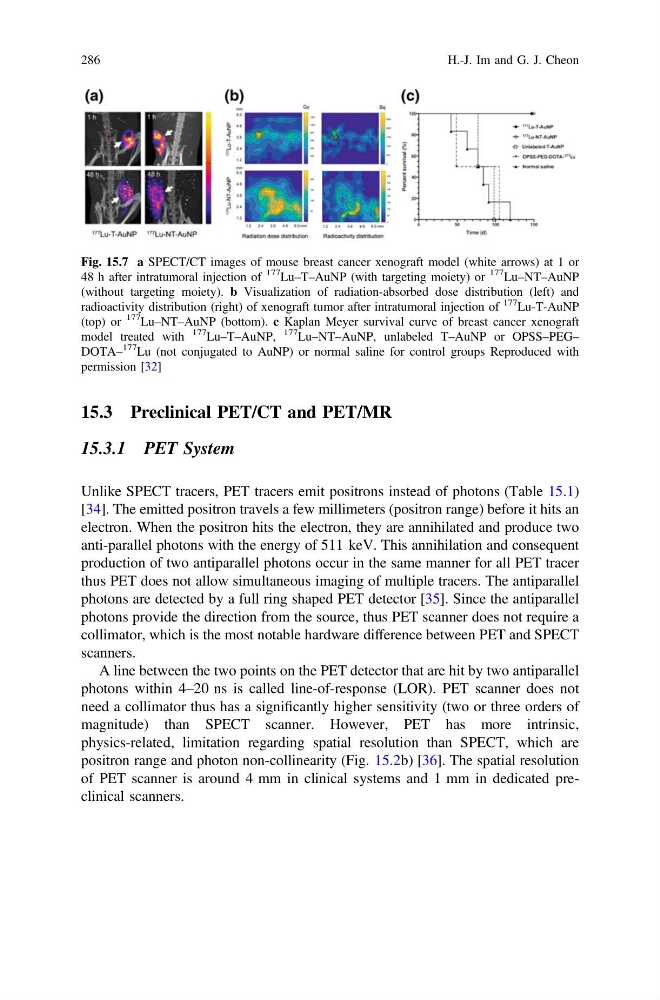
Fig. 15.7 a SPECT/CT images of mouse breast cancer xenograft model (white arrows) at 1 or
48 h after intratumoral injection of
177
Lu–T–AuNP (with targeting moiety) or
177
Lu–NT–AuNP
(without targeting moiety). b Visualization of radiation-absorbed dose distribution (left) and
radioactivity distribution (right) of xenograft tumor after intratumoral injection of
177
Lu-T-AuNP
(top) or
177
Lu–NT–AuNP (bottom). c Kaplan Meyer survival curve of breast cancer xenograft
model treated with
177
Lu–T–AuNP,
177
Lu–NT–AuNP, unlabeled T–AuNP or OPSS–PEG–
DOTA–
177
Lu (not conjugated to AuNP) or normal saline for control groups Reproduced with
permission [32]
286
H.-J. Im and G. J. Cheon
15.3.1 PET System
Unlike SPECT tracers, PET tracers emit positrons instead of photons (Table 15.1)
[34]. The emitted positron travels a few millimeters (positron range) before it hits an
electron. When the positron hits the electron, they are annihilated and produce two
anti-parallel photons with the energy of 511 keV. This annihilation and consequent
production of two antiparallel photons occur in the same manner for all PET tracer
thus PET does not allow simultaneous imaging of multiple tracers. The antiparallel
photons are detected by a full ring shaped PET detector [35]. Since the antiparallel
photons provide the direction from the source, thus PET scanner does not require a
collimator, which is the most notable hardware difference between PET and SPECT
scanners.
A line between the two points on the PET detector that are hit by two antiparallel
photons within 4–20 ns is called line-of-response (LOR). PET scanner does not
need a collimator thus has a significantly higher sensitivity (two or three orders of
magnitude) than SPECT scanner. However, PET has more intrinsic,
physics-related, limitation regarding spatial resolution than SPECT, which are
positron range and photon non-collinearity (Fig. 15.2b) [36]. The spatial resolution
of PET scanner is around 4 mm in clinical systems and 1 mm in dedicated preclinical scanners.
Fig. 15.7 a SPECT/CT images of mouse breast cancer xenograft model (white arrows) at 1 or
48 h after intratumoral injection of
177
Lu–T–AuNP (with targeting moiety) or
177
Lu–NT–AuNP
(without targeting moiety). b Visualization of radiation-absorbed dose distribution (left) and
radioactivity distribution (right) of xenograft tumor after intratumoral injection of
177
Lu-T-AuNP
(top) or
177
Lu–NT–AuNP (bottom). c Kaplan Meyer survival curve of breast cancer xenograft
model treated with
177
Lu–T–AuNP,
177
Lu–NT–AuNP, unlabeled T–AuNP or OPSS–PEG–
DOTA–
177
Lu (not conjugated to AuNP) or normal saline for control groups Reproduced with
permission [32]
286
H.-J. Im and G. J. Cheon