

development of the conjugation between
18 F labeled cyclooctyne building blocks
and azido-tagged peptides [9]. For example,
18 F labeled A20FMDV2, which is an
integrin a v b 6 -specific peptide, was prepared using this SPAAC based protocol by
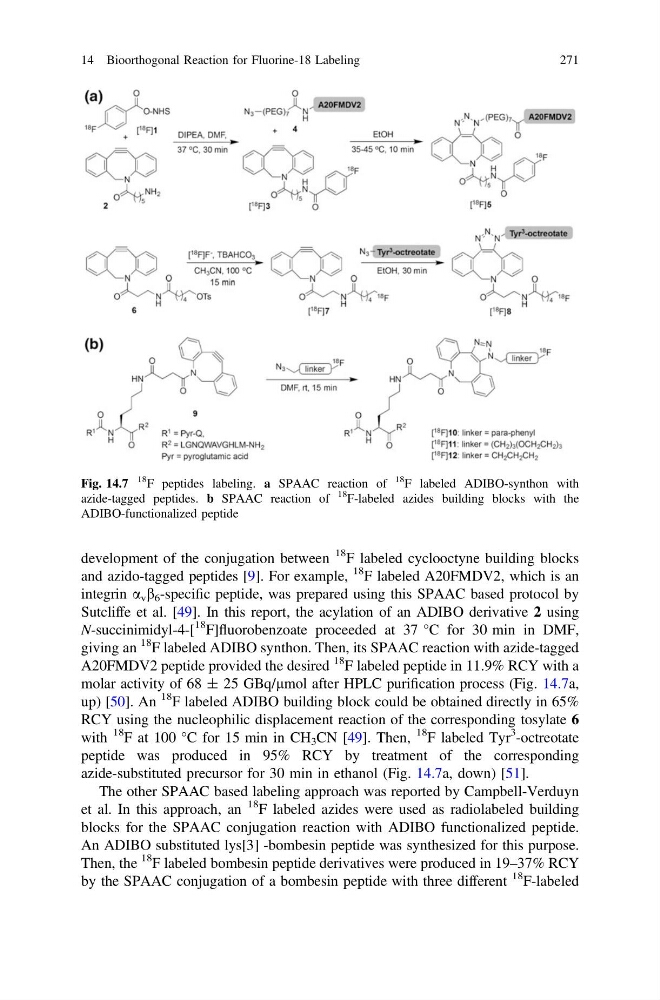
Sutcliffe et al. [49]. In this report, the acylation of an ADIBO derivative 2 using
N-succinimidyl-4-[
18 F]fluorobenzoate proceeded at 37 °C for 30 min in DMF,
giving an
18
F labeled ADIBO synthon. Then, its SPAAC reaction with azide-tagged
A20FMDV2 peptide provided the desired
18 F labeled peptide in 11.9% RCY with a
molar activity of 68 ± 25 GBq/lmol after HPLC purification process (Fig. 14.7a,
up) [50]. An
18 F labeled ADIBO building block could be obtained directly in 65%
RCY using the nucleophilic displacement reaction of the corresponding tosylate 6
with
18 F at 100 °C for 15 min in CH 3 CN [49]. Then,
18 F labeled Tyr
3 -octreotate
peptide was produced in 95% RCY by treatment of the corresponding
azide-substituted precursor for 30 min in ethanol (Fig. 14.7a, down) [51].
The other SPAAC based labeling approach was reported by Campbell-Verduyn
et al. In this approach, an
18 F labeled azides were used as radiolabeled building
blocks for the SPAAC conjugation reaction with ADIBO functionalized peptide.
An ADIBO substituted lys[3] -bombesin peptide was synthesized for this purpose.
Then, the
18
F labeled bombesin peptide derivatives were produced in 19–37% RCY
by the SPAAC conjugation of a bombesin peptide with three different
18 F-labeled
Fig. 14.7
18 F peptides labeling. a SPAAC reaction of
18
F labeled ADIBO-synthon with
azide-tagged peptides. b SPAAC reaction of
18
F-labeled azides building blocks with the
ADIBO-functionalized peptide
14 Bioorthogonal Reaction for Fluorine-18 Labeling
271
18 F labeled cyclooctyne building blocks
and azido-tagged peptides [9]. For example,
18 F labeled A20FMDV2, which is an
integrin a v b 6 -specific peptide, was prepared using this SPAAC based protocol by
Sutcliffe et al. [49]. In this report, the acylation of an ADIBO derivative 2 using
N-succinimidyl-4-[
18 F]fluorobenzoate proceeded at 37 °C for 30 min in DMF,
giving an
18
F labeled ADIBO synthon. Then, its SPAAC reaction with azide-tagged
A20FMDV2 peptide provided the desired
18 F labeled peptide in 11.9% RCY with a
molar activity of 68 ± 25 GBq/lmol after HPLC purification process (Fig. 14.7a,
up) [50]. An
18 F labeled ADIBO building block could be obtained directly in 65%
RCY using the nucleophilic displacement reaction of the corresponding tosylate 6
with
18 F at 100 °C for 15 min in CH 3 CN [49]. Then,
18 F labeled Tyr
3 -octreotate
peptide was produced in 95% RCY by treatment of the corresponding
azide-substituted precursor for 30 min in ethanol (Fig. 14.7a, down) [51].
The other SPAAC based labeling approach was reported by Campbell-Verduyn
et al. In this approach, an
18 F labeled azides were used as radiolabeled building
blocks for the SPAAC conjugation reaction with ADIBO functionalized peptide.
An ADIBO substituted lys[3] -bombesin peptide was synthesized for this purpose.
Then, the
18
F labeled bombesin peptide derivatives were produced in 19–37% RCY
by the SPAAC conjugation of a bombesin peptide with three different
18 F-labeled
Fig. 14.7
18 F peptides labeling. a SPAAC reaction of
18
F labeled ADIBO-synthon with
azide-tagged peptides. b SPAAC reaction of
18
F-labeled azides building blocks with the
ADIBO-functionalized peptide
14 Bioorthogonal Reaction for Fluorine-18 Labeling
271