

as a directly injectable solution for PET molecular imaging study without HPLC
purification and formulation process. More recently, Kim et al. reported that
18 F
labeled di-cRGD peptide, which was prepared by this
18 F peptide labeling protocol,
could visualize successfully the tumor in vivo on PET imaging study [48].
In particular, the high throughput synthesis of various
18 F labeled peptide tracers
can be achieved efficiently by this
18 F labeling protocol platform [47]. With only
once production of
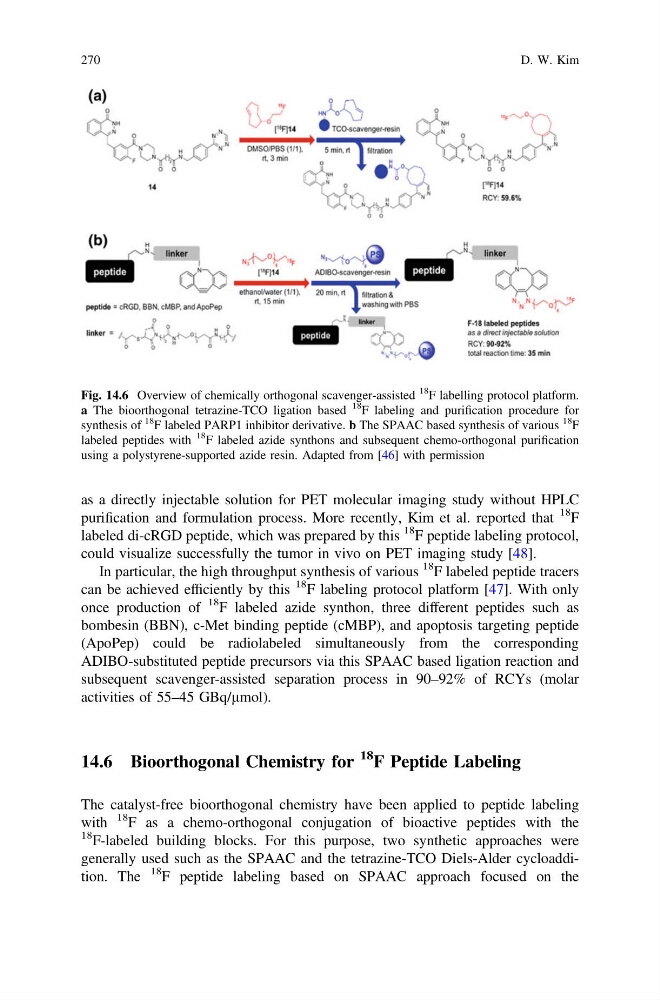
18 F labeled azide synthon, three different peptides such as
bombesin (BBN), c-Met binding peptide (cMBP), and apoptosis targeting peptide
(ApoPep) could be radiolabeled simultaneously from the corresponding
ADIBO-substituted peptide precursors via this SPAAC based ligation reaction and
subsequent scavenger-assisted separation process in 90–92% of RCYs (molar
activities of 55–45 GBq/lmol).
14.6 Bioorthogonal Chemistry for
18
F Peptide Labeling
The catalyst-free bioorthogonal chemistry have been applied to peptide labeling
with
18 F as a chemo-orthogonal conjugation of bioactive peptides with the
18 F-labeled building blocks. For this purpose, two synthetic approaches were
generally used such as the SPAAC and the tetrazine-TCO Diels-Alder cycloaddition. The
18 F peptide labeling based on SPAAC approach focused on the
Fig. 14.6 Overview of chemically orthogonal scavenger-assisted
18
F labelling protocol platform.
a The bioorthogonal tetrazine-TCO ligation based
18
F labeling and purification procedure for
synthesis of
18
F labeled PARP1 inhibitor derivative. b The SPAAC based synthesis of various
18
F
labeled peptides with
18
F labeled azide synthons and subsequent chemo-orthogonal purification
using a polystyrene-supported azide resin. Adapted from [46] with permission
270
D. W. Kim
purification and formulation process. More recently, Kim et al. reported that
18 F
labeled di-cRGD peptide, which was prepared by this
18 F peptide labeling protocol,
could visualize successfully the tumor in vivo on PET imaging study [48].
In particular, the high throughput synthesis of various
18 F labeled peptide tracers
can be achieved efficiently by this
18 F labeling protocol platform [47]. With only
once production of
18 F labeled azide synthon, three different peptides such as
bombesin (BBN), c-Met binding peptide (cMBP), and apoptosis targeting peptide
(ApoPep) could be radiolabeled simultaneously from the corresponding
ADIBO-substituted peptide precursors via this SPAAC based ligation reaction and
subsequent scavenger-assisted separation process in 90–92% of RCYs (molar
activities of 55–45 GBq/lmol).
14.6 Bioorthogonal Chemistry for
18
F Peptide Labeling
The catalyst-free bioorthogonal chemistry have been applied to peptide labeling
with
18 F as a chemo-orthogonal conjugation of bioactive peptides with the
18 F-labeled building blocks. For this purpose, two synthetic approaches were
generally used such as the SPAAC and the tetrazine-TCO Diels-Alder cycloaddition. The
18 F peptide labeling based on SPAAC approach focused on the
Fig. 14.6 Overview of chemically orthogonal scavenger-assisted
18
F labelling protocol platform.
a The bioorthogonal tetrazine-TCO ligation based
18
F labeling and purification procedure for
synthesis of
18
F labeled PARP1 inhibitor derivative. b The SPAAC based synthesis of various
18
F
labeled peptides with
18
F labeled azide synthons and subsequent chemo-orthogonal purification
using a polystyrene-supported azide resin. Adapted from [46] with permission
270
D. W. Kim