

In 2013, Kim et al. firstly reported the pretargeting concept for in vivo covalent
18 F labeling reaction of nanoparticles using a bioorthogonal chemistry [39]. In this
report, highly efficient MSN pretargeting and PET imaging was successfully done
with this short half-life
18 F using a rapid and bioorthogonal SPAAC reaction of
ADIBO-substituted MSNs with
18 F-labeled azide in tumor-bearing mice [39].
Using the strategy of bioorthogonal chemistry, an ADIBO group-tethered
PEGylated MSNs (ADIBO–PEG–MSNs) were prepared with such a size of 100–
150 nm that MSNs accumulate in the tumor by the EPR effect [40]. To investigate
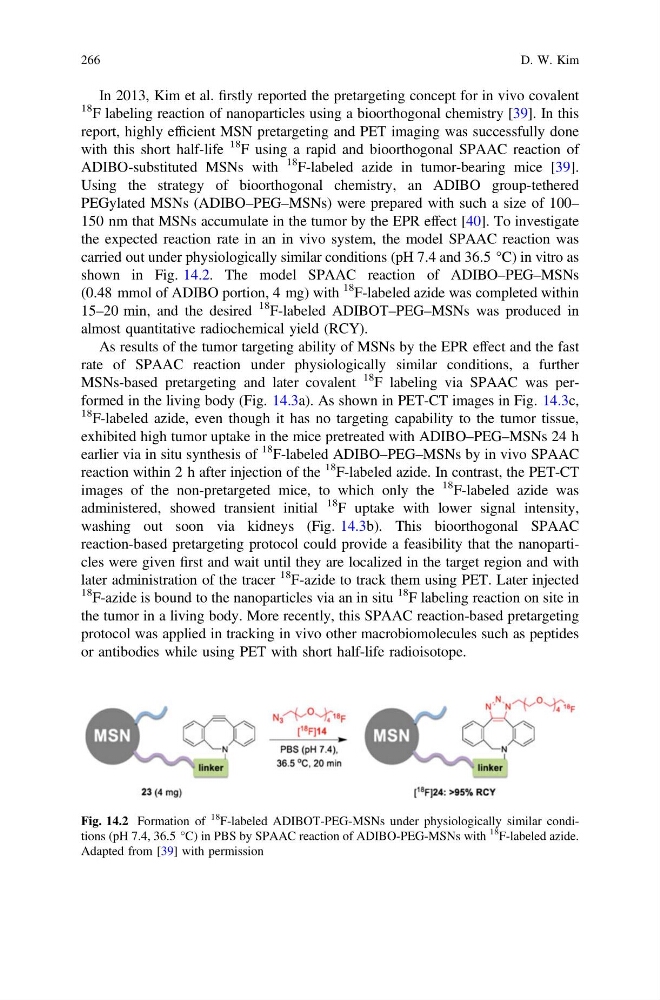
the expected reaction rate in an in vivo system, the model SPAAC reaction was
carried out under physiologically similar conditions (pH 7.4 and 36.5 °C) in vitro as
shown in Fig. 14.2. The model SPAAC reaction of ADIBO–PEG–MSNs
(0.48 mmol of ADIBO portion, 4 mg) with
18 F-labeled azide was completed within
15–20 min, and the desired
18 F-labeled ADIBOT–PEG–MSNs was produced in
almost quantitative radiochemical yield (RCY).
As results of the tumor targeting ability of MSNs by the EPR effect and the fast
rate of SPAAC reaction under physiologically similar conditions, a further
MSNs-based pretargeting and later covalent
18 F labeling via SPAAC was performed in the living body (Fig. 14.3a). As shown in PET-CT images in Fig. 14.3c,
18 F-labeled azide, even though it has no targeting capability to the tumor tissue,
exhibited high tumor uptake in the mice pretreated with ADIBO–PEG–MSNs 24 h
earlier via in situ synthesis of
18 F-labeled ADIBO–PEG–MSNs by in vivo SPAAC
reaction within 2 h after injection of the
18 F-labeled azide. In contrast, the PET-CT
images of the non-pretargeted mice, to which only the
18 F-labeled azide was
administered, showed transient initial
18 F uptake with lower signal intensity,
washing out soon via kidneys (Fig. 14.3b). This bioorthogonal SPAAC
reaction-based pretargeting protocol could provide a feasibility that the nanoparticles were given first and wait until they are localized in the target region and with
later administration of the tracer
18 F-azide to track them using PET. Later injected
18 F-azide is bound to the nanoparticles via an in situ
18 F labeling reaction on site in
the tumor in a living body. More recently, this SPAAC reaction-based pretargeting
protocol was applied in tracking in vivo other macrobiomolecules such as peptides
or antibodies while using PET with short half-life radioisotope.
Fig. 14.2 Formation of
18
F-labeled ADIBOT-PEG-MSNs under physiologically similar conditions (pH 7.4, 36.5 °C) in PBS by SPAAC reaction of ADIBO-PEG-MSNs with
18
F-labeled azide.
Adapted from [39] with permission
266
D. W. Kim
18 F labeling reaction of nanoparticles using a bioorthogonal chemistry [39]. In this
report, highly efficient MSN pretargeting and PET imaging was successfully done
with this short half-life
18 F using a rapid and bioorthogonal SPAAC reaction of
ADIBO-substituted MSNs with
18 F-labeled azide in tumor-bearing mice [39].
Using the strategy of bioorthogonal chemistry, an ADIBO group-tethered
PEGylated MSNs (ADIBO–PEG–MSNs) were prepared with such a size of 100–
150 nm that MSNs accumulate in the tumor by the EPR effect [40]. To investigate
the expected reaction rate in an in vivo system, the model SPAAC reaction was
carried out under physiologically similar conditions (pH 7.4 and 36.5 °C) in vitro as
shown in Fig. 14.2. The model SPAAC reaction of ADIBO–PEG–MSNs
(0.48 mmol of ADIBO portion, 4 mg) with
18 F-labeled azide was completed within
15–20 min, and the desired
18 F-labeled ADIBOT–PEG–MSNs was produced in
almost quantitative radiochemical yield (RCY).
As results of the tumor targeting ability of MSNs by the EPR effect and the fast
rate of SPAAC reaction under physiologically similar conditions, a further
MSNs-based pretargeting and later covalent
18 F labeling via SPAAC was performed in the living body (Fig. 14.3a). As shown in PET-CT images in Fig. 14.3c,
18 F-labeled azide, even though it has no targeting capability to the tumor tissue,
exhibited high tumor uptake in the mice pretreated with ADIBO–PEG–MSNs 24 h
earlier via in situ synthesis of
18 F-labeled ADIBO–PEG–MSNs by in vivo SPAAC
reaction within 2 h after injection of the
18 F-labeled azide. In contrast, the PET-CT
images of the non-pretargeted mice, to which only the
18 F-labeled azide was
administered, showed transient initial
18 F uptake with lower signal intensity,
washing out soon via kidneys (Fig. 14.3b). This bioorthogonal SPAAC
reaction-based pretargeting protocol could provide a feasibility that the nanoparticles were given first and wait until they are localized in the target region and with
later administration of the tracer
18 F-azide to track them using PET. Later injected
18 F-azide is bound to the nanoparticles via an in situ
18 F labeling reaction on site in
the tumor in a living body. More recently, this SPAAC reaction-based pretargeting
protocol was applied in tracking in vivo other macrobiomolecules such as peptides
or antibodies while using PET with short half-life radioisotope.
Fig. 14.2 Formation of
18
F-labeled ADIBOT-PEG-MSNs under physiologically similar conditions (pH 7.4, 36.5 °C) in PBS by SPAAC reaction of ADIBO-PEG-MSNs with
18
F-labeled azide.
Adapted from [39] with permission
266
D. W. Kim