

10.1 General Comments on Surface Modification
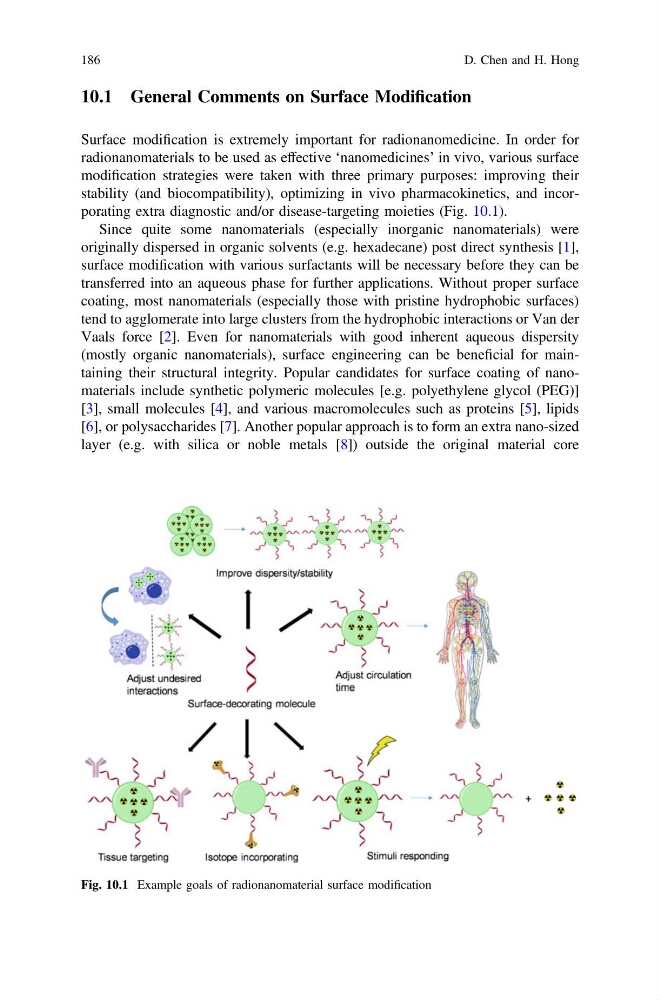
Surface modification is extremely important for radionanomedicine. In order for
radionanomaterials to be used as effective ‘nanomedicines’ in vivo, various surface
modification strategies were taken with three primary purposes: improving their
stability (and biocompatibility), optimizing in vivo pharmacokinetics, and incorporating extra diagnostic and/or disease-targeting moieties (Fig. 10.1).
Since quite some nanomaterials (especially inorganic nanomaterials) were
originally dispersed in organic solvents (e.g. hexadecane) post direct synthesis [1],
surface modification with various surfactants will be necessary before they can be
transferred into an aqueous phase for further applications. Without proper surface
coating, most nanomaterials (especially those with pristine hydrophobic surfaces)
tend to agglomerate into large clusters from the hydrophobic interactions or Van der
Vaals force [2]. Even for nanomaterials with good inherent aqueous dispersity
(mostly organic nanomaterials), surface engineering can be beneficial for maintaining their structural integrity. Popular candidates for surface coating of nanomaterials include synthetic polymeric molecules [e.g. polyethylene glycol (PEG)]
[3], small molecules [4], and various macromolecules such as proteins [5], lipids
[6], or polysaccharides [7]. Another popular approach is to form an extra nano-sized
layer (e.g. with silica or noble metals [8]) outside the original material core
Fig. 10.1 Example goals of radionanomaterial surface modification
186
D. Chen and H. Hong
Surface modification is extremely important for radionanomedicine. In order for
radionanomaterials to be used as effective ‘nanomedicines’ in vivo, various surface
modification strategies were taken with three primary purposes: improving their
stability (and biocompatibility), optimizing in vivo pharmacokinetics, and incorporating extra diagnostic and/or disease-targeting moieties (Fig. 10.1).
Since quite some nanomaterials (especially inorganic nanomaterials) were
originally dispersed in organic solvents (e.g. hexadecane) post direct synthesis [1],
surface modification with various surfactants will be necessary before they can be
transferred into an aqueous phase for further applications. Without proper surface
coating, most nanomaterials (especially those with pristine hydrophobic surfaces)
tend to agglomerate into large clusters from the hydrophobic interactions or Van der
Vaals force [2]. Even for nanomaterials with good inherent aqueous dispersity
(mostly organic nanomaterials), surface engineering can be beneficial for maintaining their structural integrity. Popular candidates for surface coating of nanomaterials include synthetic polymeric molecules [e.g. polyethylene glycol (PEG)]
[3], small molecules [4], and various macromolecules such as proteins [5], lipids
[6], or polysaccharides [7]. Another popular approach is to form an extra nano-sized
layer (e.g. with silica or noble metals [8]) outside the original material core
Fig. 10.1 Example goals of radionanomaterial surface modification
186
D. Chen and H. Hong