

physiologic condition. Furthermore,
99m Tc imaging is one of the most widely using
SPECT images. However, despite these advantages, the question still remains that
99m Tc-HMPAO compounds could circulate and be excreted from the body when
EVs were metabolized and/or degraded. There is no guarantee that the radioactivity
we are observing is coming from the intact EVs administered. Relatively short
half-life of
99m Tc of 6 h limited long-term monitoring of EVs and if EVs accumulated slowly in the target tissues such as tumor, radionuclides with long half-life
would be required.
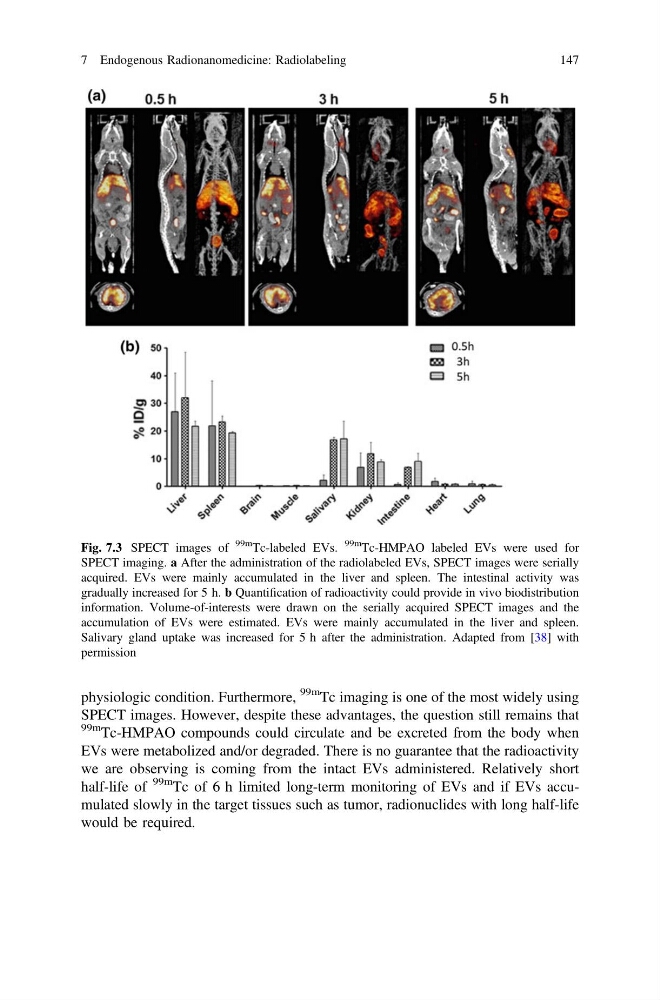
Fig. 7.3 SPECT images of
99m Tc-labeled EVs.
99m
Tc-HMPAO labeled EVs were used for
SPECT imaging. a After the administration of the radiolabeled EVs, SPECT images were serially
acquired. EVs were mainly accumulated in the liver and spleen. The intestinal activity was
gradually increased for 5 h. b Quantification of radioactivity could provide in vivo biodistribution
information. Volume-of-interests were drawn on the serially acquired SPECT images and the
accumulation of EVs were estimated. EVs were mainly accumulated in the liver and spleen.
Salivary gland uptake was increased for 5 h after the administration. Adapted from [38] with
permission
7 Endogenous Radionanomedicine: Radiolabeling
147
99m Tc imaging is one of the most widely using
SPECT images. However, despite these advantages, the question still remains that
99m Tc-HMPAO compounds could circulate and be excreted from the body when
EVs were metabolized and/or degraded. There is no guarantee that the radioactivity
we are observing is coming from the intact EVs administered. Relatively short
half-life of
99m Tc of 6 h limited long-term monitoring of EVs and if EVs accumulated slowly in the target tissues such as tumor, radionuclides with long half-life
would be required.
Fig. 7.3 SPECT images of
99m Tc-labeled EVs.
99m
Tc-HMPAO labeled EVs were used for
SPECT imaging. a After the administration of the radiolabeled EVs, SPECT images were serially
acquired. EVs were mainly accumulated in the liver and spleen. The intestinal activity was
gradually increased for 5 h. b Quantification of radioactivity could provide in vivo biodistribution
information. Volume-of-interests were drawn on the serially acquired SPECT images and the
accumulation of EVs were estimated. EVs were mainly accumulated in the liver and spleen.
Salivary gland uptake was increased for 5 h after the administration. Adapted from [38] with
permission
7 Endogenous Radionanomedicine: Radiolabeling
147