

7.3.2
99m Tc Radiolabeled EVs
As another simple labeling method without protein modification, the labeling based
on radionuclide trapping in EVs was developed [38]. The radiolabeling was performed by
99m Tc-hexamethylpropyleneamineoxime (HMPAO) under physiologic
condition. Because
99m Tc is one of the most commonly used tracers in nuclear
medicine, it has merits in facilitating future clinical translation. The authors used
exosome-mimetic nanovesicles collected from murine macrophage cell lines, which
yielded much larger amount than the pristine EVs [13]. Purified EVs were simply
incubated with
99m
Tc-HMPAO under room temperature for 1 h (Fig. 7.2). To
remove free
99m Tc-HMPAO and its metabolites, either a size-exclusion column,
PD-10, or exosome exclusive spin column with centrifugation was applied. The
99m Tc-HMPAO-labeled EVs were used for the biodistribution study as well as
SPECT imaging. The method is based on previously well-known labeling methods
clinically used for WBC labeling [39, 40]. The highly lipophilic HMPAO penetrate
easily the lipid bilayers of the cellular membranes and be trapped by reaction with
glutathione which contains sulfhydryl groups. By this reaction, HMPAO is converted to hydrophilic metabolites that cannot go out of the lipid bilayers. As the
study also revealed that EVs had glutathione as cells did, labeling of EVs with
99m Tc-HMPAO was supposed to be stable until the integrity of the lipid bilayers are
maintained. Serial SPECT images acquired from this study are represented in
Fig. 7.3. SPECT imaging revealed high accumulation of EVs in the liver and spleen
and radioactivity increased in intestine as time lapsed. Interestingly, one could see
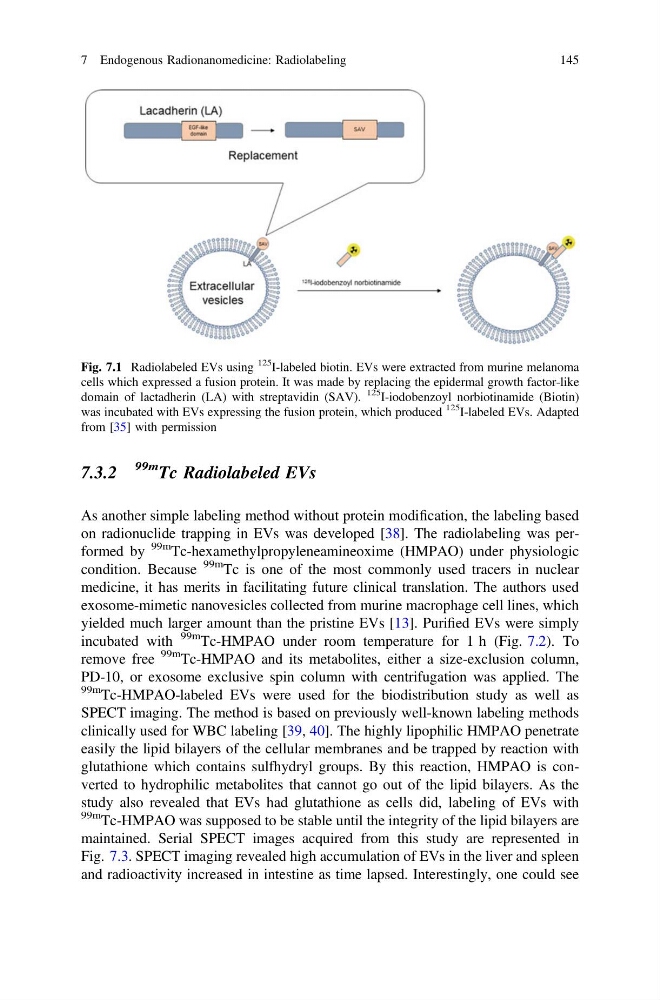
Fig. 7.1 Radiolabeled EVs using
125
I-labeled biotin. EVs were extracted from murine melanoma
cells which expressed a fusion protein. It was made by replacing the epidermal growth factor-like
domain of lactadherin (LA) with streptavidin (SAV).
125
I-iodobenzoyl norbiotinamide (Biotin)
was incubated with EVs expressing the fusion protein, which produced
125
I-labeled EVs. Adapted
from [35] with permission
7 Endogenous Radionanomedicine: Radiolabeling
145
99m Tc Radiolabeled EVs
As another simple labeling method without protein modification, the labeling based
on radionuclide trapping in EVs was developed [38]. The radiolabeling was performed by
99m Tc-hexamethylpropyleneamineoxime (HMPAO) under physiologic
condition. Because
99m Tc is one of the most commonly used tracers in nuclear
medicine, it has merits in facilitating future clinical translation. The authors used
exosome-mimetic nanovesicles collected from murine macrophage cell lines, which
yielded much larger amount than the pristine EVs [13]. Purified EVs were simply
incubated with
99m
Tc-HMPAO under room temperature for 1 h (Fig. 7.2). To
remove free
99m Tc-HMPAO and its metabolites, either a size-exclusion column,
PD-10, or exosome exclusive spin column with centrifugation was applied. The
99m Tc-HMPAO-labeled EVs were used for the biodistribution study as well as
SPECT imaging. The method is based on previously well-known labeling methods
clinically used for WBC labeling [39, 40]. The highly lipophilic HMPAO penetrate
easily the lipid bilayers of the cellular membranes and be trapped by reaction with
glutathione which contains sulfhydryl groups. By this reaction, HMPAO is converted to hydrophilic metabolites that cannot go out of the lipid bilayers. As the
study also revealed that EVs had glutathione as cells did, labeling of EVs with
99m Tc-HMPAO was supposed to be stable until the integrity of the lipid bilayers are
maintained. Serial SPECT images acquired from this study are represented in
Fig. 7.3. SPECT imaging revealed high accumulation of EVs in the liver and spleen
and radioactivity increased in intestine as time lapsed. Interestingly, one could see
Fig. 7.1 Radiolabeled EVs using
125
I-labeled biotin. EVs were extracted from murine melanoma
cells which expressed a fusion protein. It was made by replacing the epidermal growth factor-like
domain of lactadherin (LA) with streptavidin (SAV).
125
I-iodobenzoyl norbiotinamide (Biotin)
was incubated with EVs expressing the fusion protein, which produced
125
I-labeled EVs. Adapted
from [35] with permission
7 Endogenous Radionanomedicine: Radiolabeling
145