

cyclopamine (CPA) which is a radio-sensitizer, encapsulated in liquid–lipid NPs
(CPA-LLP) for intravenous injection. The size of CCPM177 Lu was
33.1 ± 1.2 nm, and that of CPA-LLP was 48.2 ± 3.1 nm. For the combination
therapy, CPA-LLP was injected via tail vein, and CCPM177 Lu was injected
intratumorally in 4T1 murine breast cancer and Miapaca-2 human pancreatic adenocarcinoma mice models. The combination of CPA-LLP and CCPM177 Lu
delayed tumor growth more than either monotherapy did alone.
The natural polymeric NPs are made of chitosan, hyaluronic acid, and etc.
Chitosan is a natural biodegradable cationic polysaccharide consisting of
D-glucosamine and N-acetyl-D-glucosamine. It is prepared by the deacetylation of
natural biopolymer chitin which is found in the exoskeleton of crustaceans.
Chitosan derivatives have been actively studied because of high viscosity, low
toxicity, superior mucoadhesive properties, and biocompatibility [57]. They are
suitable for drug delivery vehicle as well as biomaterials for tissue engineering.
Chitosan has been approved by the FDA for wound dressing, because it achieves
hemostasis and induces normal tissue regeneration [58].
About 300 nm sized glycol chitosan NPs (CNPs) were labeled with
64 Cu to
monitor in vivo biodistribution of NPs [59]. A strained cyclooctyne derivative,
dibenzyl cyclooctyne (DBCO) conjugated with a DOTA chelator. Azide (N3)
group was introduce to CNPs.
64 Cu-radiolabeled CNPs was synthesized via
copper-free click reaction between
64 Cu-DOTA-Lys-PEG4-DBCO and CNP-N3.
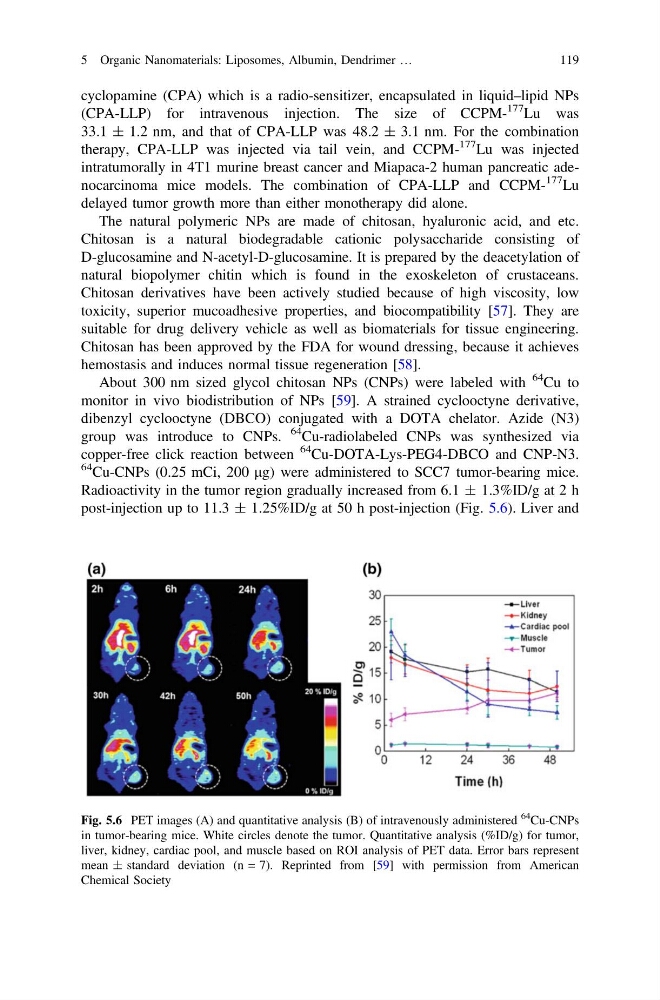
64 Cu-CNPs (0.25 mCi, 200 lg) were administered to SCC7 tumor-bearing mice.
Radioactivity in the tumor region gradually increased from 6.1 ± 1.3%ID/g at 2 h
post-injection up to 11.3 ± 1.25%ID/g at 50 h post-injection (Fig. 5.6). Liver and
Fig. 5.6 PET images (A) and quantitative analysis (B) of intravenously administered
64
Cu-CNPs
in tumor-bearing mice. White circles denote the tumor. Quantitative analysis (%ID/g) for tumor,
liver, kidney, cardiac pool, and muscle based on ROI analysis of PET data. Error bars represent
mean ± standard deviation (n = 7). Reprinted from [59] with permission from American
Chemical Society
5 Organic Nanomaterials: Liposomes, Albumin, Dendrimer …
119
(CPA-LLP) for intravenous injection. The size of CCPM177 Lu was
33.1 ± 1.2 nm, and that of CPA-LLP was 48.2 ± 3.1 nm. For the combination
therapy, CPA-LLP was injected via tail vein, and CCPM177 Lu was injected
intratumorally in 4T1 murine breast cancer and Miapaca-2 human pancreatic adenocarcinoma mice models. The combination of CPA-LLP and CCPM177 Lu
delayed tumor growth more than either monotherapy did alone.
The natural polymeric NPs are made of chitosan, hyaluronic acid, and etc.
Chitosan is a natural biodegradable cationic polysaccharide consisting of
D-glucosamine and N-acetyl-D-glucosamine. It is prepared by the deacetylation of
natural biopolymer chitin which is found in the exoskeleton of crustaceans.
Chitosan derivatives have been actively studied because of high viscosity, low
toxicity, superior mucoadhesive properties, and biocompatibility [57]. They are
suitable for drug delivery vehicle as well as biomaterials for tissue engineering.
Chitosan has been approved by the FDA for wound dressing, because it achieves
hemostasis and induces normal tissue regeneration [58].
About 300 nm sized glycol chitosan NPs (CNPs) were labeled with
64 Cu to
monitor in vivo biodistribution of NPs [59]. A strained cyclooctyne derivative,
dibenzyl cyclooctyne (DBCO) conjugated with a DOTA chelator. Azide (N3)
group was introduce to CNPs.
64 Cu-radiolabeled CNPs was synthesized via
copper-free click reaction between
64 Cu-DOTA-Lys-PEG4-DBCO and CNP-N3.
64 Cu-CNPs (0.25 mCi, 200 lg) were administered to SCC7 tumor-bearing mice.
Radioactivity in the tumor region gradually increased from 6.1 ± 1.3%ID/g at 2 h
post-injection up to 11.3 ± 1.25%ID/g at 50 h post-injection (Fig. 5.6). Liver and
Fig. 5.6 PET images (A) and quantitative analysis (B) of intravenously administered
64
Cu-CNPs
in tumor-bearing mice. White circles denote the tumor. Quantitative analysis (%ID/g) for tumor,
liver, kidney, cardiac pool, and muscle based on ROI analysis of PET data. Error bars represent
mean ± standard deviation (n = 7). Reprinted from [59] with permission from American
Chemical Society
5 Organic Nanomaterials: Liposomes, Albumin, Dendrimer …
119