

other benign or malignant focal hepatic lesions. The radiolabeled EB was also
evaluated as a radiotherapeutic agent in a mouse model of glioblastoma. Two
injections of 7.4 MBq of
90 Y-1,4,7,10-tetra-azacyclododecanetetra-acetic acid
(DOTA)-EB-RGD peptide eliminated the tumor xenografts.
5.4 Dendrimers
Dendrimers are a group of highly branched spherical synthetic polymers. Tomalia
and his colleagues described the stepwise synthesis of dendrimers in 1980s, and
coined the name of dendrimer meaning dendritic polymer [37]. They consist of a
core and several layers with active terminal groups. These layers are formed by
repetition of the polymer. The core is generation 0 (G0) and each layer will be G1,
G2, G3, and so on. Due to the high loading capacity of payloads and the capability
to control the polymer structure, dendrimers are favorable platforms for drug and
gene delivery. Through the modification of cores, interiors, and surface groups of
dendrimer, the properties of dendrimer can be optimized to reach favorable physical
characteristics, biodistribution, receptor-mediated targeting, and controlled release
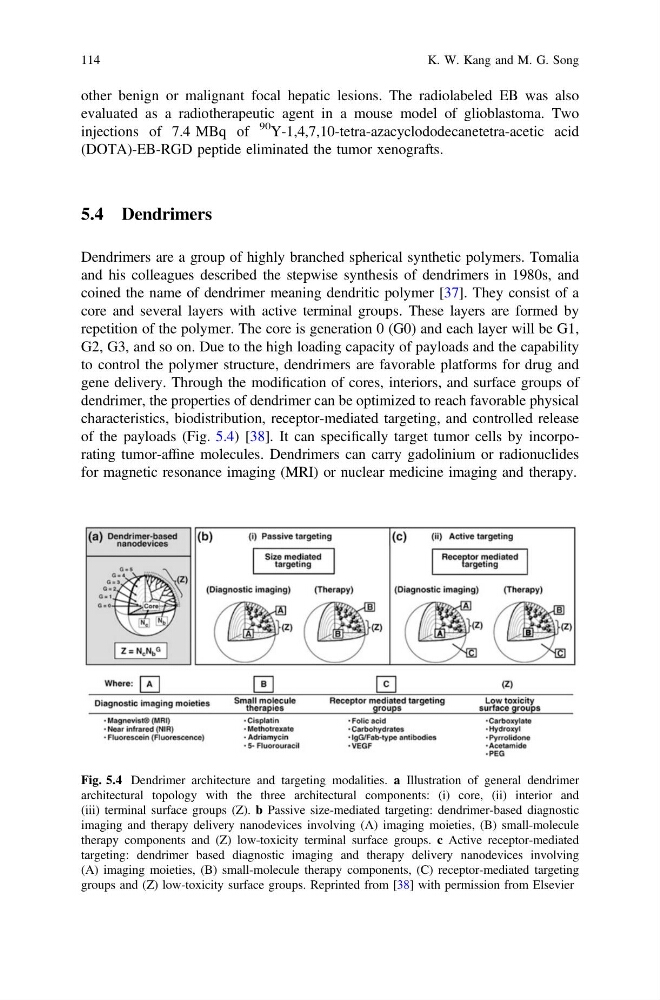
of the payloads (Fig. 5.4) [38]. It can specifically target tumor cells by incorporating tumor-affine molecules. Dendrimers can carry gadolinium or radionuclides
for magnetic resonance imaging (MRI) or nuclear medicine imaging and therapy.
Fig. 5.4 Dendrimer architecture and targeting modalities. a Illustration of general dendrimer
architectural topology with the three architectural components: (i) core, (ii) interior and
(iii) terminal surface groups (Z). b Passive size-mediated targeting: dendrimer-based diagnostic
imaging and therapy delivery nanodevices involving (A) imaging moieties, (B) small-molecule
therapy components and (Z) low-toxicity terminal surface groups. c Active receptor-mediated
targeting: dendrimer based diagnostic imaging and therapy delivery nanodevices involving
(A) imaging moieties, (B) small-molecule therapy components, (C) receptor-mediated targeting
groups and (Z) low-toxicity surface groups. Reprinted from [38] with permission from Elsevier
114
K. W. Kang and M. G. Song
evaluated as a radiotherapeutic agent in a mouse model of glioblastoma. Two
injections of 7.4 MBq of
90 Y-1,4,7,10-tetra-azacyclododecanetetra-acetic acid
(DOTA)-EB-RGD peptide eliminated the tumor xenografts.
5.4 Dendrimers
Dendrimers are a group of highly branched spherical synthetic polymers. Tomalia
and his colleagues described the stepwise synthesis of dendrimers in 1980s, and
coined the name of dendrimer meaning dendritic polymer [37]. They consist of a
core and several layers with active terminal groups. These layers are formed by
repetition of the polymer. The core is generation 0 (G0) and each layer will be G1,
G2, G3, and so on. Due to the high loading capacity of payloads and the capability
to control the polymer structure, dendrimers are favorable platforms for drug and
gene delivery. Through the modification of cores, interiors, and surface groups of
dendrimer, the properties of dendrimer can be optimized to reach favorable physical
characteristics, biodistribution, receptor-mediated targeting, and controlled release
of the payloads (Fig. 5.4) [38]. It can specifically target tumor cells by incorporating tumor-affine molecules. Dendrimers can carry gadolinium or radionuclides
for magnetic resonance imaging (MRI) or nuclear medicine imaging and therapy.
Fig. 5.4 Dendrimer architecture and targeting modalities. a Illustration of general dendrimer
architectural topology with the three architectural components: (i) core, (ii) interior and
(iii) terminal surface groups (Z). b Passive size-mediated targeting: dendrimer-based diagnostic
imaging and therapy delivery nanodevices involving (A) imaging moieties, (B) small-molecule
therapy components and (Z) low-toxicity terminal surface groups. c Active receptor-mediated
targeting: dendrimer based diagnostic imaging and therapy delivery nanodevices involving
(A) imaging moieties, (B) small-molecule therapy components, (C) receptor-mediated targeting
groups and (Z) low-toxicity surface groups. Reprinted from [38] with permission from Elsevier
114
K. W. Kang and M. G. Song