

far-reaching applications and high multi-functionality versatile within biomedical
imaging purposes and provides new nanoplatforms for in vivo drug delivery and
therapy.
References
1. K.S. Novoselov, A.K. Geim, S.V. Morozov, D. Jiang, Y. Zhang, S.V. Dubonos et al.,
Electric field effect in atomically thin carbon films. Science 306(5696), 666–669 (2004)
2. J.M. Yoo, J.H. Kang, B.H. Hong, Graphene-based nanomaterials for versatile imaging
studies. Chem. Soc. Rev. 44(14), 4835–4852 (2015)
3. D. Bitounis, H. Ali-Boucetta, B.H. Hong, D.H. Min, K. Kostarelos, Prospects and challenges
of graphene in biomedical applications. Adv. Mater. 25(16), 2258–2268 (2013)
4. S. Zhu, H. Zhen, Y. Li, P. Wang, X. Huang, P. Shi, PEGylated graphene oxide as a
nanocarrier for podophyllotoxin. J. Nanopart. Res. 16(8), 2530 (2014)
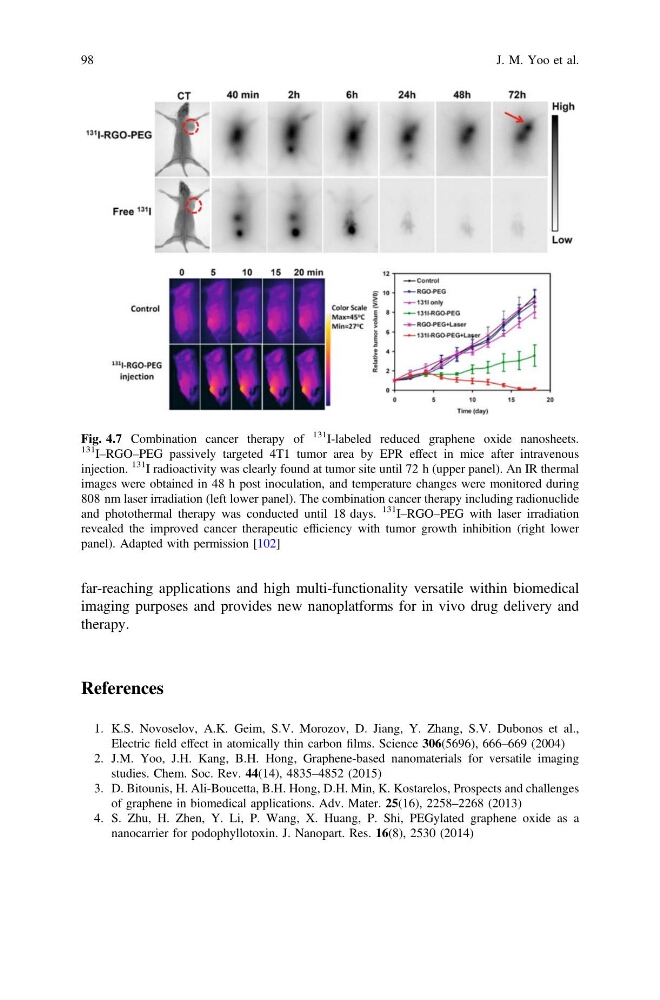
Fig. 4.7 Combination cancer therapy of
131
I-labeled reduced graphene oxide nanosheets.
131
I–RGO–PEG passively targeted 4T1 tumor area by EPR effect in mice after intravenous
injection.
131
I radioactivity was clearly found at tumor site until 72 h (upper panel). An IR thermal
images were obtained in 48 h post inoculation, and temperature changes were monitored during
808 nm laser irradiation (left lower panel). The combination cancer therapy including radionuclide
and photothermal therapy was conducted until 18 days.
131
I–RGO–PEG with laser irradiation
revealed the improved cancer therapeutic efficiency with tumor growth inhibition (right lower
panel). Adapted with permission [102]
98
J. M. Yoo et al.
imaging purposes and provides new nanoplatforms for in vivo drug delivery and
therapy.
References
1. K.S. Novoselov, A.K. Geim, S.V. Morozov, D. Jiang, Y. Zhang, S.V. Dubonos et al.,
Electric field effect in atomically thin carbon films. Science 306(5696), 666–669 (2004)
2. J.M. Yoo, J.H. Kang, B.H. Hong, Graphene-based nanomaterials for versatile imaging
studies. Chem. Soc. Rev. 44(14), 4835–4852 (2015)
3. D. Bitounis, H. Ali-Boucetta, B.H. Hong, D.H. Min, K. Kostarelos, Prospects and challenges
of graphene in biomedical applications. Adv. Mater. 25(16), 2258–2268 (2013)
4. S. Zhu, H. Zhen, Y. Li, P. Wang, X. Huang, P. Shi, PEGylated graphene oxide as a
nanocarrier for podophyllotoxin. J. Nanopart. Res. 16(8), 2530 (2014)
Fig. 4.7 Combination cancer therapy of
131
I-labeled reduced graphene oxide nanosheets.
131
I–RGO–PEG passively targeted 4T1 tumor area by EPR effect in mice after intravenous
injection.
131
I radioactivity was clearly found at tumor site until 72 h (upper panel). An IR thermal
images were obtained in 48 h post inoculation, and temperature changes were monitored during
808 nm laser irradiation (left lower panel). The combination cancer therapy including radionuclide
and photothermal therapy was conducted until 18 days.
131
I–RGO–PEG with laser irradiation
revealed the improved cancer therapeutic efficiency with tumor growth inhibition (right lower
panel). Adapted with permission [102]
98
J. M. Yoo et al.