

promoted and validated as one of the most promising plant cell-based biologics.
In fact, preclinical and current clinical trials hold promise for immunotherapy based
on these recombinant molecules with peerless safety and economic qualities.
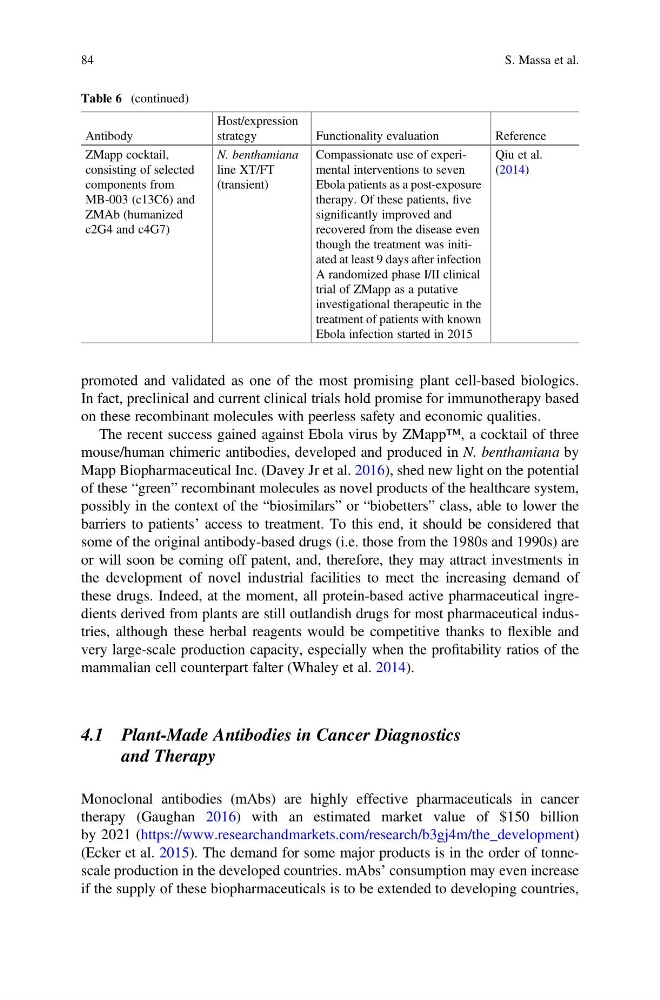
The recent success gained against Ebola virus by ZMapp™, a cocktail of three
mouse/human chimeric antibodies, developed and produced in N. benthamiana by
Mapp Biopharmaceutical Inc. (Davey Jr et al. 2016), shed new light on the potential
of these “green” recombinant molecules as novel products of the healthcare system,
possibly in the context of the “biosimilars” or “biobetters” class, able to lower the
barriers to patients’ access to treatment. To this end, it should be considered that
some of the original antibody-based drugs (i.e. those from the 1980s and 1990s) are
or will soon be coming off patent, and, therefore, they may attract investments in
the development of novel industrial facilities to meet the increasing demand of
these drugs. Indeed, at the moment, all protein-based active pharmaceutical ingredients derived from plants are still outlandish drugs for most pharmaceutical industries, although these herbal reagents would be competitive thanks to flexible and
very large-scale production capacity, especially when the profitability ratios of the
mammalian cell counterpart falter (Whaley et al. 2014).
4.1 Plant-Made Antibodies in Cancer Diagnostics
and Therapy
Monoclonal antibodies (mAbs) are highly effective pharmaceuticals in cancer
therapy (Gaughan 2016) with an estimated market value of $150 billion
by 2021 (https://www.researchandmarkets.com/research/b3gj4m/the_development)
(Ecker et al. 2015). The demand for some major products is in the order of tonnescale production in the developed countries. mAbs’ consumption may even increase
if the supply of these biopharmaceuticals is to be extended to developing countries,
Table 6 (continued)
Antibody
Host/expression
strategy
Functionality evaluation
Reference
ZMapp cocktail,
consisting of selected
components from
MB-003 (c13C6) and
ZMAb (humanized
c2G4 and c4G7)
N. benthamiana
line XT/FT
(transient)
Compassionate use of experimental interventions to seven
Ebola patients as a post-exposure
therapy. Of these patients, five
significantly improved and
recovered from the disease even
though the treatment was initiated at least 9 days after infection
A randomized phase I/II clinical
trial of ZMapp as a putative
investigational therapeutic in the
treatment of patients with known
Ebola infection started in 2015
Qiu et al.
(2014)
84
S. Massa et al.
In fact, preclinical and current clinical trials hold promise for immunotherapy based
on these recombinant molecules with peerless safety and economic qualities.
The recent success gained against Ebola virus by ZMapp™, a cocktail of three
mouse/human chimeric antibodies, developed and produced in N. benthamiana by
Mapp Biopharmaceutical Inc. (Davey Jr et al. 2016), shed new light on the potential
of these “green” recombinant molecules as novel products of the healthcare system,
possibly in the context of the “biosimilars” or “biobetters” class, able to lower the
barriers to patients’ access to treatment. To this end, it should be considered that
some of the original antibody-based drugs (i.e. those from the 1980s and 1990s) are
or will soon be coming off patent, and, therefore, they may attract investments in
the development of novel industrial facilities to meet the increasing demand of
these drugs. Indeed, at the moment, all protein-based active pharmaceutical ingredients derived from plants are still outlandish drugs for most pharmaceutical industries, although these herbal reagents would be competitive thanks to flexible and
very large-scale production capacity, especially when the profitability ratios of the
mammalian cell counterpart falter (Whaley et al. 2014).
4.1 Plant-Made Antibodies in Cancer Diagnostics
and Therapy
Monoclonal antibodies (mAbs) are highly effective pharmaceuticals in cancer
therapy (Gaughan 2016) with an estimated market value of $150 billion
by 2021 (https://www.researchandmarkets.com/research/b3gj4m/the_development)
(Ecker et al. 2015). The demand for some major products is in the order of tonnescale production in the developed countries. mAbs’ consumption may even increase
if the supply of these biopharmaceuticals is to be extended to developing countries,
Table 6 (continued)
Antibody
Host/expression
strategy
Functionality evaluation
Reference
ZMapp cocktail,
consisting of selected
components from
MB-003 (c13C6) and
ZMAb (humanized
c2G4 and c4G7)
N. benthamiana
line XT/FT
(transient)
Compassionate use of experimental interventions to seven
Ebola patients as a post-exposure
therapy. Of these patients, five
significantly improved and
recovered from the disease even
though the treatment was initiated at least 9 days after infection
A randomized phase I/II clinical
trial of ZMapp as a putative
investigational therapeutic in the
treatment of patients with known
Ebola infection started in 2015
Qiu et al.
(2014)
84
S. Massa et al.