

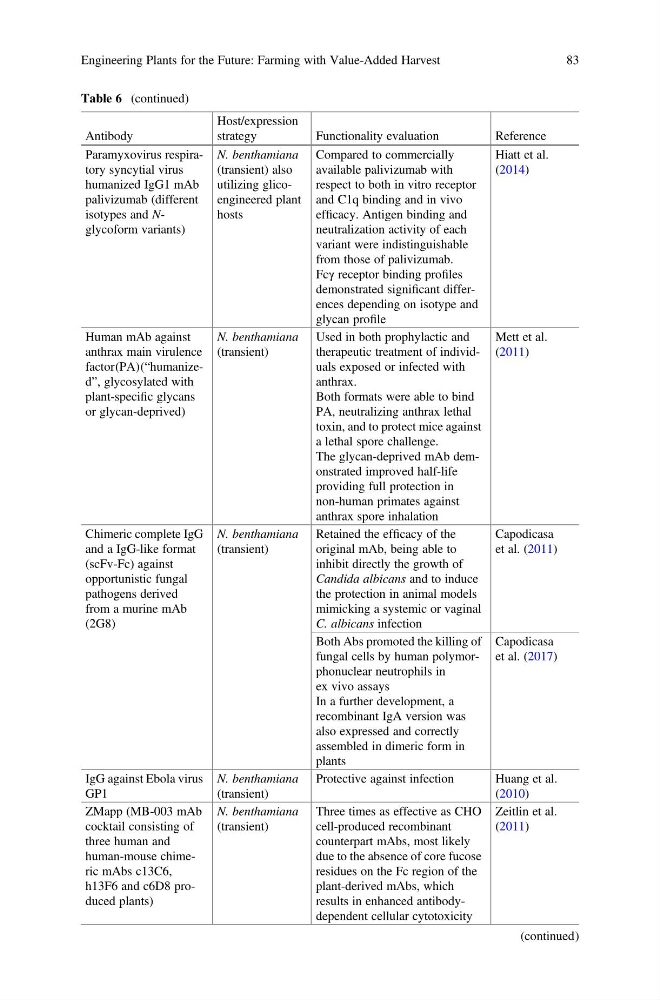
Table 6 (continued)
Antibody
Host/expression
strategy
Functionality evaluation
Reference
Paramyxovirus respiratory syncytial virus
humanized IgG1 mAb
palivizumab (different
isotypes and Nglycoform variants)
N. benthamiana
(transient) also
utilizing glicoengineered plant
hosts
Compared to commercially
available palivizumab with
respect to both in vitro receptor
and C1q binding and in vivo
efficacy. Antigen binding and
neutralization activity of each
variant were indistinguishable
from those of palivizumab.
Fcγ receptor binding profiles
demonstrated significant differences depending on isotype and
glycan profile
Hiatt et al.
(2014)
Human mAb against
anthrax main virulence
factor(PA)(“humanized”, glycosylated with
plant-specific glycans
or glycan-deprived)
N. benthamiana
(transient)
Used in both prophylactic and
therapeutic treatment of individuals exposed or infected with
anthrax.
Both formats were able to bind
PA, neutralizing anthrax lethal
toxin, and to protect mice against
a lethal spore challenge.
The glycan-deprived mAb demonstrated improved half-life
providing full protection in
non-human primates against
anthrax spore inhalation
Mett et al.
(2011)
Chimeric complete IgG
and a IgG-like format
(scFv-Fc) against
opportunistic fungal
pathogens derived
from a murine mAb
(2G8)
N. benthamiana
(transient)
Retained the efficacy of the
original mAb, being able to
inhibit directly the growth of
Candida albicans and to induce
the protection in animal models
mimicking a systemic or vaginal
C. albicans infection
Capodicasa
et al. (2011)
Both Abs promoted the killing of
fungal cells by human polymorphonuclear neutrophils in
ex vivo assays
In a further development, a
recombinant IgA version was
also expressed and correctly
assembled in dimeric form in
plants
Capodicasa
et al. (2017)
IgG against Ebola virus
GP1
N. benthamiana
(transient)
Protective against infection
Huang et al.
(2010)
ZMapp (MB-003 mAb
cocktail consisting of
three human and
human-mouse chimeric mAbs c13C6,
h13F6 and c6D8 produced plants)
N. benthamiana
(transient)
Three times as effective as CHO
cell-produced recombinant
counterpart mAbs, most likely
due to the absence of core fucose
residues on the Fc region of the
plant-derived mAbs, which
results in enhanced antibodydependent cellular cytotoxicity
Zeitlin et al.
(2011)
(continued)
Engineering Plants for the Future: Farming with Value-Added Harvest
83
Antibody
Host/expression
strategy
Functionality evaluation
Reference
Paramyxovirus respiratory syncytial virus
humanized IgG1 mAb
palivizumab (different
isotypes and Nglycoform variants)
N. benthamiana
(transient) also
utilizing glicoengineered plant
hosts
Compared to commercially
available palivizumab with
respect to both in vitro receptor
and C1q binding and in vivo
efficacy. Antigen binding and
neutralization activity of each
variant were indistinguishable
from those of palivizumab.
Fcγ receptor binding profiles
demonstrated significant differences depending on isotype and
glycan profile
Hiatt et al.
(2014)
Human mAb against
anthrax main virulence
factor(PA)(“humanized”, glycosylated with
plant-specific glycans
or glycan-deprived)
N. benthamiana
(transient)
Used in both prophylactic and
therapeutic treatment of individuals exposed or infected with
anthrax.
Both formats were able to bind
PA, neutralizing anthrax lethal
toxin, and to protect mice against
a lethal spore challenge.
The glycan-deprived mAb demonstrated improved half-life
providing full protection in
non-human primates against
anthrax spore inhalation
Mett et al.
(2011)
Chimeric complete IgG
and a IgG-like format
(scFv-Fc) against
opportunistic fungal
pathogens derived
from a murine mAb
(2G8)
N. benthamiana
(transient)
Retained the efficacy of the
original mAb, being able to
inhibit directly the growth of
Candida albicans and to induce
the protection in animal models
mimicking a systemic or vaginal
C. albicans infection
Capodicasa
et al. (2011)
Both Abs promoted the killing of
fungal cells by human polymorphonuclear neutrophils in
ex vivo assays
In a further development, a
recombinant IgA version was
also expressed and correctly
assembled in dimeric form in
plants
Capodicasa
et al. (2017)
IgG against Ebola virus
GP1
N. benthamiana
(transient)
Protective against infection
Huang et al.
(2010)
ZMapp (MB-003 mAb
cocktail consisting of
three human and
human-mouse chimeric mAbs c13C6,
h13F6 and c6D8 produced plants)
N. benthamiana
(transient)
Three times as effective as CHO
cell-produced recombinant
counterpart mAbs, most likely
due to the absence of core fucose
residues on the Fc region of the
plant-derived mAbs, which
results in enhanced antibodydependent cellular cytotoxicity
Zeitlin et al.
(2011)
(continued)
Engineering Plants for the Future: Farming with Value-Added Harvest
83