

case of fisheries, since farming relies on ocean water and excessive use of antibiotics
may have impact on the environment, the use of (edible) vaccines for disease
prevention may mitigate this problem (Clarke et al. 2013).
4 Plantibodies
Antibodies represent a peculiar example of biopharmaceuticals that can be efficiently expressed utilizing plants as low-cost heterologous hosts. In fact, prokaryotic
expression systems are generally inappropriate for complete antibodies, due to the
lack of some post-translational modifications such as N-linked glycosylation, which
is often required for therapeutic proteins to be effective, and the inconsistency of
others like the stabilization of free sulphydryls (i.e. from cysteines) and the reduction
of disulphide bonds necessary for peptides and proteins to fold correctly.
As already mentioned, in the past decades, after the first, impressive evidence
of correct expression and assembly of a full immunoglobulin in plant cells (Hiatt
et al. 1989), unimaginable before the early 1990s, plant-made antibodies have been
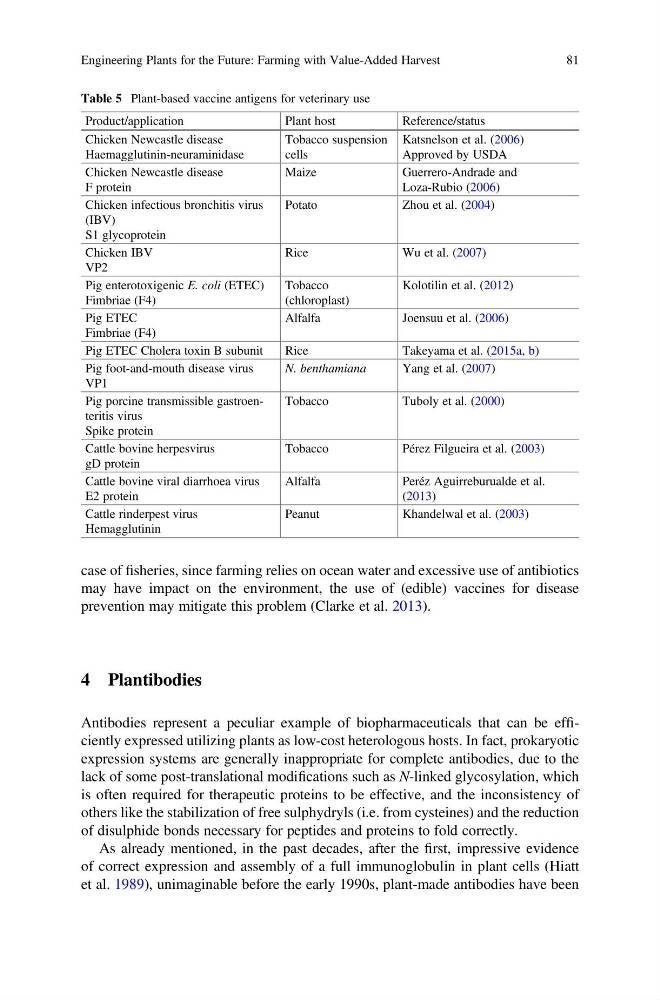
Table 5 Plant-based vaccine antigens for veterinary use
Product/application
Plant host
Reference/status
Chicken Newcastle disease
Haemagglutinin-neuraminidase
Tobacco suspension
cells
Katsnelson et al. (2006)
Approved by USDA
Chicken Newcastle disease
F protein
Maize
Guerrero-Andrade and
Loza-Rubio (2006)
Chicken infectious bronchitis virus
(IBV)
S1 glycoprotein
Potato
Zhou et al. (2004)
Chicken IBV
VP2
Rice
Wu et al. (2007)
Pig enterotoxigenic E. coli (ETEC)
Fimbriae (F4)
Tobacco
(chloroplast)
Kolotilin et al. (2012)
Pig ETEC
Fimbriae (F4)
Alfalfa
Joensuu et al. (2006)
Pig ETEC Cholera toxin B subunit
Rice
Takeyama et al. (2015a, b)
Pig foot-and-mouth disease virus
VP1
N. benthamiana
Yang et al. (2007)
Pig porcine transmissible gastroenteritis virus
Spike protein
Tobacco
Tuboly et al. (2000)
Cattle bovine herpesvirus
gD protein
Tobacco
Pérez Filgueira et al. (2003)
Cattle bovine viral diarrhoea virus
E2 protein
Alfalfa
Peréz Aguirreburualde et al.
(2013)
Cattle rinderpest virus
Hemagglutinin
Peanut
Khandelwal et al. (2003)
Engineering Plants for the Future: Farming with Value-Added Harvest
81
may have impact on the environment, the use of (edible) vaccines for disease
prevention may mitigate this problem (Clarke et al. 2013).
4 Plantibodies
Antibodies represent a peculiar example of biopharmaceuticals that can be efficiently expressed utilizing plants as low-cost heterologous hosts. In fact, prokaryotic
expression systems are generally inappropriate for complete antibodies, due to the
lack of some post-translational modifications such as N-linked glycosylation, which
is often required for therapeutic proteins to be effective, and the inconsistency of
others like the stabilization of free sulphydryls (i.e. from cysteines) and the reduction
of disulphide bonds necessary for peptides and proteins to fold correctly.
As already mentioned, in the past decades, after the first, impressive evidence
of correct expression and assembly of a full immunoglobulin in plant cells (Hiatt
et al. 1989), unimaginable before the early 1990s, plant-made antibodies have been
Table 5 Plant-based vaccine antigens for veterinary use
Product/application
Plant host
Reference/status
Chicken Newcastle disease
Haemagglutinin-neuraminidase
Tobacco suspension
cells
Katsnelson et al. (2006)
Approved by USDA
Chicken Newcastle disease
F protein
Maize
Guerrero-Andrade and
Loza-Rubio (2006)
Chicken infectious bronchitis virus
(IBV)
S1 glycoprotein
Potato
Zhou et al. (2004)
Chicken IBV
VP2
Rice
Wu et al. (2007)
Pig enterotoxigenic E. coli (ETEC)
Fimbriae (F4)
Tobacco
(chloroplast)
Kolotilin et al. (2012)
Pig ETEC
Fimbriae (F4)
Alfalfa
Joensuu et al. (2006)
Pig ETEC Cholera toxin B subunit
Rice
Takeyama et al. (2015a, b)
Pig foot-and-mouth disease virus
VP1
N. benthamiana
Yang et al. (2007)
Pig porcine transmissible gastroenteritis virus
Spike protein
Tobacco
Tuboly et al. (2000)
Cattle bovine herpesvirus
gD protein
Tobacco
Pérez Filgueira et al. (2003)
Cattle bovine viral diarrhoea virus
E2 protein
Alfalfa
Peréz Aguirreburualde et al.
(2013)
Cattle rinderpest virus
Hemagglutinin
Peanut
Khandelwal et al. (2003)
Engineering Plants for the Future: Farming with Value-Added Harvest
81