

Aquatic plants like duckweed (Lemna minor) and other non-vascular plants such
as moss (Physcomitrella patens) have been considered as alternative expression
platforms (Reski et al. 2015). Having properties in common with both terrestrial
plants (in that they are differentiated whole plants) and cell suspension cultures (they
can be grown in containment and in simple mediums), technologies applicable to
aquatic plants and cell suspension cultures are similar with the difference being
that aquatic plants require light, while cell suspension cultures are usually grown in
the dark with the addition of a carbon source.
2.1.2 Cell Suspension Cultures
Removal of cell walls and gene transfer into the resulting protoplasts and suspension
culture is an easier method in comparison to whole-plant genetic manipulation, since
this might simplify purification and downstream processing (Santos et al. 2016).
In addition, suspension culture allows homogeneity in cell proteins and sugars
(N-glycans) due to the high uniformity of type and cell size (Lienard et al. 2007).
Plant cells can be cultivated aseptically using classical fermentation technology,
are easy to scale up and must comply with regulatory requirements similar to
those established for consolidated systems based on both microbial and mammalian
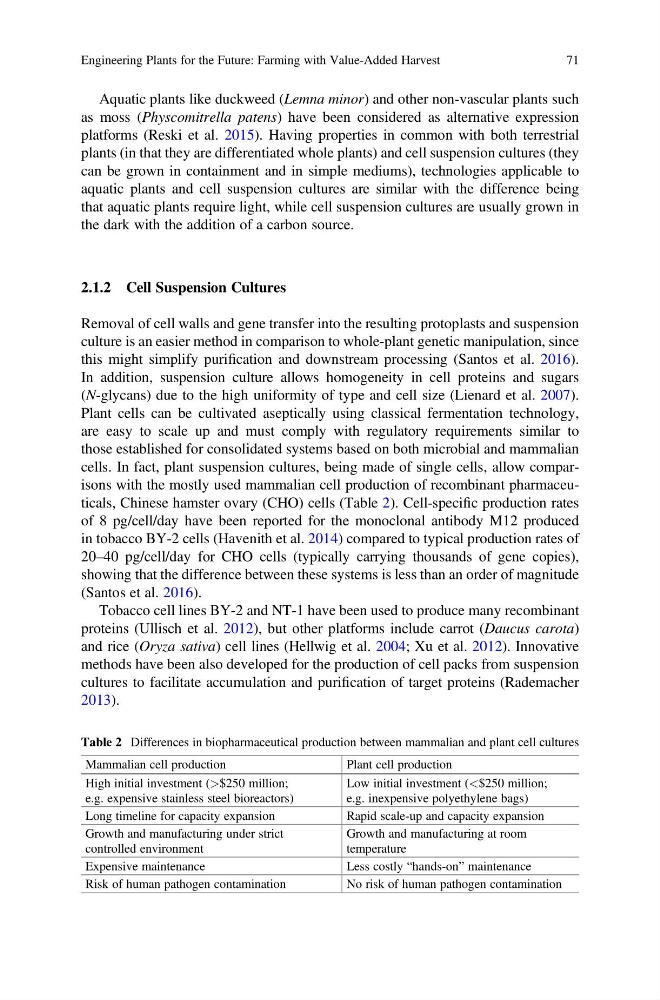
cells. In fact, plant suspension cultures, being made of single cells, allow comparisons with the mostly used mammalian cell production of recombinant pharmaceuticals, Chinese hamster ovary (CHO) cells (Table 2). Cell-specific production rates
of 8 pg/cell/day have been reported for the monoclonal antibody M12 produced
in tobacco BY-2 cells (Havenith et al. 2014) compared to typical production rates of
20–40 pg/cell/day for CHO cells (typically carrying thousands of gene copies),
showing that the difference between these systems is less than an order of magnitude
(Santos et al. 2016).
Tobacco cell lines BY-2 and NT-1 have been used to produce many recombinant
proteins (Ullisch et al. 2012), but other platforms include carrot (Daucus carota)
and rice (Oryza sativa) cell lines (Hellwig et al. 2004; Xu et al. 2012). Innovative
methods have been also developed for the production of cell packs from suspension
cultures to facilitate accumulation and purification of target proteins (Rademacher
2013).
Table 2 Differences in biopharmaceutical production between mammalian and plant cell cultures
Mammalian cell production
Plant cell production
High initial investment (>$250 million;
e.g. expensive stainless steel bioreactors)
Low initial investment (<$250 million;
e.g. inexpensive polyethylene bags)
Long timeline for capacity expansion
Rapid scale-up and capacity expansion
Growth and manufacturing under strict
controlled environment
Growth and manufacturing at room
temperature
Expensive maintenance
Less costly “hands-on” maintenance
Risk of human pathogen contamination
No risk of human pathogen contamination
Engineering Plants for the Future: Farming with Value-Added Harvest
71
as moss (Physcomitrella patens) have been considered as alternative expression
platforms (Reski et al. 2015). Having properties in common with both terrestrial
plants (in that they are differentiated whole plants) and cell suspension cultures (they
can be grown in containment and in simple mediums), technologies applicable to
aquatic plants and cell suspension cultures are similar with the difference being
that aquatic plants require light, while cell suspension cultures are usually grown in
the dark with the addition of a carbon source.
2.1.2 Cell Suspension Cultures
Removal of cell walls and gene transfer into the resulting protoplasts and suspension
culture is an easier method in comparison to whole-plant genetic manipulation, since
this might simplify purification and downstream processing (Santos et al. 2016).
In addition, suspension culture allows homogeneity in cell proteins and sugars
(N-glycans) due to the high uniformity of type and cell size (Lienard et al. 2007).
Plant cells can be cultivated aseptically using classical fermentation technology,
are easy to scale up and must comply with regulatory requirements similar to
those established for consolidated systems based on both microbial and mammalian
cells. In fact, plant suspension cultures, being made of single cells, allow comparisons with the mostly used mammalian cell production of recombinant pharmaceuticals, Chinese hamster ovary (CHO) cells (Table 2). Cell-specific production rates
of 8 pg/cell/day have been reported for the monoclonal antibody M12 produced
in tobacco BY-2 cells (Havenith et al. 2014) compared to typical production rates of
20–40 pg/cell/day for CHO cells (typically carrying thousands of gene copies),
showing that the difference between these systems is less than an order of magnitude
(Santos et al. 2016).
Tobacco cell lines BY-2 and NT-1 have been used to produce many recombinant
proteins (Ullisch et al. 2012), but other platforms include carrot (Daucus carota)
and rice (Oryza sativa) cell lines (Hellwig et al. 2004; Xu et al. 2012). Innovative
methods have been also developed for the production of cell packs from suspension
cultures to facilitate accumulation and purification of target proteins (Rademacher
2013).
Table 2 Differences in biopharmaceutical production between mammalian and plant cell cultures
Mammalian cell production
Plant cell production
High initial investment (>$250 million;
e.g. expensive stainless steel bioreactors)
Low initial investment (<$250 million;
e.g. inexpensive polyethylene bags)
Long timeline for capacity expansion
Rapid scale-up and capacity expansion
Growth and manufacturing under strict
controlled environment
Growth and manufacturing at room
temperature
Expensive maintenance
Less costly “hands-on” maintenance
Risk of human pathogen contamination
No risk of human pathogen contamination
Engineering Plants for the Future: Farming with Value-Added Harvest
71