

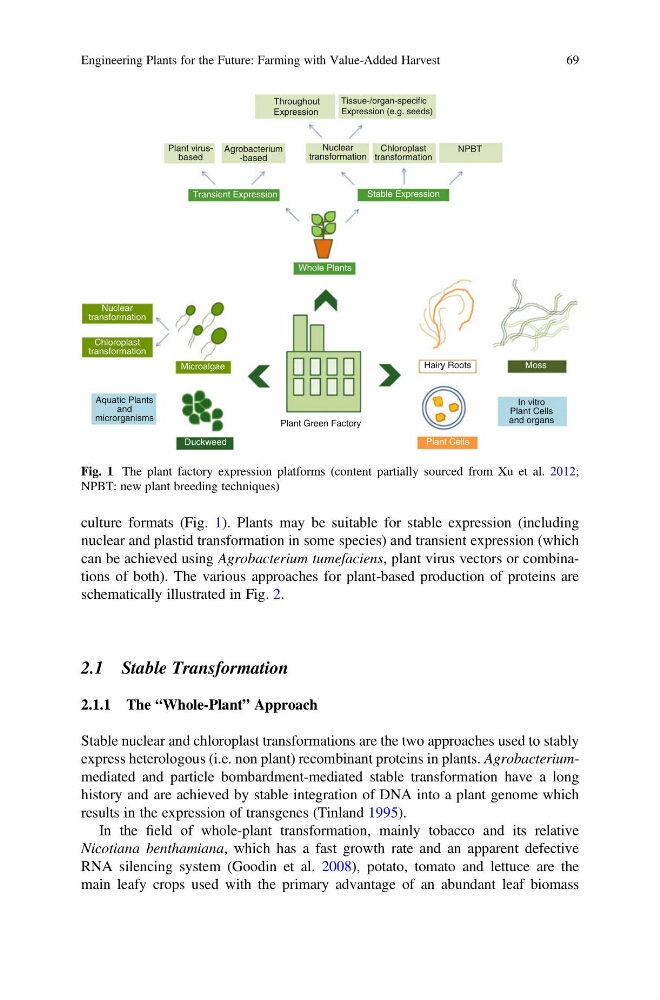
culture formats (Fig. 1). Plants may be suitable for stable expression (including
nuclear and plastid transformation in some species) and transient expression (which
can be achieved using Agrobacterium tumefaciens, plant virus vectors or combinations of both). The various approaches for plant-based production of proteins are
schematically illustrated in Fig. 2.
2.1 Stable Transformation
2.1.1 The “Whole-Plant” Approach
Stable nuclear and chloroplast transformations are the two approaches used to stably
express heterologous (i.e. non plant) recombinant proteins in plants. Agrobacteriummediated and particle bombardment-mediated stable transformation have a long
history and are achieved by stable integration of DNA into a plant genome which
results in the expression of transgenes (Tinland 1995).
In the field of whole-plant transformation, mainly tobacco and its relative
Nicotiana benthamiana, which has a fast growth rate and an apparent defective
RNA silencing system (Goodin et al. 2008), potato, tomato and lettuce are the
main leafy crops used with the primary advantage of an abundant leaf biomass
Throughout
Expression
Plant virusbased
Transient Expression
Stable Expression
Whole Plants
Agrobacterium
-based
Nuclear
transformation
Nuclear
transformation
Chloroplast
transformation
Chloroplast
transformation
Aquatic Plants
and
microrganisms
Microalgae
Duckweed
Plant Green Factory
Hairy Roots
In vitro
Plant Cells
and organs
Moss
Plant Cells
NPBT
Tissue-/organ-specific
Expression (e.g. seeds)
Fig. 1 The plant factory expression platforms (content partially sourced from Xu et al. 2012;
NPBT: new plant breeding techniques)
Engineering Plants for the Future: Farming with Value-Added Harvest
69
nuclear and plastid transformation in some species) and transient expression (which
can be achieved using Agrobacterium tumefaciens, plant virus vectors or combinations of both). The various approaches for plant-based production of proteins are
schematically illustrated in Fig. 2.
2.1 Stable Transformation
2.1.1 The “Whole-Plant” Approach
Stable nuclear and chloroplast transformations are the two approaches used to stably
express heterologous (i.e. non plant) recombinant proteins in plants. Agrobacteriummediated and particle bombardment-mediated stable transformation have a long
history and are achieved by stable integration of DNA into a plant genome which
results in the expression of transgenes (Tinland 1995).
In the field of whole-plant transformation, mainly tobacco and its relative
Nicotiana benthamiana, which has a fast growth rate and an apparent defective
RNA silencing system (Goodin et al. 2008), potato, tomato and lettuce are the
main leafy crops used with the primary advantage of an abundant leaf biomass
Throughout
Expression
Plant virusbased
Transient Expression
Stable Expression
Whole Plants
Agrobacterium
-based
Nuclear
transformation
Nuclear
transformation
Chloroplast
transformation
Chloroplast
transformation
Aquatic Plants
and
microrganisms
Microalgae
Duckweed
Plant Green Factory
Hairy Roots
In vitro
Plant Cells
and organs
Moss
Plant Cells
NPBT
Tissue-/organ-specific
Expression (e.g. seeds)
Fig. 1 The plant factory expression platforms (content partially sourced from Xu et al. 2012;
NPBT: new plant breeding techniques)
Engineering Plants for the Future: Farming with Value-Added Harvest
69