

is better to think before talking. Use international contacts and try to be able to communicate
in more than one foreign language. Visit foreign countries and realize how small Germany
is. Be aware of the short lifetime and the limited size of humans – in comparison with our
planet, our sun, and our galaxy.
Acknowledgements Scientific curiosity has to be animated, by parents and by teachers. To both,
I say thanks.
If university faculties offer excursions for students, they firstly have to be attractive and
secondly worth the price. If, during the time of study, it is possible to join about ten 2-week
excursions (soil science, botany, geography, geology, limnology, palaeontology, ethnology, zoology), then this is the most intensive learning process and best way of scientific mediation – though
also a strain. I say thanks.
Personally, I would like to mention and acknowledge a few scientists and university teachers: Prof.
Hermann Aldinger, Stuttgart (geology); Prof. Max Bense, Stuttgart (philosophy); Prof. Hellmut
Bredereck, Stuttgart (organic chemistry); Prof. Heinz Ellenberg, Göttingen (ecology); Prof. Theodor
Förster, Stuttgart (physical chemistry); Prof. Helmut Gams, Innsbruck (botany); Prof. Josef Goubeau,
Stuttgart (inorganic chemistry); Prof. Emil Greiner, Ludwigsburg (physics); Prof. Helmut Heuberger,
Innsbruck (geography); Prof. Johannes-Erich Hiller, Stuttgart (crystal chemistry); Prof. Herfried
Hoinkes, Innsbruck (climatology); Prof. Karl Ilg, Innsbruck (ethnology); Prof. Helmut Kinzel, Vienna
(ecophysiology); Prof. Hans Kinzl, Innsbruck (geography); Prof. Hermann Lautensach, Stuttgart
(geography); Dr Werner Marten, Blanes (entomology); Prof. Wolfgang Meckelein, Stuttgart (geography); Prof. Otto Pflugfelder, Stuttgart-Hohenheim (zoology); Prof. Arthur Pisek, Innsbruck (ecophysiology of plants); Prof. Hans Pitschmann, Innsbruck (botany); Prof. Herbert Reisigl, Innsbruck
(botany); Prof. Ernst Schlichting, Stuttgart-Hohenheim (pedology); Prof. Maximilian Steiner, Bonn
(pharmacognosy); and Prof. Heinrich Walter, Stuttgart-Hohenheim (geobotany/ecology). I say thanks.
Additionally, I have to thank all of those colleagues who have been very cooperative in joint
projects and other joint ventures or were visiting guests for some time; not all can be named: Prof.
Otar Abdalaze (Tbilisi); Prof. Okmir Agakhanjanz (Minsk); Prof. Roland Albert (Vienna); Prof.
Wilhelm Barthlott (Bonn); Prof. Kamal H. Batanouny (Cairo); Dr Rasik Bhadresa (Tehran,
London); Prof. Martyn Caldwell (Logan); Dr Liliya Dimeyeva (Almati); Dr Eskandar Firouz
(Tehran); Prof. Helmut Freitag (Kassel); Prof. Helena Freitas (Coimbra); Prof. Jan Greszta
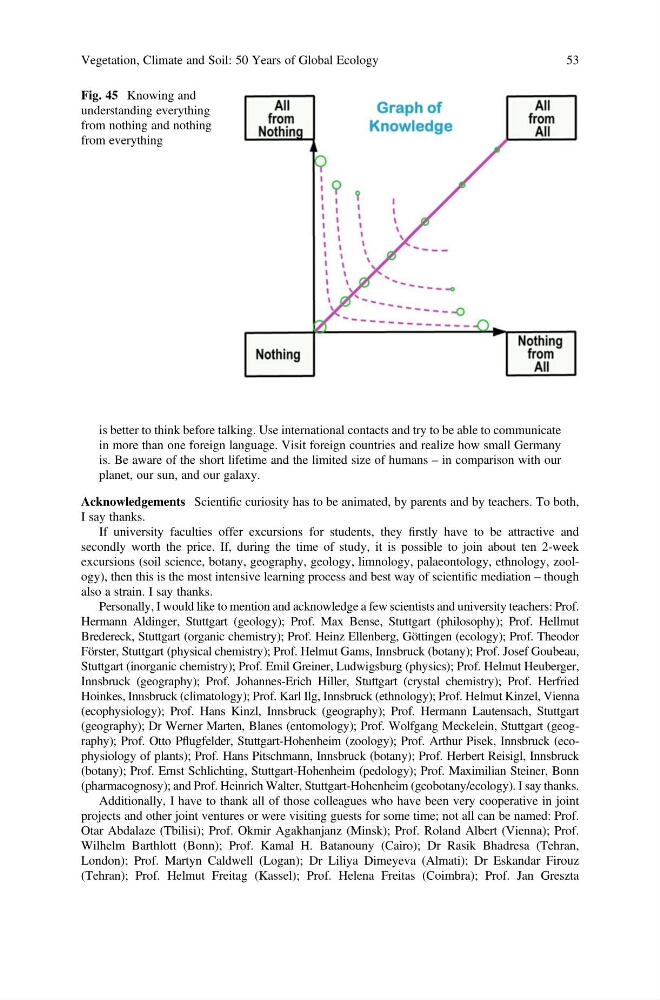
Fig. 45 Knowing and
understanding everything
from nothing and nothing
from everything
Vegetation, Climate and Soil: 50 Years of Global Ecology
53
in more than one foreign language. Visit foreign countries and realize how small Germany
is. Be aware of the short lifetime and the limited size of humans – in comparison with our
planet, our sun, and our galaxy.
Acknowledgements Scientific curiosity has to be animated, by parents and by teachers. To both,
I say thanks.
If university faculties offer excursions for students, they firstly have to be attractive and
secondly worth the price. If, during the time of study, it is possible to join about ten 2-week
excursions (soil science, botany, geography, geology, limnology, palaeontology, ethnology, zoology), then this is the most intensive learning process and best way of scientific mediation – though
also a strain. I say thanks.
Personally, I would like to mention and acknowledge a few scientists and university teachers: Prof.
Hermann Aldinger, Stuttgart (geology); Prof. Max Bense, Stuttgart (philosophy); Prof. Hellmut
Bredereck, Stuttgart (organic chemistry); Prof. Heinz Ellenberg, Göttingen (ecology); Prof. Theodor
Förster, Stuttgart (physical chemistry); Prof. Helmut Gams, Innsbruck (botany); Prof. Josef Goubeau,
Stuttgart (inorganic chemistry); Prof. Emil Greiner, Ludwigsburg (physics); Prof. Helmut Heuberger,
Innsbruck (geography); Prof. Johannes-Erich Hiller, Stuttgart (crystal chemistry); Prof. Herfried
Hoinkes, Innsbruck (climatology); Prof. Karl Ilg, Innsbruck (ethnology); Prof. Helmut Kinzel, Vienna
(ecophysiology); Prof. Hans Kinzl, Innsbruck (geography); Prof. Hermann Lautensach, Stuttgart
(geography); Dr Werner Marten, Blanes (entomology); Prof. Wolfgang Meckelein, Stuttgart (geography); Prof. Otto Pflugfelder, Stuttgart-Hohenheim (zoology); Prof. Arthur Pisek, Innsbruck (ecophysiology of plants); Prof. Hans Pitschmann, Innsbruck (botany); Prof. Herbert Reisigl, Innsbruck
(botany); Prof. Ernst Schlichting, Stuttgart-Hohenheim (pedology); Prof. Maximilian Steiner, Bonn
(pharmacognosy); and Prof. Heinrich Walter, Stuttgart-Hohenheim (geobotany/ecology). I say thanks.
Additionally, I have to thank all of those colleagues who have been very cooperative in joint
projects and other joint ventures or were visiting guests for some time; not all can be named: Prof.
Otar Abdalaze (Tbilisi); Prof. Okmir Agakhanjanz (Minsk); Prof. Roland Albert (Vienna); Prof.
Wilhelm Barthlott (Bonn); Prof. Kamal H. Batanouny (Cairo); Dr Rasik Bhadresa (Tehran,
London); Prof. Martyn Caldwell (Logan); Dr Liliya Dimeyeva (Almati); Dr Eskandar Firouz
(Tehran); Prof. Helmut Freitag (Kassel); Prof. Helena Freitas (Coimbra); Prof. Jan Greszta
Fig. 45 Knowing and
understanding everything
from nothing and nothing
from everything
Vegetation, Climate and Soil: 50 Years of Global Ecology
53