

dynamics between several associations and bare salt desert patches. For the older
sandy sea floor, the succession differs considerably because of the better water
availability on sand. Small sand dunes can form with various Calligonum species
but lately also with Haloxylon aphyllum.
The desiccation history is not easy to reveal. The changing shoreline from year to
year left seeds and saplings, mainly of fast-germinating Tamarix species. After a few
years, the former shorelines could be seen easily from a distance (Fig. 28a, b). At
four transects, Breckle et al. (2014a) did a retrospective dating of the vegetation
belts. Also, in the northern Aral Sea basin, the restart of inundation – as a result of the
new dam – was visible.
Breckle et al. (2012) brought together the results of international and interdisciplinary studies on the new desert ecosystem. The physical characteristics of the area,
mainly geological and climatological aspects and their dynamics, especially the dust
storm dynamics, were discussed. There was a strong need to find ways to minimize
the destructive salt–dust storms in the area. Phyto-melioration experiments (Breckle
2003) on 250 ha of sea floor with the help of Kazak villagers (financed by the
BMBF and the German Society for Technical Cooperation [GTZ]) showed the best
potential of Haloxylon aphyllum (saxaul) to grow and reproduce under these extreme
conditions of continentality (À40
C in winter, +43
C in summer) and salinity.
Under natural conditions, Tamarix species were the main invaders along the desiccation belts (Fig. 28a) but were not successful in planting experiments; they were
always totally destroyed by rodents.
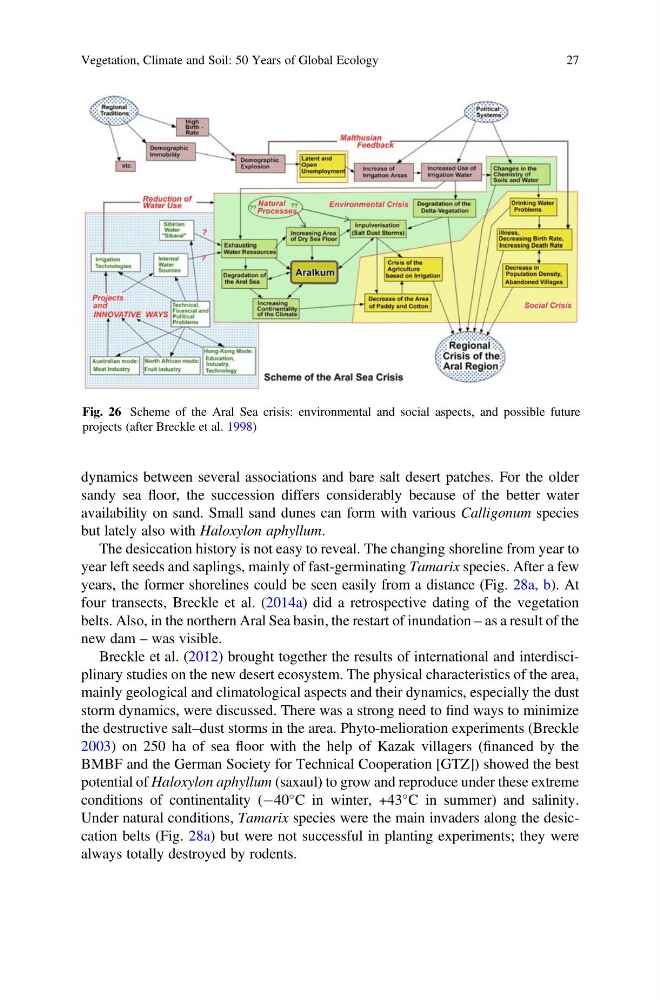
Fig. 26 Scheme of the Aral Sea crisis: environmental and social aspects, and possible future
projects (after Breckle et al. 1998)
Vegetation, Climate and Soil: 50 Years of Global Ecology
27
sandy sea floor, the succession differs considerably because of the better water
availability on sand. Small sand dunes can form with various Calligonum species
but lately also with Haloxylon aphyllum.
The desiccation history is not easy to reveal. The changing shoreline from year to
year left seeds and saplings, mainly of fast-germinating Tamarix species. After a few
years, the former shorelines could be seen easily from a distance (Fig. 28a, b). At
four transects, Breckle et al. (2014a) did a retrospective dating of the vegetation
belts. Also, in the northern Aral Sea basin, the restart of inundation – as a result of the
new dam – was visible.
Breckle et al. (2012) brought together the results of international and interdisciplinary studies on the new desert ecosystem. The physical characteristics of the area,
mainly geological and climatological aspects and their dynamics, especially the dust
storm dynamics, were discussed. There was a strong need to find ways to minimize
the destructive salt–dust storms in the area. Phyto-melioration experiments (Breckle
2003) on 250 ha of sea floor with the help of Kazak villagers (financed by the
BMBF and the German Society for Technical Cooperation [GTZ]) showed the best
potential of Haloxylon aphyllum (saxaul) to grow and reproduce under these extreme
conditions of continentality (À40
C in winter, +43
C in summer) and salinity.
Under natural conditions, Tamarix species were the main invaders along the desiccation belts (Fig. 28a) but were not successful in planting experiments; they were
always totally destroyed by rodents.
Fig. 26 Scheme of the Aral Sea crisis: environmental and social aspects, and possible future
projects (after Breckle et al. 1998)
Vegetation, Climate and Soil: 50 Years of Global Ecology
27