

In the southern Negev (Kibbutz Yotvata), the large experimental fields and
infrastructure, as well as large lysimeters (Fig. 22d), were used for several experiments to check water consumption under strongly arid and hot conditions. This
project, titled “Optimization of Irrigation and Water Use under Desert Conditions”,
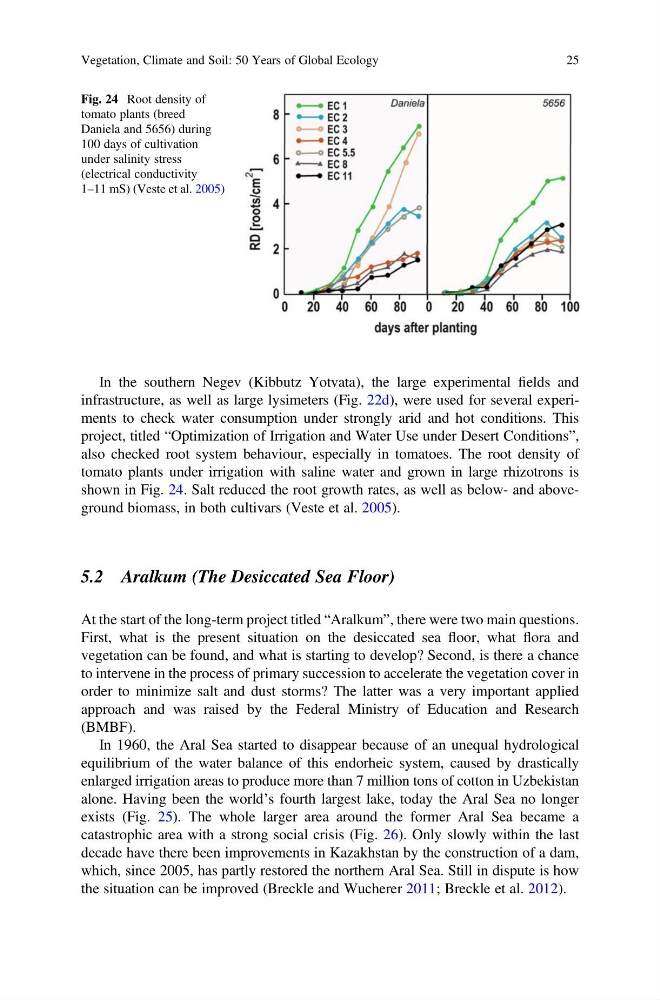
also checked root system behaviour, especially in tomatoes. The root density of
tomato plants under irrigation with saline water and grown in large rhizotrons is
shown in Fig. 24. Salt reduced the root growth rates, as well as below- and aboveground biomass, in both cultivars (Veste et al. 2005).
5.2 Aralkum (The Desiccated Sea Floor)
At the start of the long-term project titled “Aralkum”, there were two main questions.
First, what is the present situation on the desiccated sea floor, what flora and
vegetation can be found, and what is starting to develop? Second, is there a chance
to intervene in the process of primary succession to accelerate the vegetation cover in
order to minimize salt and dust storms? The latter was a very important applied
approach and was raised by the Federal Ministry of Education and Research
(BMBF).
In 1960, the Aral Sea started to disappear because of an unequal hydrological
equilibrium of the water balance of this endorheic system, caused by drastically
enlarged irrigation areas to produce more than 7 million tons of cotton in Uzbekistan
alone. Having been the world’s fourth largest lake, today the Aral Sea no longer
exists (Fig. 25). The whole larger area around the former Aral Sea became a
catastrophic area with a strong social crisis (Fig. 26). Only slowly within the last
decade have there been improvements in Kazakhstan by the construction of a dam,
which, since 2005, has partly restored the northern Aral Sea. Still in dispute is how
the situation can be improved (Breckle and Wucherer 2011; Breckle et al. 2012).
Fig. 24 Root density of
tomato plants (breed
Daniela and 5656) during
100 days of cultivation
under salinity stress
(electrical conductivity
1–11 mS) (Veste et al. 2005)
Vegetation, Climate and Soil: 50 Years of Global Ecology
25
infrastructure, as well as large lysimeters (Fig. 22d), were used for several experiments to check water consumption under strongly arid and hot conditions. This
project, titled “Optimization of Irrigation and Water Use under Desert Conditions”,
also checked root system behaviour, especially in tomatoes. The root density of
tomato plants under irrigation with saline water and grown in large rhizotrons is
shown in Fig. 24. Salt reduced the root growth rates, as well as below- and aboveground biomass, in both cultivars (Veste et al. 2005).
5.2 Aralkum (The Desiccated Sea Floor)
At the start of the long-term project titled “Aralkum”, there were two main questions.
First, what is the present situation on the desiccated sea floor, what flora and
vegetation can be found, and what is starting to develop? Second, is there a chance
to intervene in the process of primary succession to accelerate the vegetation cover in
order to minimize salt and dust storms? The latter was a very important applied
approach and was raised by the Federal Ministry of Education and Research
(BMBF).
In 1960, the Aral Sea started to disappear because of an unequal hydrological
equilibrium of the water balance of this endorheic system, caused by drastically
enlarged irrigation areas to produce more than 7 million tons of cotton in Uzbekistan
alone. Having been the world’s fourth largest lake, today the Aral Sea no longer
exists (Fig. 25). The whole larger area around the former Aral Sea became a
catastrophic area with a strong social crisis (Fig. 26). Only slowly within the last
decade have there been improvements in Kazakhstan by the construction of a dam,
which, since 2005, has partly restored the northern Aral Sea. Still in dispute is how
the situation can be improved (Breckle and Wucherer 2011; Breckle et al. 2012).
Fig. 24 Root density of
tomato plants (breed
Daniela and 5656) during
100 days of cultivation
under salinity stress
(electrical conductivity
1–11 mS) (Veste et al. 2005)
Vegetation, Climate and Soil: 50 Years of Global Ecology
25