

source, and dew in the morning is the other – although it provides only about
0.06–0.14 mm of water input per night (Veste et al. 2008) – which could add up
to about 26–33 m per year.
In many sand deserts, those biotic crusts are formed, but with strong winds, and
even more with grazing and trampling, a closed thick crust normally cannot develop.
On rocks, biotic crusts are present everywhere worldwide.
The interdisciplinary approach to the study of this highly complex and dynamic
ecosystem mosaic revealed many astonishing details of the processes that form such
a dune mosaic. The occurrence of surface run-off on sand dunes is not irrelevant, as
is often said, and is seen on mobile sands. The accumulation of a thin cover of finegrained particles and the existence of the widespread biological topsoil crust change
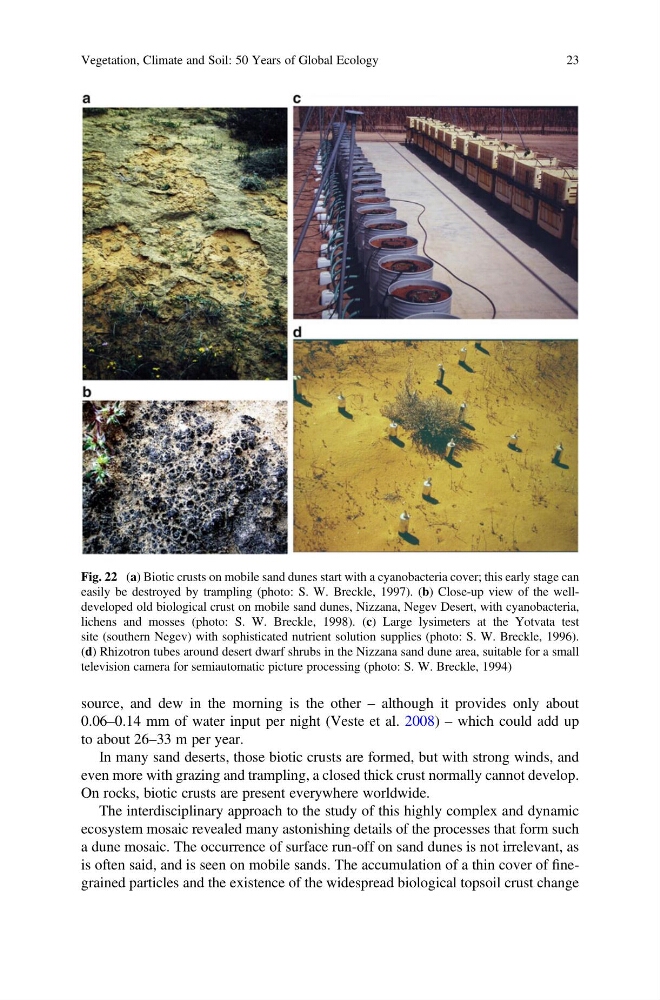
Fig. 22 (a) Biotic crusts on mobile sand dunes start with a cyanobacteria cover; this early stage can
easily be destroyed by trampling (photo: S. W. Breckle, 1997). (b) Close-up view of the welldeveloped old biological crust on mobile sand dunes, Nizzana, Negev Desert, with cyanobacteria,
lichens and mosses (photo: S. W. Breckle, 1998). (c) Large lysimeters at the Yotvata test
site (southern Negev) with sophisticated nutrient solution supplies (photo: S. W. Breckle, 1996).
(d) Rhizotron tubes around desert dwarf shrubs in the Nizzana sand dune area, suitable for a small
television camera for semiautomatic picture processing (photo: S. W. Breckle, 1994)
Vegetation, Climate and Soil: 50 Years of Global Ecology
23
0.06–0.14 mm of water input per night (Veste et al. 2008) – which could add up
to about 26–33 m per year.
In many sand deserts, those biotic crusts are formed, but with strong winds, and
even more with grazing and trampling, a closed thick crust normally cannot develop.
On rocks, biotic crusts are present everywhere worldwide.
The interdisciplinary approach to the study of this highly complex and dynamic
ecosystem mosaic revealed many astonishing details of the processes that form such
a dune mosaic. The occurrence of surface run-off on sand dunes is not irrelevant, as
is often said, and is seen on mobile sands. The accumulation of a thin cover of finegrained particles and the existence of the widespread biological topsoil crust change
Fig. 22 (a) Biotic crusts on mobile sand dunes start with a cyanobacteria cover; this early stage can
easily be destroyed by trampling (photo: S. W. Breckle, 1997). (b) Close-up view of the welldeveloped old biological crust on mobile sand dunes, Nizzana, Negev Desert, with cyanobacteria,
lichens and mosses (photo: S. W. Breckle, 1998). (c) Large lysimeters at the Yotvata test
site (southern Negev) with sophisticated nutrient solution supplies (photo: S. W. Breckle, 1996).
(d) Rhizotron tubes around desert dwarf shrubs in the Nizzana sand dune area, suitable for a small
television camera for semiautomatic picture processing (photo: S. W. Breckle, 1994)
Vegetation, Climate and Soil: 50 Years of Global Ecology
23