

Fig. 12
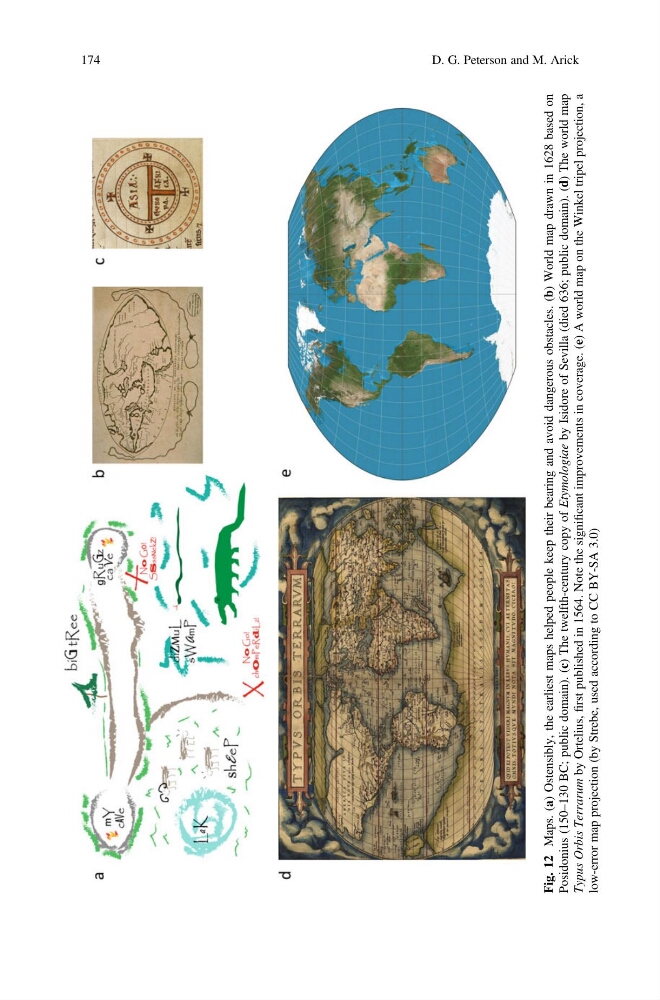
Maps. (a) Ostensibly, the earliest maps helped people keep their bearing and avoid dangerous obstacles. (b) World map drawn in 1628 based on
Posidonius (150–130 BC; public domain). (c) The twelfth-century copy of Etymologiae
by Isidore of Sevilla (died 636; public domain). (d) The world map
Typus Orbis Terrarum
by Ortelius,
first published in 1564. Note the significant improvements in coverage. (e) A world map on the Winkel tripel projection, a
low-error map projection (by Strebe, used according to CC BY-SA 3.0)
174
D. G. Peterson and M. Arick
Maps. (a) Ostensibly, the earliest maps helped people keep their bearing and avoid dangerous obstacles. (b) World map drawn in 1628 based on
Posidonius (150–130 BC; public domain). (c) The twelfth-century copy of Etymologiae
by Isidore of Sevilla (died 636; public domain). (d) The world map
Typus Orbis Terrarum
by Ortelius,
first published in 1564. Note the significant improvements in coverage. (e) A world map on the Winkel tripel projection, a
low-error map projection (by Strebe, used according to CC BY-SA 3.0)
174
D. G. Peterson and M. Arick