

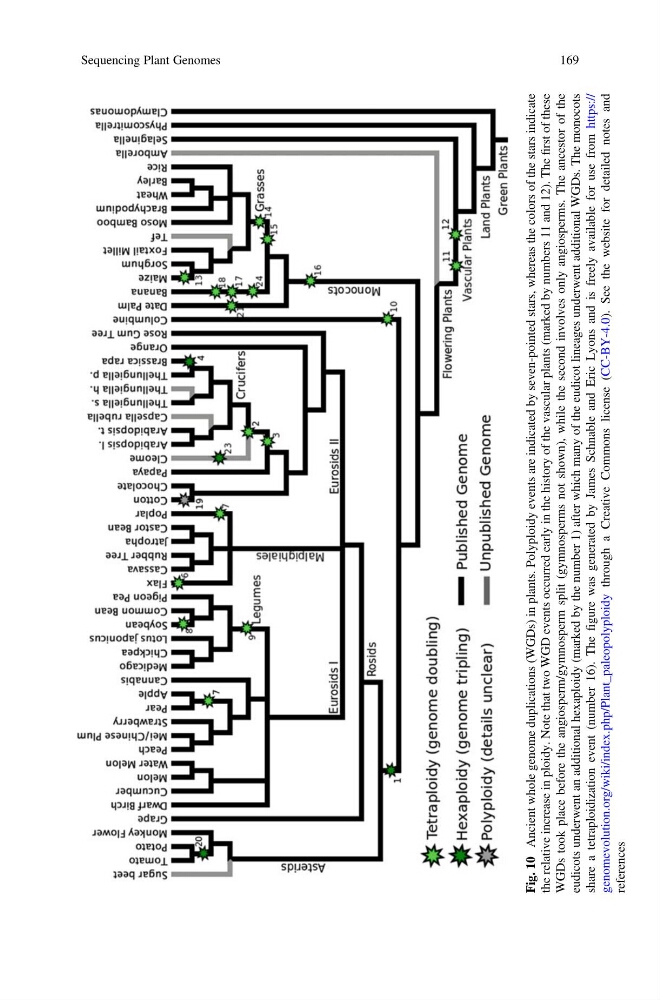
Fig. 10
Ancient whole genome duplications (WGDs) in plants. Polyploidy events are indicated by seven-pointed stars, whereas the colors of the stars indicate
the relative increase in ploidy. Note that two WGD events occurred early in the history of the vascular plants (marked by numbers 11 and 12). The
first of these
WGDs took place before the angiosperm/gymnosperm split (gymnosperms not shown), while the second involves only angiosperms. The ancestor of the
eudicots underwent an additional hexaploidy (marked by the number 1) after which many of the eudicot lineages underwent additional WGDs. The monocots
share a tetraploidization event (number 16). The
figure was generated by James Schnable and Eric Lyons and is freely available for use from https://
genomevolution.org/wiki/index.php/Plant_paleopolyploidy through a Creative Commons license (CC-BY-4.0). See the website for detailed notes and
references
Sequencing Plant Genomes
169
Ancient whole genome duplications (WGDs) in plants. Polyploidy events are indicated by seven-pointed stars, whereas the colors of the stars indicate
the relative increase in ploidy. Note that two WGD events occurred early in the history of the vascular plants (marked by numbers 11 and 12). The
first of these
WGDs took place before the angiosperm/gymnosperm split (gymnosperms not shown), while the second involves only angiosperms. The ancestor of the
eudicots underwent an additional hexaploidy (marked by the number 1) after which many of the eudicot lineages underwent additional WGDs. The monocots
share a tetraploidization event (number 16). The
figure was generated by James Schnable and Eric Lyons and is freely available for use from https://
genomevolution.org/wiki/index.php/Plant_paleopolyploidy through a Creative Commons license (CC-BY-4.0). See the website for detailed notes and
references
Sequencing Plant Genomes
169