

2.4 Techniques for Recovering DNAPL
Recovering LNAPL in pure phase (free product) is easier than recovering DNAPL.
Indeed, LNAPLs float on top of the water table, which makes it easier to localize and
clean up, despite the required skills needed to achieve the best results at the
lowest cost.
DNAPL recovery, however, is more complicated. The distribution of DNAPL
can be random depending on soil permeabilities, and related variations in the
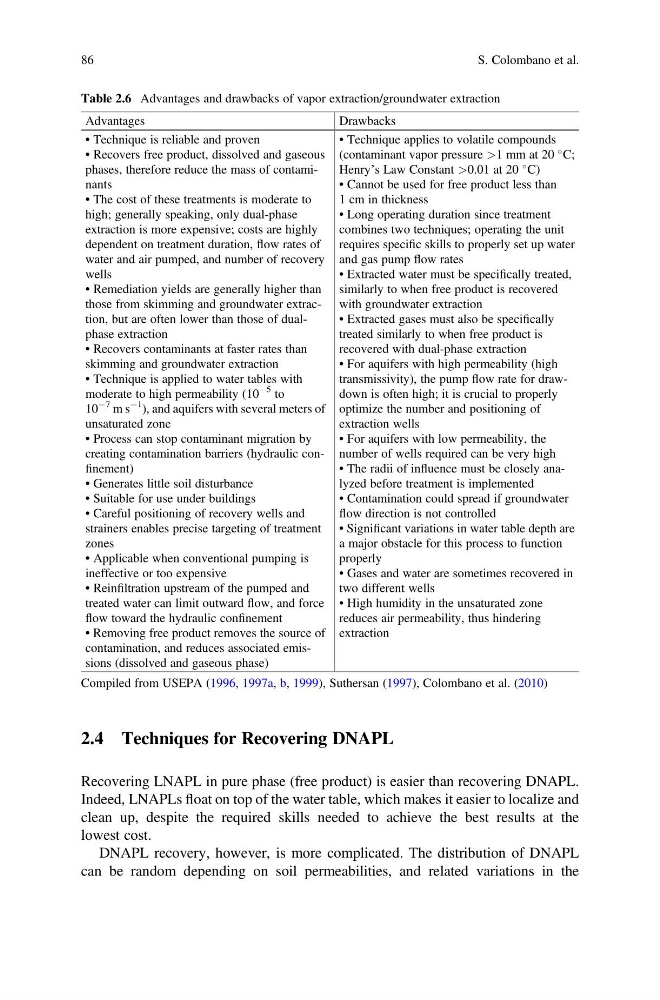
Table 2.6 Advantages and drawbacks of vapor extraction/groundwater extraction
Advantages
Drawbacks
• Technique is reliable and proven
• Recovers free product, dissolved and gaseous
phases, therefore reduce the mass of contaminants
• The cost of these treatments is moderate to
high; generally speaking, only dual-phase
extraction is more expensive; costs are highly
dependent on treatment duration, flow rates of
water and air pumped, and number of recovery
wells
• Remediation yields are generally higher than
those from skimming and groundwater extraction, but are often lower than those of dualphase extraction
• Recovers contaminants at faster rates than
skimming and groundwater extraction
• Technique is applied to water tables with
moderate to high permeability (10
À5 to
10
À7 m s
À1
), and aquifers with several meters of
unsaturated zone
• Process can stop contaminant migration by
creating contamination barriers (hydraulic confinement)
• Generates little soil disturbance
• Suitable for use under buildings
• Careful positioning of recovery wells and
strainers enables precise targeting of treatment
zones
• Applicable when conventional pumping is
ineffective or too expensive
• Reinfiltration upstream of the pumped and
treated water can limit outward flow, and force
flow toward the hydraulic confinement
• Removing free product removes the source of
contamination, and reduces associated emissions (dissolved and gaseous phase)
• Technique applies to volatile compounds
(contaminant vapor pressure >1 mm at 20
C;
Henry’s Law Constant >0.01 at 20
C)
• Cannot be used for free product less than
1 cm in thickness
• Long operating duration since treatment
combines two techniques; operating the unit
requires specific skills to properly set up water
and gas pump flow rates
• Extracted water must be specifically treated,
similarly to when free product is recovered
with groundwater extraction
• Extracted gases must also be specifically
treated similarly to when free product is
recovered with dual-phase extraction
• For aquifers with high permeability (high
transmissivity), the pump flow rate for drawdown is often high; it is crucial to properly
optimize the number and positioning of
extraction wells
• For aquifers with low permeability, the
number of wells required can be very high
• The radii of influence must be closely analyzed before treatment is implemented
• Contamination could spread if groundwater
flow direction is not controlled
• Significant variations in water table depth are
a major obstacle for this process to function
properly
• Gases and water are sometimes recovered in
two different wells
• High humidity in the unsaturated zone
reduces air permeability, thus hindering
extraction
Compiled from USEPA (1996, 1997a, b, 1999), Suthersan (1997), Colombano et al. (2010)
86
S. Colombano et al.
Recovering LNAPL in pure phase (free product) is easier than recovering DNAPL.
Indeed, LNAPLs float on top of the water table, which makes it easier to localize and
clean up, despite the required skills needed to achieve the best results at the
lowest cost.
DNAPL recovery, however, is more complicated. The distribution of DNAPL
can be random depending on soil permeabilities, and related variations in the
Table 2.6 Advantages and drawbacks of vapor extraction/groundwater extraction
Advantages
Drawbacks
• Technique is reliable and proven
• Recovers free product, dissolved and gaseous
phases, therefore reduce the mass of contaminants
• The cost of these treatments is moderate to
high; generally speaking, only dual-phase
extraction is more expensive; costs are highly
dependent on treatment duration, flow rates of
water and air pumped, and number of recovery
wells
• Remediation yields are generally higher than
those from skimming and groundwater extraction, but are often lower than those of dualphase extraction
• Recovers contaminants at faster rates than
skimming and groundwater extraction
• Technique is applied to water tables with
moderate to high permeability (10
À5 to
10
À7 m s
À1
), and aquifers with several meters of
unsaturated zone
• Process can stop contaminant migration by
creating contamination barriers (hydraulic confinement)
• Generates little soil disturbance
• Suitable for use under buildings
• Careful positioning of recovery wells and
strainers enables precise targeting of treatment
zones
• Applicable when conventional pumping is
ineffective or too expensive
• Reinfiltration upstream of the pumped and
treated water can limit outward flow, and force
flow toward the hydraulic confinement
• Removing free product removes the source of
contamination, and reduces associated emissions (dissolved and gaseous phase)
• Technique applies to volatile compounds
(contaminant vapor pressure >1 mm at 20
C;
Henry’s Law Constant >0.01 at 20
C)
• Cannot be used for free product less than
1 cm in thickness
• Long operating duration since treatment
combines two techniques; operating the unit
requires specific skills to properly set up water
and gas pump flow rates
• Extracted water must be specifically treated,
similarly to when free product is recovered
with groundwater extraction
• Extracted gases must also be specifically
treated similarly to when free product is
recovered with dual-phase extraction
• For aquifers with high permeability (high
transmissivity), the pump flow rate for drawdown is often high; it is crucial to properly
optimize the number and positioning of
extraction wells
• For aquifers with low permeability, the
number of wells required can be very high
• The radii of influence must be closely analyzed before treatment is implemented
• Contamination could spread if groundwater
flow direction is not controlled
• Significant variations in water table depth are
a major obstacle for this process to function
properly
• Gases and water are sometimes recovered in
two different wells
• High humidity in the unsaturated zone
reduces air permeability, thus hindering
extraction
Compiled from USEPA (1996, 1997a, b, 1999), Suthersan (1997), Colombano et al. (2010)
86
S. Colombano et al.