

2.3.4 Dual-Phase Extraction
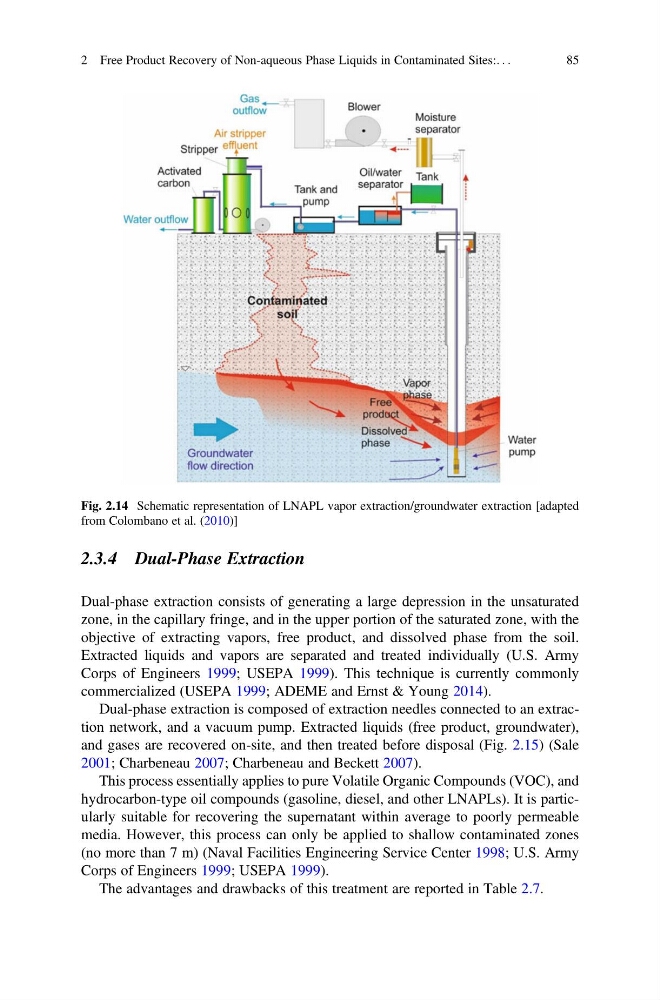
Dual-phase extraction consists of generating a large depression in the unsaturated
zone, in the capillary fringe, and in the upper portion of the saturated zone, with the
objective of extracting vapors, free product, and dissolved phase from the soil.
Extracted liquids and vapors are separated and treated individually (U.S. Army
Corps of Engineers 1999; USEPA 1999). This technique is currently commonly
commercialized (USEPA 1999; ADEME and Ernst & Young 2014).
Dual-phase extraction is composed of extraction needles connected to an extraction network, and a vacuum pump. Extracted liquids (free product, groundwater),
and gases are recovered on-site, and then treated before disposal (Fig. 2.15) (Sale
2001; Charbeneau 2007; Charbeneau and Beckett 2007).
This process essentially applies to pure Volatile Organic Compounds (VOC), and
hydrocarbon-type oil compounds (gasoline, diesel, and other LNAPLs). It is particularly suitable for recovering the supernatant within average to poorly permeable
media. However, this process can only be applied to shallow contaminated zones
(no more than 7 m) (Naval Facilities Engineering Service Center 1998; U.S. Army
Corps of Engineers 1999; USEPA 1999).
The advantages and drawbacks of this treatment are reported in Table 2.7.
Fig. 2.14 Schematic representation of LNAPL vapor extraction/groundwater extraction [adapted
from Colombano et al. (2010)]
2 Free Product Recovery of Non-aqueous Phase Liquids in Contaminated Sites:. . .
85
Dual-phase extraction consists of generating a large depression in the unsaturated
zone, in the capillary fringe, and in the upper portion of the saturated zone, with the
objective of extracting vapors, free product, and dissolved phase from the soil.
Extracted liquids and vapors are separated and treated individually (U.S. Army
Corps of Engineers 1999; USEPA 1999). This technique is currently commonly
commercialized (USEPA 1999; ADEME and Ernst & Young 2014).
Dual-phase extraction is composed of extraction needles connected to an extraction network, and a vacuum pump. Extracted liquids (free product, groundwater),
and gases are recovered on-site, and then treated before disposal (Fig. 2.15) (Sale
2001; Charbeneau 2007; Charbeneau and Beckett 2007).
This process essentially applies to pure Volatile Organic Compounds (VOC), and
hydrocarbon-type oil compounds (gasoline, diesel, and other LNAPLs). It is particularly suitable for recovering the supernatant within average to poorly permeable
media. However, this process can only be applied to shallow contaminated zones
(no more than 7 m) (Naval Facilities Engineering Service Center 1998; U.S. Army
Corps of Engineers 1999; USEPA 1999).
The advantages and drawbacks of this treatment are reported in Table 2.7.
Fig. 2.14 Schematic representation of LNAPL vapor extraction/groundwater extraction [adapted
from Colombano et al. (2010)]
2 Free Product Recovery of Non-aqueous Phase Liquids in Contaminated Sites:. . .
85