

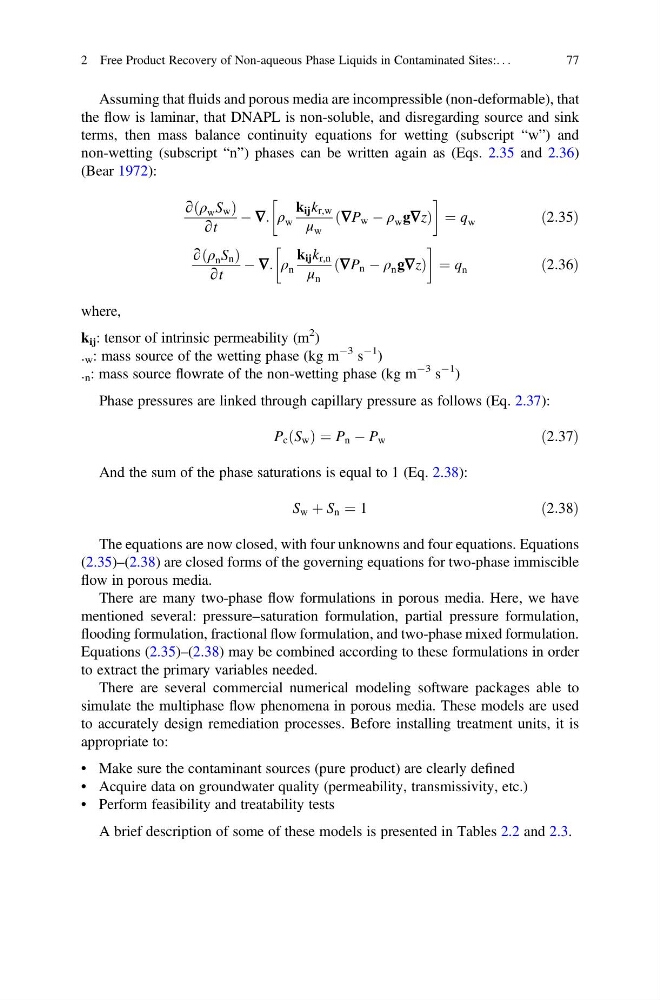
Assuming that fluids and porous media are incompressible (non-deformable), that
the flow is laminar, that DNAPL is non-soluble, and disregarding source and sink
terms, then mass balance continuity equations for wetting (subscript “w”) and
non-wetting (subscript “n”) phases can be written again as (Eqs. 2.35 and 2.36)
(Bear 1972):
∂ ρ w S w
ð
Þ
∂t
À —: ρ w
k ij k r,w
μ w
—P w À ρ w g—z
ð
Þ
!
¼ q w
ð2:35Þ
∂ ρ n S n
ð
Þ
∂t
À —: ρ n
k ij k r,n
μ n
—P n À ρ n g—z
ð
Þ
!
¼ q n
ð2:36Þ
where,
k ij : tensor of intrinsic permeability (m
2 )
. w : mass source of the wetting phase (kg m
À3 s
À1 )
. n : mass source flowrate of the non-wetting phase (kg m
À3 s
À1
)
Phase pressures are linked through capillary pressure as follows (Eq. 2.37):
P c S w
ð Þ ¼ P n À P w
ð2:37Þ
And the sum of the phase saturations is equal to 1 (Eq. 2.38):
S w þ S n ¼ 1
ð2:38Þ
The equations are now closed, with four unknowns and four equations. Equations
(2.35)–(2.38) are closed forms of the governing equations for two-phase immiscible
flow in porous media.
There are many two-phase flow formulations in porous media. Here, we have
mentioned several: pressure–saturation formulation, partial pressure formulation,
flooding formulation, fractional flow formulation, and two-phase mixed formulation.
Equations (2.35)–(2.38) may be combined according to these formulations in order
to extract the primary variables needed.
There are several commercial numerical modeling software packages able to
simulate the multiphase flow phenomena in porous media. These models are used
to accurately design remediation processes. Before installing treatment units, it is
appropriate to:
• Make sure the contaminant sources (pure product) are clearly defined
• Acquire data on groundwater quality (permeability, transmissivity, etc.)
• Perform feasibility and treatability tests
A brief description of some of these models is presented in Tables 2.2 and 2.3.
2 Free Product Recovery of Non-aqueous Phase Liquids in Contaminated Sites:. . .
77
the flow is laminar, that DNAPL is non-soluble, and disregarding source and sink
terms, then mass balance continuity equations for wetting (subscript “w”) and
non-wetting (subscript “n”) phases can be written again as (Eqs. 2.35 and 2.36)
(Bear 1972):
∂ ρ w S w
ð
Þ
∂t
À —: ρ w
k ij k r,w
μ w
—P w À ρ w g—z
ð
Þ
!
¼ q w
ð2:35Þ
∂ ρ n S n
ð
Þ
∂t
À —: ρ n
k ij k r,n
μ n
—P n À ρ n g—z
ð
Þ
!
¼ q n
ð2:36Þ
where,
k ij : tensor of intrinsic permeability (m
2 )
. w : mass source of the wetting phase (kg m
À3 s
À1 )
. n : mass source flowrate of the non-wetting phase (kg m
À3 s
À1
)
Phase pressures are linked through capillary pressure as follows (Eq. 2.37):
P c S w
ð Þ ¼ P n À P w
ð2:37Þ
And the sum of the phase saturations is equal to 1 (Eq. 2.38):
S w þ S n ¼ 1
ð2:38Þ
The equations are now closed, with four unknowns and four equations. Equations
(2.35)–(2.38) are closed forms of the governing equations for two-phase immiscible
flow in porous media.
There are many two-phase flow formulations in porous media. Here, we have
mentioned several: pressure–saturation formulation, partial pressure formulation,
flooding formulation, fractional flow formulation, and two-phase mixed formulation.
Equations (2.35)–(2.38) may be combined according to these formulations in order
to extract the primary variables needed.
There are several commercial numerical modeling software packages able to
simulate the multiphase flow phenomena in porous media. These models are used
to accurately design remediation processes. Before installing treatment units, it is
appropriate to:
• Make sure the contaminant sources (pure product) are clearly defined
• Acquire data on groundwater quality (permeability, transmissivity, etc.)
• Perform feasibility and treatability tests
A brief description of some of these models is presented in Tables 2.2 and 2.3.
2 Free Product Recovery of Non-aqueous Phase Liquids in Contaminated Sites:. . .
77