

J
α
k,x : diffusive flux of component . from α phase in the . direction (kg m
À2 s
À1 )
I
α
k : transfer of component . by phase change and diffusion throughout the α phase
boundaries (kg m
À3 s
À1 )
E
α
k : source of . to the α phase over biotic and abiotic transformations (kg m
À3 s
À1 )
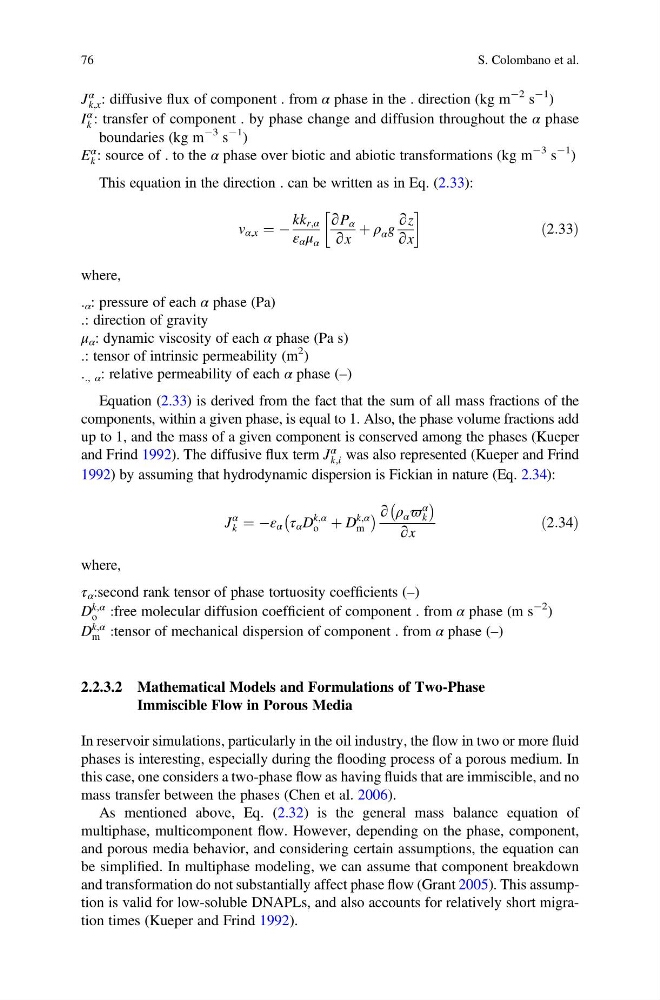
This equation in the direction . can be written as in Eq. (2.33):
v α,x ¼ À
kk r,α
ε α μ α
∂P α
∂x
þ ρ α g
∂z
∂x
!
ð2:33Þ
where,
. α : pressure of each α phase (Pa)
.: direction of gravity
μ α : dynamic viscosity of each α phase (Pa s)
.: tensor of intrinsic permeability (m
2 )
. ., α : relative permeability of each α phase (–)
Equation (2.33) is derived from the fact that the sum of all mass fractions of the
components, within a given phase, is equal to 1. Also, the phase volume fractions add
up to 1, and the mass of a given component is conserved among the phases (Kueper
and Frind 1992). The diffusive flux term J
α
k,i was also represented (Kueper and Frind
1992) by assuming that hydrodynamic dispersion is Fickian in nature (Eq. 2.34):
J
α
k ¼ Àε α τ α D
k,α
o þ D
k,α
m
À
Á ∂ ρ α ϖ
α
k
À
Á
∂x
ð2:34Þ
where,
τ α :second rank tensor of phase tortuosity coefficients (–)
D
k,α
o :free molecular diffusion coefficient of component . from α phase (m s
À2 )
D
k,α
m :tensor of mechanical dispersion of component . from α phase (–)
2.2.3.2 Mathematical Models and Formulations of Two-Phase
Immiscible Flow in Porous Media
In reservoir simulations, particularly in the oil industry, the flow in two or more fluid
phases is interesting, especially during the flooding process of a porous medium. In
this case, one considers a two-phase flow as having fluids that are immiscible, and no
mass transfer between the phases (Chen et al. 2006).
As mentioned above, Eq. (2.32) is the general mass balance equation of
multiphase, multicomponent flow. However, depending on the phase, component,
and porous media behavior, and considering certain assumptions, the equation can
be simplified. In multiphase modeling, we can assume that component breakdown
and transformation do not substantially affect phase flow (Grant 2005). This assumption is valid for low-soluble DNAPLs, and also accounts for relatively short migration times (Kueper and Frind 1992).
76
S. Colombano et al.
α
k,x : diffusive flux of component . from α phase in the . direction (kg m
À2 s
À1 )
I
α
k : transfer of component . by phase change and diffusion throughout the α phase
boundaries (kg m
À3 s
À1 )
E
α
k : source of . to the α phase over biotic and abiotic transformations (kg m
À3 s
À1 )
This equation in the direction . can be written as in Eq. (2.33):
v α,x ¼ À
kk r,α
ε α μ α
∂P α
∂x
þ ρ α g
∂z
∂x
!
ð2:33Þ
where,
. α : pressure of each α phase (Pa)
.: direction of gravity
μ α : dynamic viscosity of each α phase (Pa s)
.: tensor of intrinsic permeability (m
2 )
. ., α : relative permeability of each α phase (–)
Equation (2.33) is derived from the fact that the sum of all mass fractions of the
components, within a given phase, is equal to 1. Also, the phase volume fractions add
up to 1, and the mass of a given component is conserved among the phases (Kueper
and Frind 1992). The diffusive flux term J
α
k,i was also represented (Kueper and Frind
1992) by assuming that hydrodynamic dispersion is Fickian in nature (Eq. 2.34):
J
α
k ¼ Àε α τ α D
k,α
o þ D
k,α
m
À
Á ∂ ρ α ϖ
α
k
À
Á
∂x
ð2:34Þ
where,
τ α :second rank tensor of phase tortuosity coefficients (–)
D
k,α
o :free molecular diffusion coefficient of component . from α phase (m s
À2 )
D
k,α
m :tensor of mechanical dispersion of component . from α phase (–)
2.2.3.2 Mathematical Models and Formulations of Two-Phase
Immiscible Flow in Porous Media
In reservoir simulations, particularly in the oil industry, the flow in two or more fluid
phases is interesting, especially during the flooding process of a porous medium. In
this case, one considers a two-phase flow as having fluids that are immiscible, and no
mass transfer between the phases (Chen et al. 2006).
As mentioned above, Eq. (2.32) is the general mass balance equation of
multiphase, multicomponent flow. However, depending on the phase, component,
and porous media behavior, and considering certain assumptions, the equation can
be simplified. In multiphase modeling, we can assume that component breakdown
and transformation do not substantially affect phase flow (Grant 2005). This assumption is valid for low-soluble DNAPLs, and also accounts for relatively short migration times (Kueper and Frind 1992).
76
S. Colombano et al.