

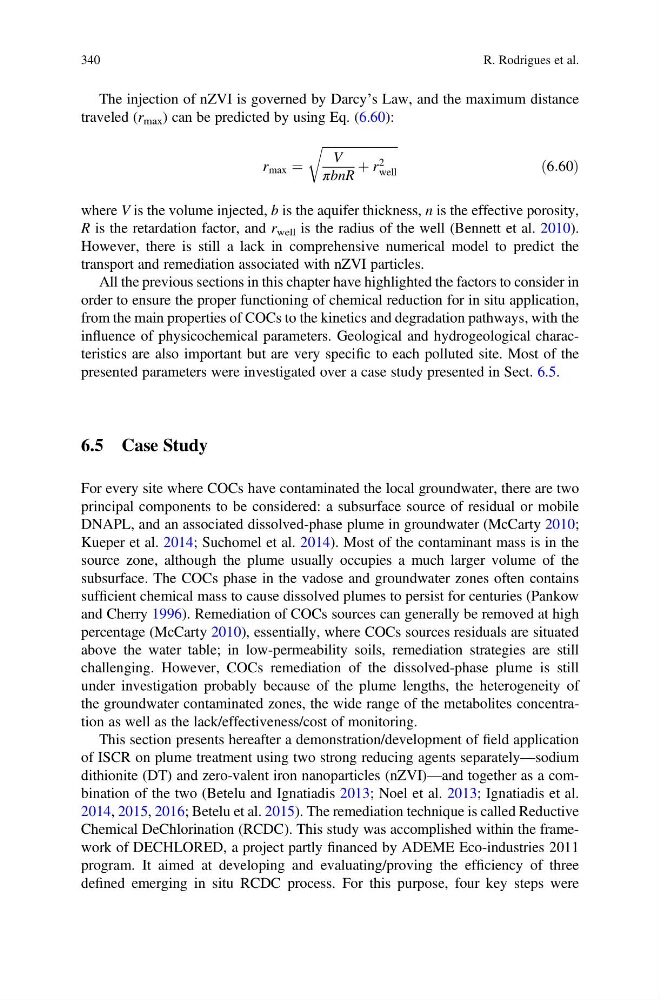
The injection of nZVI is governed by Darcy’s Law, and the maximum distance
traveled (r max ) can be predicted by using Eq. (6.60):
r max ¼
ffiffiffiffiffiffiffiffiffiffiffiffiffiffiffiffiffiffiffiffiffiffiffiffi ffi
V
πbnR
þ r 2
well
r
ð6:60Þ
where V is the volume injected, b is the aquifer thickness, n is the effective porosity,
R is the retardation factor, and r well is the radius of the well (Bennett et al. 2010).
However, there is still a lack in comprehensive numerical model to predict the
transport and remediation associated with nZVI particles.
All the previous sections in this chapter have highlighted the factors to consider in
order to ensure the proper functioning of chemical reduction for in situ application,
from the main properties of COCs to the kinetics and degradation pathways, with the
influence of physicochemical parameters. Geological and hydrogeological characteristics are also important but are very specific to each polluted site. Most of the
presented parameters were investigated over a case study presented in Sect. 6.5.
6.5 Case Study
For every site where COCs have contaminated the local groundwater, there are two
principal components to be considered: a subsurface source of residual or mobile
DNAPL, and an associated dissolved-phase plume in groundwater (McCarty 2010;
Kueper et al. 2014; Suchomel et al. 2014). Most of the contaminant mass is in the
source zone, although the plume usually occupies a much larger volume of the
subsurface. The COCs phase in the vadose and groundwater zones often contains
sufficient chemical mass to cause dissolved plumes to persist for centuries (Pankow
and Cherry 1996). Remediation of COCs sources can generally be removed at high
percentage (McCarty 2010), essentially, where COCs sources residuals are situated
above the water table; in low-permeability soils, remediation strategies are still
challenging. However, COCs remediation of the dissolved-phase plume is still
under investigation probably because of the plume lengths, the heterogeneity of
the groundwater contaminated zones, the wide range of the metabolites concentration as well as the lack/effectiveness/cost of monitoring.
This section presents hereafter a demonstration/development of field application
of ISCR on plume treatment using two strong reducing agents separately—sodium
dithionite (DT) and zero-valent iron nanoparticles (nZVI)—and together as a combination of the two (Betelu and Ignatiadis 2013; Noel et al. 2013; Ignatiadis et al.
2014, 2015, 2016; Betelu et al. 2015). The remediation technique is called Reductive
Chemical DeChlorination (RCDC). This study was accomplished within the framework of DECHLORED, a project partly financed by ADEME Eco-industries 2011
program. It aimed at developing and evaluating/proving the efficiency of three
defined emerging in situ RCDC process. For this purpose, four key steps were
340
R. Rodrigues et al.
traveled (r max ) can be predicted by using Eq. (6.60):
r max ¼
ffiffiffiffiffiffiffiffiffiffiffiffiffiffiffiffiffiffiffiffiffiffiffiffi ffi
V
πbnR
þ r 2
well
r
ð6:60Þ
where V is the volume injected, b is the aquifer thickness, n is the effective porosity,
R is the retardation factor, and r well is the radius of the well (Bennett et al. 2010).
However, there is still a lack in comprehensive numerical model to predict the
transport and remediation associated with nZVI particles.
All the previous sections in this chapter have highlighted the factors to consider in
order to ensure the proper functioning of chemical reduction for in situ application,
from the main properties of COCs to the kinetics and degradation pathways, with the
influence of physicochemical parameters. Geological and hydrogeological characteristics are also important but are very specific to each polluted site. Most of the
presented parameters were investigated over a case study presented in Sect. 6.5.
6.5 Case Study
For every site where COCs have contaminated the local groundwater, there are two
principal components to be considered: a subsurface source of residual or mobile
DNAPL, and an associated dissolved-phase plume in groundwater (McCarty 2010;
Kueper et al. 2014; Suchomel et al. 2014). Most of the contaminant mass is in the
source zone, although the plume usually occupies a much larger volume of the
subsurface. The COCs phase in the vadose and groundwater zones often contains
sufficient chemical mass to cause dissolved plumes to persist for centuries (Pankow
and Cherry 1996). Remediation of COCs sources can generally be removed at high
percentage (McCarty 2010), essentially, where COCs sources residuals are situated
above the water table; in low-permeability soils, remediation strategies are still
challenging. However, COCs remediation of the dissolved-phase plume is still
under investigation probably because of the plume lengths, the heterogeneity of
the groundwater contaminated zones, the wide range of the metabolites concentration as well as the lack/effectiveness/cost of monitoring.
This section presents hereafter a demonstration/development of field application
of ISCR on plume treatment using two strong reducing agents separately—sodium
dithionite (DT) and zero-valent iron nanoparticles (nZVI)—and together as a combination of the two (Betelu and Ignatiadis 2013; Noel et al. 2013; Ignatiadis et al.
2014, 2015, 2016; Betelu et al. 2015). The remediation technique is called Reductive
Chemical DeChlorination (RCDC). This study was accomplished within the framework of DECHLORED, a project partly financed by ADEME Eco-industries 2011
program. It aimed at developing and evaluating/proving the efficiency of three
defined emerging in situ RCDC process. For this purpose, four key steps were
340
R. Rodrigues et al.