

6.4.3 Injection of Particular Solids
Zero-valent iron particles are primarily injected using aqueous suspensions, under
gravity feed or pressurized conditions (e.g., direct push, controlled-pressure delivery). Generally, the particle concentration in the slurry ranged from 1 to 30 g L
À1
(Mueller et al. 2012). However, injection of nZVI particles can be problematic.
Indeed, particles may agglomerate, settle on the solid matrix, and create clogging
(Phenrat et al. 2007, 2010). Therefore, iron transport distances are relatively small, a
few meters at most (Bennett et al. 2010; Johnson et al. 2013). To increase these
distances, vectorization of nZVI particles can be promoted by coated polymers
(Phenrat et al. 2008, 2009a; Kaifas 2014), and delivery of nonaqueous phase liquids,
emulsion, and foam (Wang and Mulligan 2004; Quinn et al. 2005; Berge and
Ramsburg 2009; Shen et al. 2011). The main difficulty concerning the use of iron
particles is related to the creation of a homogeneous reactive zone. Generally, the
design of a pilot test delivery is the result of a compromise among several needs,
especially the reactivity, the slurring viscosity, the discharge rate, and the monitoring
setup (Luna et al. 2015).
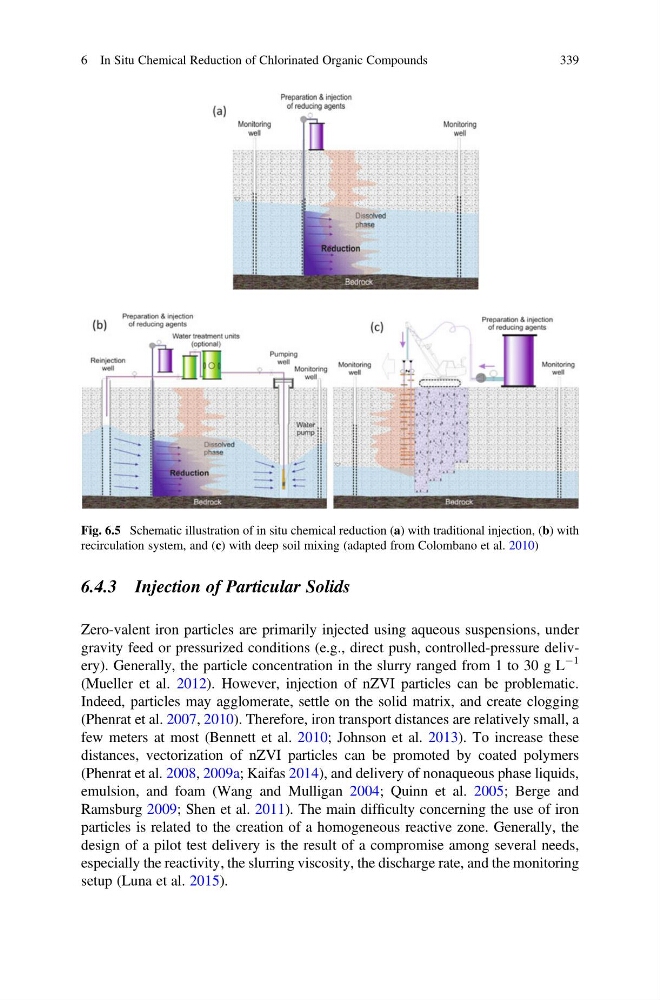
Fig. 6.5 Schematic illustration of in situ chemical reduction (a) with traditional injection, (b) with
recirculation system, and (c) with deep soil mixing (adapted from Colombano et al. 2010)
6 In Situ Chemical Reduction of Chlorinated Organic Compounds
339
Zero-valent iron particles are primarily injected using aqueous suspensions, under
gravity feed or pressurized conditions (e.g., direct push, controlled-pressure delivery). Generally, the particle concentration in the slurry ranged from 1 to 30 g L
À1
(Mueller et al. 2012). However, injection of nZVI particles can be problematic.
Indeed, particles may agglomerate, settle on the solid matrix, and create clogging
(Phenrat et al. 2007, 2010). Therefore, iron transport distances are relatively small, a
few meters at most (Bennett et al. 2010; Johnson et al. 2013). To increase these
distances, vectorization of nZVI particles can be promoted by coated polymers
(Phenrat et al. 2008, 2009a; Kaifas 2014), and delivery of nonaqueous phase liquids,
emulsion, and foam (Wang and Mulligan 2004; Quinn et al. 2005; Berge and
Ramsburg 2009; Shen et al. 2011). The main difficulty concerning the use of iron
particles is related to the creation of a homogeneous reactive zone. Generally, the
design of a pilot test delivery is the result of a compromise among several needs,
especially the reactivity, the slurring viscosity, the discharge rate, and the monitoring
setup (Luna et al. 2015).
Fig. 6.5 Schematic illustration of in situ chemical reduction (a) with traditional injection, (b) with
recirculation system, and (c) with deep soil mixing (adapted from Colombano et al. 2010)
6 In Situ Chemical Reduction of Chlorinated Organic Compounds
339