

Depending on the standard potential of metal cations relative to iron, different
observations on the reactivity of ZVI particles have been reported, such as diffusion,
encapsulation, sorption, and/or reduction at iron surface (Li and Zhang 2007; Ling
et al. 2017). Sorption and formation of surface-complex occur for metal cations with
a close or more negative standard potential than that of iron, such as Ba
2+ , Cd
2+ , Cs
+
,
or Zn
2+ , whereas adsorption and reduction occur for metal cations with a higher
potential, such as Ag
+ , Ni
2+ , Cu
2+ , or Hg
2+ . For metal cations with a slightly more
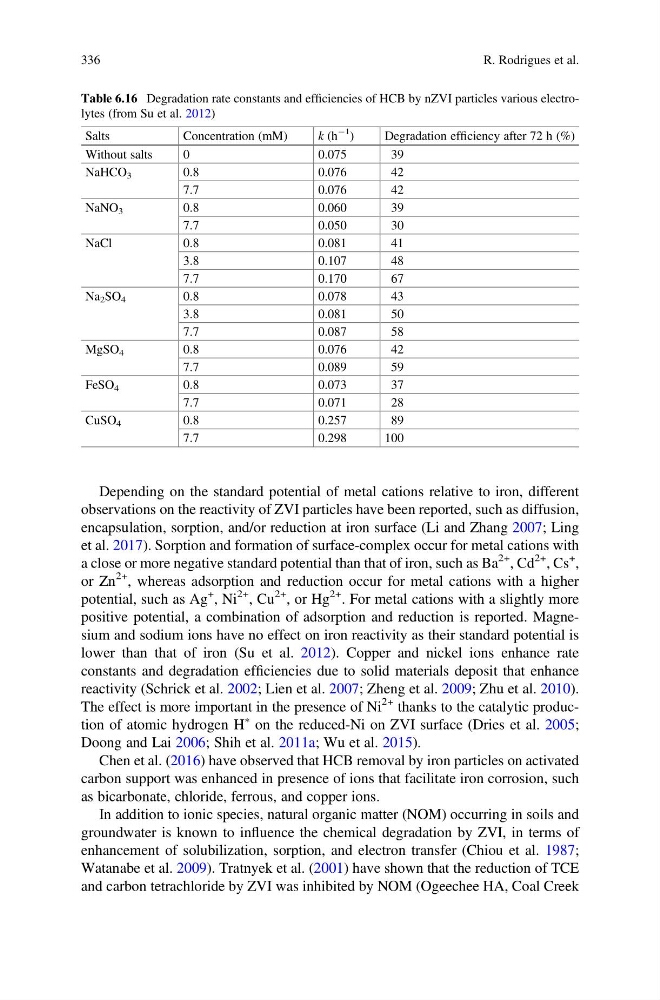
positive potential, a combination of adsorption and reduction is reported. Magnesium and sodium ions have no effect on iron reactivity as their standard potential is
lower than that of iron (Su et al. 2012). Copper and nickel ions enhance rate
constants and degradation efficiencies due to solid materials deposit that enhance
reactivity (Schrick et al. 2002; Lien et al. 2007; Zheng et al. 2009; Zhu et al. 2010).
The effect is more important in the presence of Ni
2+ thanks to the catalytic production of atomic hydrogen H
à on the reduced-Ni on ZVI surface (Dries et al. 2005;
Doong and Lai 2006; Shih et al. 2011a; Wu et al. 2015).
Chen et al. (2016) have observed that HCB removal by iron particles on activated
carbon support was enhanced in presence of ions that facilitate iron corrosion, such
as bicarbonate, chloride, ferrous, and copper ions.
In addition to ionic species, natural organic matter (NOM) occurring in soils and
groundwater is known to influence the chemical degradation by ZVI, in terms of
enhancement of solubilization, sorption, and electron transfer (Chiou et al. 1987;
Watanabe et al. 2009). Tratnyek et al. (2001) have shown that the reduction of TCE
and carbon tetrachloride by ZVI was inhibited by NOM (Ogeechee HA, Coal Creek
Table 6.16 Degradation rate constants and efficiencies of HCB by nZVI particles various electrolytes (from Su et al. 2012)
Salts
Concentration (mM)
k (h
À1
)
Degradation efficiency after 72 h (%)
Without salts
0
0.075
39
NaHCO 3
0.8
0.076
42
7.7
0.076
42
NaNO 3
0.8
0.060
39
7.7
0.050
30
NaCl
0.8
0.081
41
3.8
0.107
48
7.7
0.170
67
Na 2 SO 4
0.8
0.078
43
3.8
0.081
50
7.7
0.087
58
MgSO 4
0.8
0.076
42
7.7
0.089
59
FeSO 4
0.8
0.073
37
7.7
0.071
28
CuSO 4
0.8
0.257
89
7.7
0.298
100
336
R. Rodrigues et al.
observations on the reactivity of ZVI particles have been reported, such as diffusion,
encapsulation, sorption, and/or reduction at iron surface (Li and Zhang 2007; Ling
et al. 2017). Sorption and formation of surface-complex occur for metal cations with
a close or more negative standard potential than that of iron, such as Ba
2+ , Cd
2+ , Cs
+
,
or Zn
2+ , whereas adsorption and reduction occur for metal cations with a higher
potential, such as Ag
+ , Ni
2+ , Cu
2+ , or Hg
2+ . For metal cations with a slightly more
positive potential, a combination of adsorption and reduction is reported. Magnesium and sodium ions have no effect on iron reactivity as their standard potential is
lower than that of iron (Su et al. 2012). Copper and nickel ions enhance rate
constants and degradation efficiencies due to solid materials deposit that enhance
reactivity (Schrick et al. 2002; Lien et al. 2007; Zheng et al. 2009; Zhu et al. 2010).
The effect is more important in the presence of Ni
2+ thanks to the catalytic production of atomic hydrogen H
à on the reduced-Ni on ZVI surface (Dries et al. 2005;
Doong and Lai 2006; Shih et al. 2011a; Wu et al. 2015).
Chen et al. (2016) have observed that HCB removal by iron particles on activated
carbon support was enhanced in presence of ions that facilitate iron corrosion, such
as bicarbonate, chloride, ferrous, and copper ions.
In addition to ionic species, natural organic matter (NOM) occurring in soils and
groundwater is known to influence the chemical degradation by ZVI, in terms of
enhancement of solubilization, sorption, and electron transfer (Chiou et al. 1987;
Watanabe et al. 2009). Tratnyek et al. (2001) have shown that the reduction of TCE
and carbon tetrachloride by ZVI was inhibited by NOM (Ogeechee HA, Coal Creek
Table 6.16 Degradation rate constants and efficiencies of HCB by nZVI particles various electrolytes (from Su et al. 2012)
Salts
Concentration (mM)
k (h
À1
)
Degradation efficiency after 72 h (%)
Without salts
0
0.075
39
NaHCO 3
0.8
0.076
42
7.7
0.076
42
NaNO 3
0.8
0.060
39
7.7
0.050
30
NaCl
0.8
0.081
41
3.8
0.107
48
7.7
0.170
67
Na 2 SO 4
0.8
0.078
43
3.8
0.081
50
7.7
0.087
58
MgSO 4
0.8
0.076
42
7.7
0.089
59
FeSO 4
0.8
0.073
37
7.7
0.071
28
CuSO 4
0.8
0.257
89
7.7
0.298
100
336
R. Rodrigues et al.