

6.3.5.4 Medium Composition
The presence of ionic species affects the ionic strength of a solution, as well as the
various interactions. Oleszek-Kudlak et al. (2004) have studied the influence of
sodium chloride NaCl, potassium chloride KCl, and calcium chloride CaCl 2 on
HCB aqueous solubility at 25
C, and observed a decrease in solubility with salt
addition. This phenomenon is known as the salting-out effect and depends on the
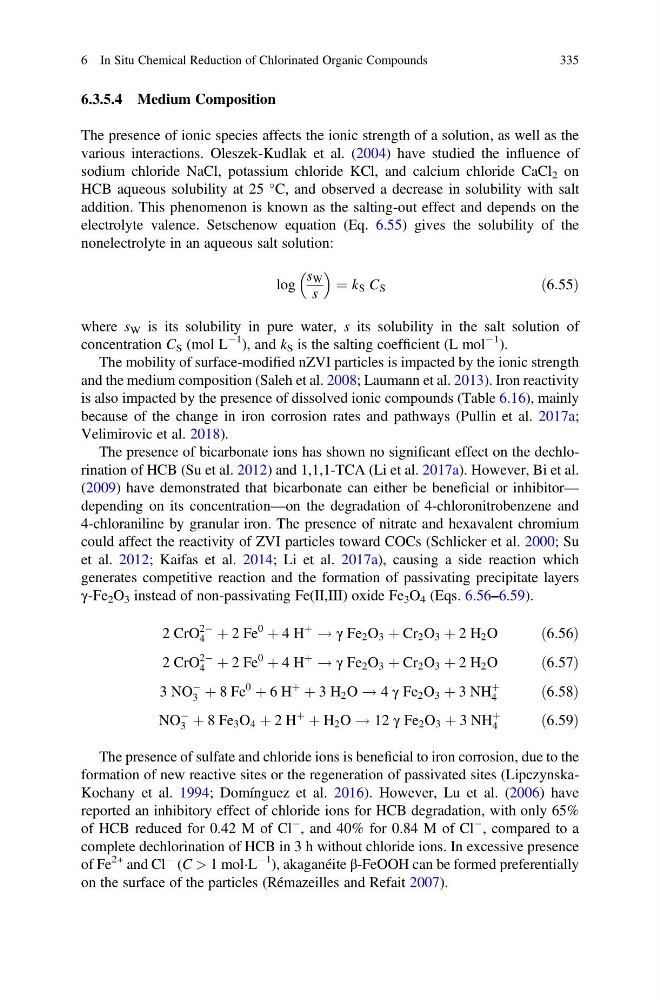
electrolyte valence. Setschenow equation (Eq. 6.55) gives the solubility of the
nonelectrolyte in an aqueous salt solution:
log
s W
s
¼ k S C S
ð6:55Þ
where s W is its solubility in pure water, s its solubility in the salt solution of
concentration C S (mol L
À1 ), and k S is the salting coefficient (L mol
À1 ).
The mobility of surface-modified nZVI particles is impacted by the ionic strength
and the medium composition (Saleh et al. 2008; Laumann et al. 2013). Iron reactivity
is also impacted by the presence of dissolved ionic compounds (Table 6.16), mainly
because of the change in iron corrosion rates and pathways (Pullin et al. 2017a;
Velimirovic et al. 2018).
The presence of bicarbonate ions has shown no significant effect on the dechlorination of HCB (Su et al. 2012) and 1,1,1-TCA (Li et al. 2017a). However, Bi et al.
(2009) have demonstrated that bicarbonate can either be beneficial or inhibitor—
depending on its concentration—on the degradation of 4-chloronitrobenzene and
4-chloraniline by granular iron. The presence of nitrate and hexavalent chromium
could affect the reactivity of ZVI particles toward COCs (Schlicker et al. 2000; Su
et al. 2012; Kaifas et al. 2014; Li et al. 2017a), causing a side reaction which
generates competitive reaction and the formation of passivating precipitate layers
γ-Fe 2 O 3 instead of non-passivating Fe(II,III) oxide Fe 3 O 4 (Eqs. 6.56–6.59).
2 CrO
2À
4 þ 2 Fe
0
þ 4 H
þ
! γ Fe 2 O 3 þ Cr 2 O 3 þ 2 H 2 O
ð6:56Þ
2 CrO
2À
4 þ 2 Fe
0
þ 4 H
þ
! γ Fe 2 O 3 þ Cr 2 O 3 þ 2 H 2 O
ð6:57Þ
3 NO
À
3 þ 8 Fe
0
þ 6 H
þ
þ 3 H 2 O ! 4 γ Fe 2 O 3 þ 3 NH
þ
4
ð6:58Þ
NO
À
3 þ 8 Fe 3 O 4 þ 2 H
þ
þ H 2 O ! 12 γ Fe 2 O 3 þ 3 NH
þ
4
ð6:59Þ
The presence of sulfate and chloride ions is beneficial to iron corrosion, due to the
formation of new reactive sites or the regeneration of passivated sites (LipczynskaKochany et al. 1994; Domínguez et al. 2016). However, Lu et al. (2006) have
reported an inhibitory effect of chloride ions for HCB degradation, with only 65%
of HCB reduced for 0.42 M of Cl
À , and 40% for 0.84 M of Cl
À , compared to a
complete dechlorination of HCB in 3 h without chloride ions. In excessive presence
of Fe
2+ and Cl
À (C > 1 molÁL
À1 ), akaganéite β-FeOOH can be formed preferentially
on the surface of the particles (Rémazeilles and Refait 2007).
6 In Situ Chemical Reduction of Chlorinated Organic Compounds
335
The presence of ionic species affects the ionic strength of a solution, as well as the
various interactions. Oleszek-Kudlak et al. (2004) have studied the influence of
sodium chloride NaCl, potassium chloride KCl, and calcium chloride CaCl 2 on
HCB aqueous solubility at 25
C, and observed a decrease in solubility with salt
addition. This phenomenon is known as the salting-out effect and depends on the
electrolyte valence. Setschenow equation (Eq. 6.55) gives the solubility of the
nonelectrolyte in an aqueous salt solution:
log
s W
s
¼ k S C S
ð6:55Þ
where s W is its solubility in pure water, s its solubility in the salt solution of
concentration C S (mol L
À1 ), and k S is the salting coefficient (L mol
À1 ).
The mobility of surface-modified nZVI particles is impacted by the ionic strength
and the medium composition (Saleh et al. 2008; Laumann et al. 2013). Iron reactivity
is also impacted by the presence of dissolved ionic compounds (Table 6.16), mainly
because of the change in iron corrosion rates and pathways (Pullin et al. 2017a;
Velimirovic et al. 2018).
The presence of bicarbonate ions has shown no significant effect on the dechlorination of HCB (Su et al. 2012) and 1,1,1-TCA (Li et al. 2017a). However, Bi et al.
(2009) have demonstrated that bicarbonate can either be beneficial or inhibitor—
depending on its concentration—on the degradation of 4-chloronitrobenzene and
4-chloraniline by granular iron. The presence of nitrate and hexavalent chromium
could affect the reactivity of ZVI particles toward COCs (Schlicker et al. 2000; Su
et al. 2012; Kaifas et al. 2014; Li et al. 2017a), causing a side reaction which
generates competitive reaction and the formation of passivating precipitate layers
γ-Fe 2 O 3 instead of non-passivating Fe(II,III) oxide Fe 3 O 4 (Eqs. 6.56–6.59).
2 CrO
2À
4 þ 2 Fe
0
þ 4 H
þ
! γ Fe 2 O 3 þ Cr 2 O 3 þ 2 H 2 O
ð6:56Þ
2 CrO
2À
4 þ 2 Fe
0
þ 4 H
þ
! γ Fe 2 O 3 þ Cr 2 O 3 þ 2 H 2 O
ð6:57Þ
3 NO
À
3 þ 8 Fe
0
þ 6 H
þ
þ 3 H 2 O ! 4 γ Fe 2 O 3 þ 3 NH
þ
4
ð6:58Þ
NO
À
3 þ 8 Fe 3 O 4 þ 2 H
þ
þ H 2 O ! 12 γ Fe 2 O 3 þ 3 NH
þ
4
ð6:59Þ
The presence of sulfate and chloride ions is beneficial to iron corrosion, due to the
formation of new reactive sites or the regeneration of passivated sites (LipczynskaKochany et al. 1994; Domínguez et al. 2016). However, Lu et al. (2006) have
reported an inhibitory effect of chloride ions for HCB degradation, with only 65%
of HCB reduced for 0.42 M of Cl
À , and 40% for 0.84 M of Cl
À , compared to a
complete dechlorination of HCB in 3 h without chloride ions. In excessive presence
of Fe
2+ and Cl
À (C > 1 molÁL
À1 ), akaganéite β-FeOOH can be formed preferentially
on the surface of the particles (Rémazeilles and Refait 2007).
6 In Situ Chemical Reduction of Chlorinated Organic Compounds
335