

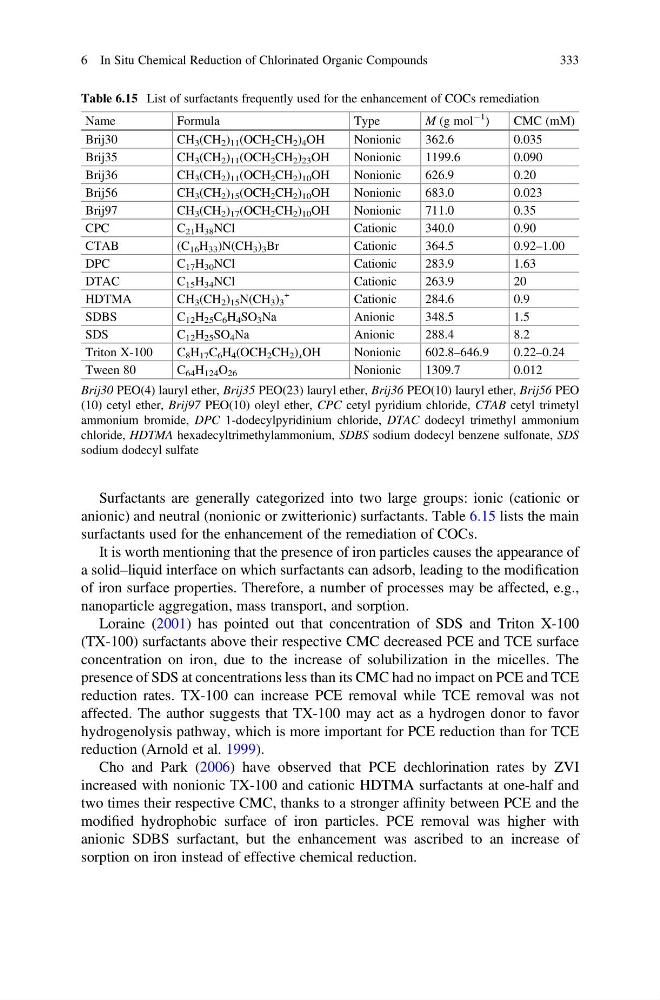
Surfactants are generally categorized into two large groups: ionic (cationic or
anionic) and neutral (nonionic or zwitterionic) surfactants. Table 6.15 lists the main
surfactants used for the enhancement of the remediation of COCs.
It is worth mentioning that the presence of iron particles causes the appearance of
a solid–liquid interface on which surfactants can adsorb, leading to the modification
of iron surface properties. Therefore, a number of processes may be affected, e.g.,
nanoparticle aggregation, mass transport, and sorption.
Loraine (2001) has pointed out that concentration of SDS and Triton X-100
(TX-100) surfactants above their respective CMC decreased PCE and TCE surface
concentration on iron, due to the increase of solubilization in the micelles. The
presence of SDS at concentrations less than its CMC had no impact on PCE and TCE
reduction rates. TX-100 can increase PCE removal while TCE removal was not
affected. The author suggests that TX-100 may act as a hydrogen donor to favor
hydrogenolysis pathway, which is more important for PCE reduction than for TCE
reduction (Arnold et al. 1999).
Cho and Park (2006) have observed that PCE dechlorination rates by ZVI
increased with nonionic TX-100 and cationic HDTMA surfactants at one-half and
two times their respective CMC, thanks to a stronger affinity between PCE and the
modified hydrophobic surface of iron particles. PCE removal was higher with
anionic SDBS surfactant, but the enhancement was ascribed to an increase of
sorption on iron instead of effective chemical reduction.
Table 6.15 List of surfactants frequently used for the enhancement of COCs remediation
Name
Formula
Type
M (g mol
À1
)
CMC (mM)
Brij30
CH 3 (CH 2 ) 11 (OCH 2 CH 2 ) 4 OH
Nonionic
362.6
0.035
Brij35
CH 3 (CH 2 ) 11 (OCH 2 CH 2 ) 23 OH
Nonionic
1199.6
0.090
Brij36
CH 3 (CH 2 ) 11 (OCH 2 CH 2 ) 10 OH
Nonionic
626.9
0.20
Brij56
CH 3 (CH 2 ) 15 (OCH 2 CH 2 ) 10 OH
Nonionic
683.0
0.023
Brij97
CH 3 (CH 2 ) 17 (OCH 2 CH 2 ) 10 OH
Nonionic
711.0
0.35
CPC
C 21 H 38 NCl
Cationic
340.0
0.90
CTAB
(C 16 H 33 )N(CH 3 ) 3 Br
Cationic
364.5
0.92–1.00
DPC
C 17 H 30 NCl
Cationic
283.9
1.63
DTAC
C 15 H 34 NCl
Cationic
263.9
20
HDTMA
CH 3 (CH 2 ) 15 N(CH 3 ) 3
+
Cationic
284.6
0.9
SDBS
C 12 H 25 C 6 H 4 SO 3 Na
Anionic
348.5
1.5
SDS
C 12 H 25 SO 4 Na
Anionic
288.4
8.2
Triton X-100
C 8 H 17 C 6 H 4 (OCH 2 CH 2 ) x OH
Nonionic
602.8–646.9
0.22–0.24
Tween 80
C 64 H 124 O 26
Nonionic
1309.7
0.012
Brij30 PEO(4) lauryl ether, Brij35 PEO(23) lauryl ether, Brij36 PEO(10) lauryl ether, Brij56 PEO
(10) cetyl ether, Brij97 PEO(10) oleyl ether, CPC cetyl pyridium chloride, CTAB cetyl trimetyl
ammonium bromide, DPC 1-dodecylpyridinium chloride, DTAC dodecyl trimethyl ammonium
chloride, HDTMA hexadecyltrimethylammonium, SDBS sodium dodecyl benzene sulfonate, SDS
sodium dodecyl sulfate
6 In Situ Chemical Reduction of Chlorinated Organic Compounds
333
anionic) and neutral (nonionic or zwitterionic) surfactants. Table 6.15 lists the main
surfactants used for the enhancement of the remediation of COCs.
It is worth mentioning that the presence of iron particles causes the appearance of
a solid–liquid interface on which surfactants can adsorb, leading to the modification
of iron surface properties. Therefore, a number of processes may be affected, e.g.,
nanoparticle aggregation, mass transport, and sorption.
Loraine (2001) has pointed out that concentration of SDS and Triton X-100
(TX-100) surfactants above their respective CMC decreased PCE and TCE surface
concentration on iron, due to the increase of solubilization in the micelles. The
presence of SDS at concentrations less than its CMC had no impact on PCE and TCE
reduction rates. TX-100 can increase PCE removal while TCE removal was not
affected. The author suggests that TX-100 may act as a hydrogen donor to favor
hydrogenolysis pathway, which is more important for PCE reduction than for TCE
reduction (Arnold et al. 1999).
Cho and Park (2006) have observed that PCE dechlorination rates by ZVI
increased with nonionic TX-100 and cationic HDTMA surfactants at one-half and
two times their respective CMC, thanks to a stronger affinity between PCE and the
modified hydrophobic surface of iron particles. PCE removal was higher with
anionic SDBS surfactant, but the enhancement was ascribed to an increase of
sorption on iron instead of effective chemical reduction.
Table 6.15 List of surfactants frequently used for the enhancement of COCs remediation
Name
Formula
Type
M (g mol
À1
)
CMC (mM)
Brij30
CH 3 (CH 2 ) 11 (OCH 2 CH 2 ) 4 OH
Nonionic
362.6
0.035
Brij35
CH 3 (CH 2 ) 11 (OCH 2 CH 2 ) 23 OH
Nonionic
1199.6
0.090
Brij36
CH 3 (CH 2 ) 11 (OCH 2 CH 2 ) 10 OH
Nonionic
626.9
0.20
Brij56
CH 3 (CH 2 ) 15 (OCH 2 CH 2 ) 10 OH
Nonionic
683.0
0.023
Brij97
CH 3 (CH 2 ) 17 (OCH 2 CH 2 ) 10 OH
Nonionic
711.0
0.35
CPC
C 21 H 38 NCl
Cationic
340.0
0.90
CTAB
(C 16 H 33 )N(CH 3 ) 3 Br
Cationic
364.5
0.92–1.00
DPC
C 17 H 30 NCl
Cationic
283.9
1.63
DTAC
C 15 H 34 NCl
Cationic
263.9
20
HDTMA
CH 3 (CH 2 ) 15 N(CH 3 ) 3
+
Cationic
284.6
0.9
SDBS
C 12 H 25 C 6 H 4 SO 3 Na
Anionic
348.5
1.5
SDS
C 12 H 25 SO 4 Na
Anionic
288.4
8.2
Triton X-100
C 8 H 17 C 6 H 4 (OCH 2 CH 2 ) x OH
Nonionic
602.8–646.9
0.22–0.24
Tween 80
C 64 H 124 O 26
Nonionic
1309.7
0.012
Brij30 PEO(4) lauryl ether, Brij35 PEO(23) lauryl ether, Brij36 PEO(10) lauryl ether, Brij56 PEO
(10) cetyl ether, Brij97 PEO(10) oleyl ether, CPC cetyl pyridium chloride, CTAB cetyl trimetyl
ammonium bromide, DPC 1-dodecylpyridinium chloride, DTAC dodecyl trimethyl ammonium
chloride, HDTMA hexadecyltrimethylammonium, SDBS sodium dodecyl benzene sulfonate, SDS
sodium dodecyl sulfate
6 In Situ Chemical Reduction of Chlorinated Organic Compounds
333