

θ i ¼
K ads,i à C i
1 þ
P n
j¼1 K ads,j à C j
À
Á
ð6:50Þ
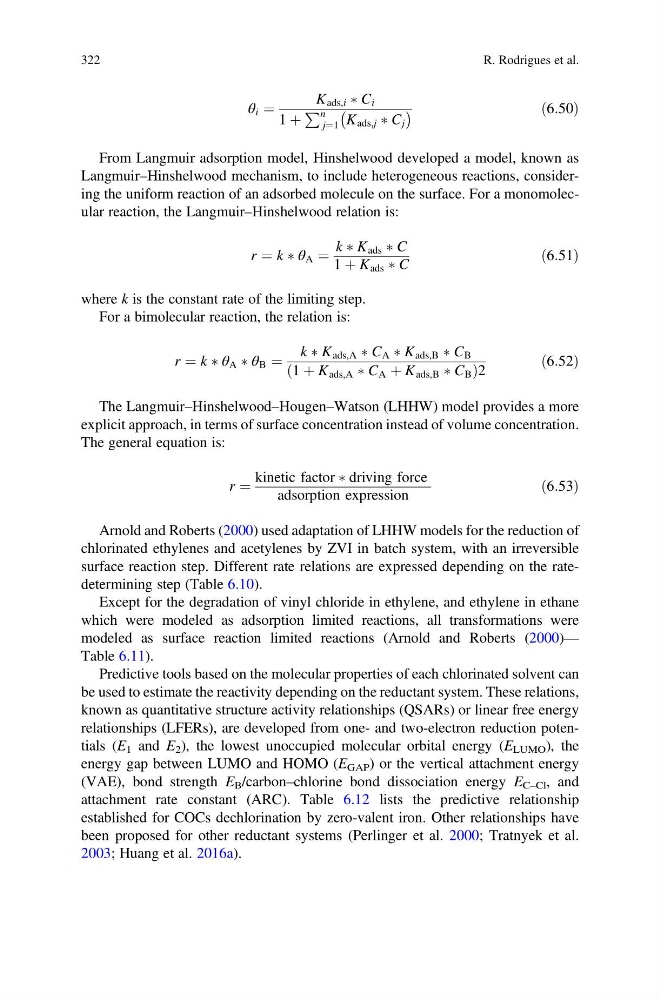
From Langmuir adsorption model, Hinshelwood developed a model, known as
Langmuir–Hinshelwood mechanism, to include heterogeneous reactions, considering the uniform reaction of an adsorbed molecule on the surface. For a monomolecular reaction, the Langmuir–Hinshelwood relation is:
r ¼ k à θ A ¼
k à K ads à C
1 þ K ads à C
ð6:51Þ
where k is the constant rate of the limiting step.
For a bimolecular reaction, the relation is:
r ¼ k à θ A à θ B ¼
k à K ads,A à C A à K ads,B à C B
1 þ K ads,A Ã C A þ K ads,B Ã C B
ð
Þ 2
ð6:52Þ
The Langmuir–Hinshelwood–Hougen–Watson (LHHW) model provides a more
explicit approach, in terms of surface concentration instead of volume concentration.
The general equation is:
r ¼
kinetic factor à driving force
adsorption expression
ð6:53Þ
Arnold and Roberts (2000) used adaptation of LHHW models for the reduction of
chlorinated ethylenes and acetylenes by ZVI in batch system, with an irreversible
surface reaction step. Different rate relations are expressed depending on the ratedetermining step (Table 6.10).
Except for the degradation of vinyl chloride in ethylene, and ethylene in ethane
which were modeled as adsorption limited reactions, all transformations were
modeled as surface reaction limited reactions (Arnold and Roberts (2000)—
Table 6.11).
Predictive tools based on the molecular properties of each chlorinated solvent can
be used to estimate the reactivity depending on the reductant system. These relations,
known as quantitative structure activity relationships (QSARs) or linear free energy
relationships (LFERs), are developed from one- and two-electron reduction potentials (E 1 and E 2 ), the lowest unoccupied molecular orbital energy (E LUMO ), the
energy gap between LUMO and HOMO (E GAP ) or the vertical attachment energy
(VAE), bond strength E B /carbon–chlorine bond dissociation energy E C–Cl , and
attachment rate constant (ARC). Table 6.12 lists the predictive relationship
established for COCs dechlorination by zero-valent iron. Other relationships have
been proposed for other reductant systems (Perlinger et al. 2000; Tratnyek et al.
2003; Huang et al. 2016a).
322
R. Rodrigues et al.
K ads,i à C i
1 þ
P n
j¼1 K ads,j à C j
À
Á
ð6:50Þ
From Langmuir adsorption model, Hinshelwood developed a model, known as
Langmuir–Hinshelwood mechanism, to include heterogeneous reactions, considering the uniform reaction of an adsorbed molecule on the surface. For a monomolecular reaction, the Langmuir–Hinshelwood relation is:
r ¼ k à θ A ¼
k à K ads à C
1 þ K ads à C
ð6:51Þ
where k is the constant rate of the limiting step.
For a bimolecular reaction, the relation is:
r ¼ k à θ A à θ B ¼
k à K ads,A à C A à K ads,B à C B
1 þ K ads,A Ã C A þ K ads,B Ã C B
ð
Þ 2
ð6:52Þ
The Langmuir–Hinshelwood–Hougen–Watson (LHHW) model provides a more
explicit approach, in terms of surface concentration instead of volume concentration.
The general equation is:
r ¼
kinetic factor à driving force
adsorption expression
ð6:53Þ
Arnold and Roberts (2000) used adaptation of LHHW models for the reduction of
chlorinated ethylenes and acetylenes by ZVI in batch system, with an irreversible
surface reaction step. Different rate relations are expressed depending on the ratedetermining step (Table 6.10).
Except for the degradation of vinyl chloride in ethylene, and ethylene in ethane
which were modeled as adsorption limited reactions, all transformations were
modeled as surface reaction limited reactions (Arnold and Roberts (2000)—
Table 6.11).
Predictive tools based on the molecular properties of each chlorinated solvent can
be used to estimate the reactivity depending on the reductant system. These relations,
known as quantitative structure activity relationships (QSARs) or linear free energy
relationships (LFERs), are developed from one- and two-electron reduction potentials (E 1 and E 2 ), the lowest unoccupied molecular orbital energy (E LUMO ), the
energy gap between LUMO and HOMO (E GAP ) or the vertical attachment energy
(VAE), bond strength E B /carbon–chlorine bond dissociation energy E C–Cl , and
attachment rate constant (ARC). Table 6.12 lists the predictive relationship
established for COCs dechlorination by zero-valent iron. Other relationships have
been proposed for other reductant systems (Perlinger et al. 2000; Tratnyek et al.
2003; Huang et al. 2016a).
322
R. Rodrigues et al.