

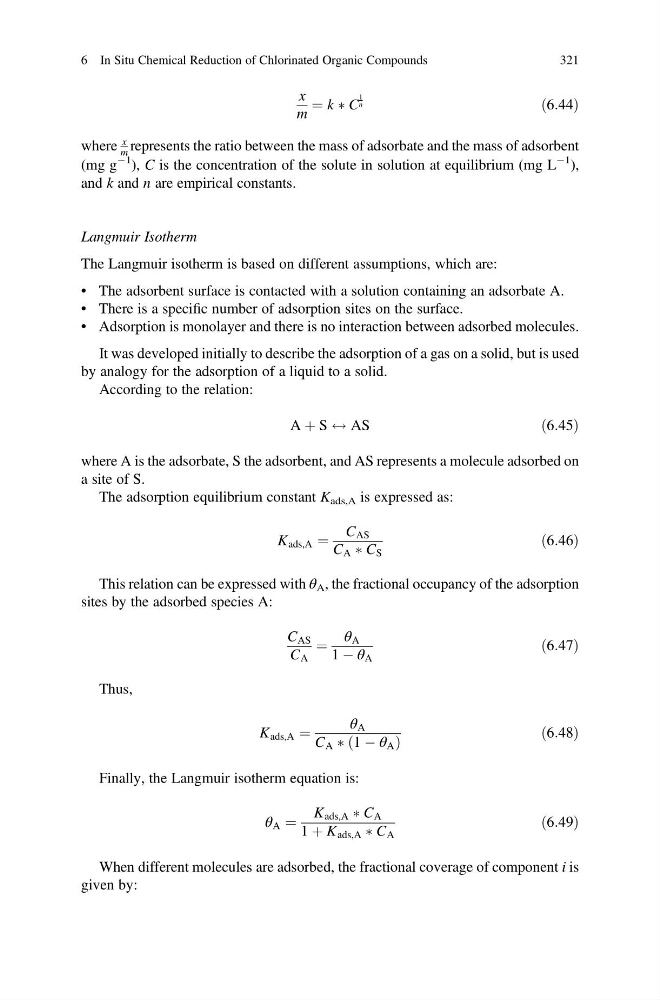
x
m
¼ k à C
1
n
ð6:44Þ
where
x
m represents the ratio between the mass of adsorbate and the mass of adsorbent
(mg g
À1 ), C is the concentration of the solute in solution at equilibrium (mg L
À1 ),
and k and n are empirical constants.
Langmuir Isotherm
The Langmuir isotherm is based on different assumptions, which are:
• The adsorbent surface is contacted with a solution containing an adsorbate A.
• There is a specific number of adsorption sites on the surface.
• Adsorption is monolayer and there is no interaction between adsorbed molecules.
It was developed initially to describe the adsorption of a gas on a solid, but is used
by analogy for the adsorption of a liquid to a solid.
According to the relation:
A þ S $ AS
ð6:45Þ
where A is the adsorbate, S the adsorbent, and AS represents a molecule adsorbed on
a site of S.
The adsorption equilibrium constant K ads,A is expressed as:
K ads,A ¼
C AS
C A Ã C S
ð6:46Þ
This relation can be expressed with θ A , the fractional occupancy of the adsorption
sites by the adsorbed species A:
C AS
C A
¼
θ A
1 À θ A
ð6:47Þ
Thus,
K ads,A ¼
θ A
C A Ã 1 À θ A
ð
Þ
ð6:48Þ
Finally, the Langmuir isotherm equation is:
θ A ¼
K ads,A Ã C A
1 þ K ads,A Ã C A
ð6:49Þ
When different molecules are adsorbed, the fractional coverage of component i is
given by:
6 In Situ Chemical Reduction of Chlorinated Organic Compounds
321
m
¼ k à C
1
n
ð6:44Þ
where
x
m represents the ratio between the mass of adsorbate and the mass of adsorbent
(mg g
À1 ), C is the concentration of the solute in solution at equilibrium (mg L
À1 ),
and k and n are empirical constants.
Langmuir Isotherm
The Langmuir isotherm is based on different assumptions, which are:
• The adsorbent surface is contacted with a solution containing an adsorbate A.
• There is a specific number of adsorption sites on the surface.
• Adsorption is monolayer and there is no interaction between adsorbed molecules.
It was developed initially to describe the adsorption of a gas on a solid, but is used
by analogy for the adsorption of a liquid to a solid.
According to the relation:
A þ S $ AS
ð6:45Þ
where A is the adsorbate, S the adsorbent, and AS represents a molecule adsorbed on
a site of S.
The adsorption equilibrium constant K ads,A is expressed as:
K ads,A ¼
C AS
C A Ã C S
ð6:46Þ
This relation can be expressed with θ A , the fractional occupancy of the adsorption
sites by the adsorbed species A:
C AS
C A
¼
θ A
1 À θ A
ð6:47Þ
Thus,
K ads,A ¼
θ A
C A Ã 1 À θ A
ð
Þ
ð6:48Þ
Finally, the Langmuir isotherm equation is:
θ A ¼
K ads,A Ã C A
1 þ K ads,A Ã C A
ð6:49Þ
When different molecules are adsorbed, the fractional coverage of component i is
given by:
6 In Situ Chemical Reduction of Chlorinated Organic Compounds
321