

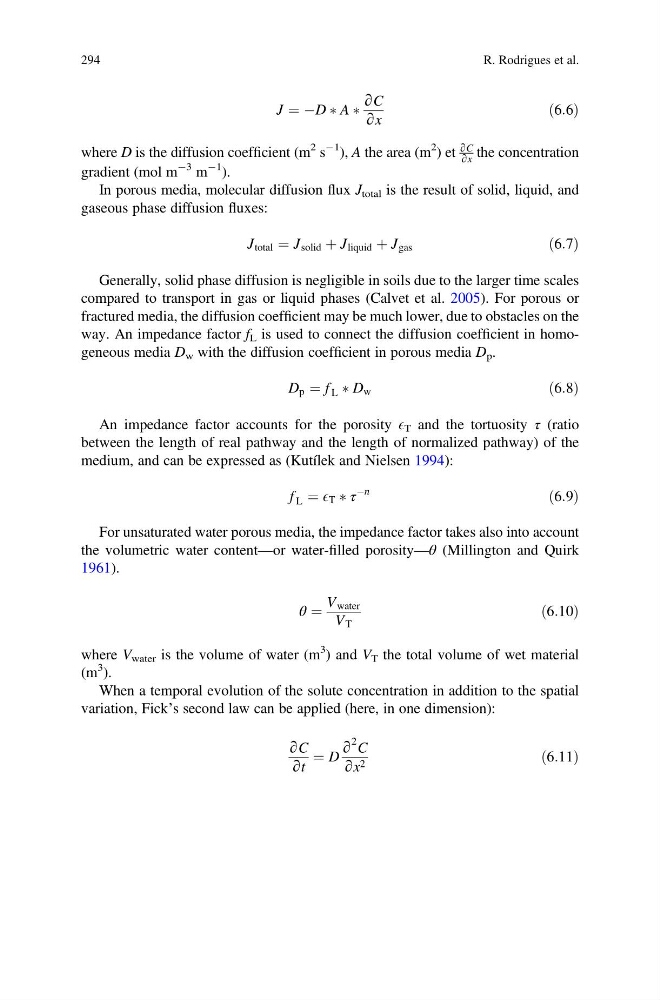
J ¼ ÀD Ã A Ã
∂C
∂x
ð6:6Þ
where D is the diffusion coefficient (m
2 s
À1 ), A the area (m
2 ) et
∂C
∂x
the concentration
gradient (mol m
À3 m
À1 ).
In porous media, molecular diffusion flux J total is the result of solid, liquid, and
gaseous phase diffusion fluxes:
J total ¼ J solid þ J liquid þ J gas
ð6:7Þ
Generally, solid phase diffusion is negligible in soils due to the larger time scales
compared to transport in gas or liquid phases (Calvet et al. 2005). For porous or
fractured media, the diffusion coefficient may be much lower, due to obstacles on the
way. An impedance factor f L is used to connect the diffusion coefficient in homogeneous media D w with the diffusion coefficient in porous media D p .
D p ¼ f L Ã D w
ð6:8Þ
An impedance factor accounts for the porosity E T and the tortuosity τ (ratio
between the length of real pathway and the length of normalized pathway) of the
medium, and can be expressed as (Kutílek and Nielsen 1994):
f L ¼ E T Ã τ
Àn
ð6:9Þ
For unsaturated water porous media, the impedance factor takes also into account
the volumetric water content—or water-filled porosity—θ (Millington and Quirk
1961).
θ ¼
V water
V T
ð6:10Þ
where V water is the volume of water (m
3 ) and V T the total volume of wet material
(m
3 ).
When a temporal evolution of the solute concentration in addition to the spatial
variation, Fick’s second law can be applied (here, in one dimension):
∂C
∂t
¼ D
∂
2 C
∂x 2
ð6:11Þ
294
R. Rodrigues et al.
∂C
∂x
ð6:6Þ
where D is the diffusion coefficient (m
2 s
À1 ), A the area (m
2 ) et
∂C
∂x
the concentration
gradient (mol m
À3 m
À1 ).
In porous media, molecular diffusion flux J total is the result of solid, liquid, and
gaseous phase diffusion fluxes:
J total ¼ J solid þ J liquid þ J gas
ð6:7Þ
Generally, solid phase diffusion is negligible in soils due to the larger time scales
compared to transport in gas or liquid phases (Calvet et al. 2005). For porous or
fractured media, the diffusion coefficient may be much lower, due to obstacles on the
way. An impedance factor f L is used to connect the diffusion coefficient in homogeneous media D w with the diffusion coefficient in porous media D p .
D p ¼ f L Ã D w
ð6:8Þ
An impedance factor accounts for the porosity E T and the tortuosity τ (ratio
between the length of real pathway and the length of normalized pathway) of the
medium, and can be expressed as (Kutílek and Nielsen 1994):
f L ¼ E T Ã τ
Àn
ð6:9Þ
For unsaturated water porous media, the impedance factor takes also into account
the volumetric water content—or water-filled porosity—θ (Millington and Quirk
1961).
θ ¼
V water
V T
ð6:10Þ
where V water is the volume of water (m
3 ) and V T the total volume of wet material
(m
3 ).
When a temporal evolution of the solute concentration in addition to the spatial
variation, Fick’s second law can be applied (here, in one dimension):
∂C
∂t
¼ D
∂
2 C
∂x 2
ð6:11Þ
294
R. Rodrigues et al.