

by diffusion phenomena. Back diffusion can finally occur with COCs desorption
(Kueper et al. 2014).
All these transport processes, in addition to chemical and biological processes,
are part of the natural attenuation in contaminated soils and groundwater. However,
natural attenuation is known to be relatively slow, especially with recalcitrant
compounds, but its understanding is of great importance in order to perform and
control chemical degradation.
6.2.3.1 Advection
Advection is the mass transport related to groundwater velocity (Morrison 2000). It
is often considered as the main pollution transport phenomena in groundwater
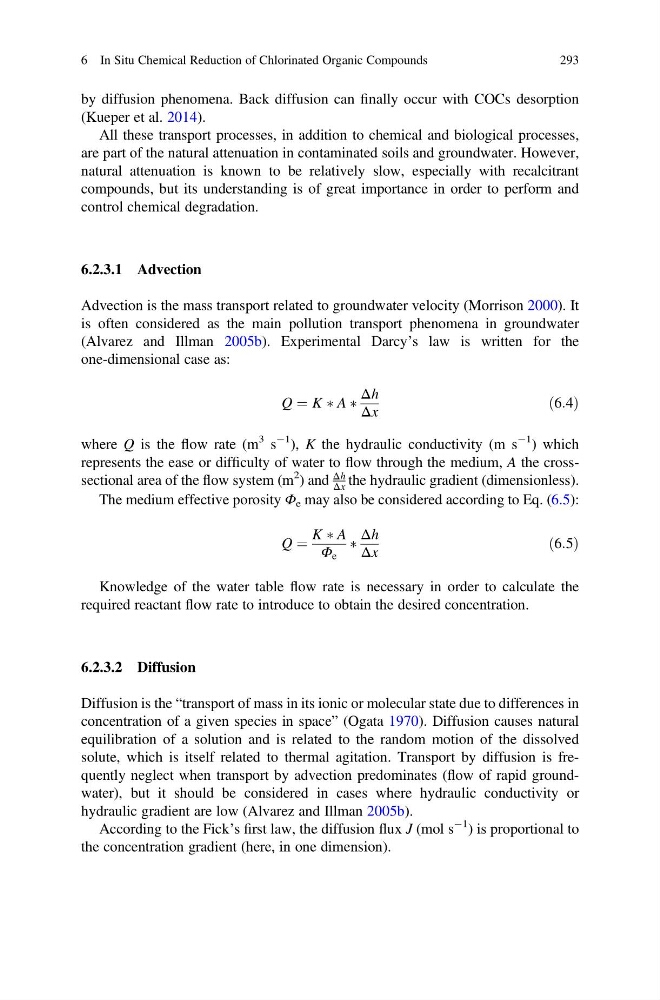
(Alvarez and Illman 2005b). Experimental Darcy’s law is written for the
one-dimensional case as:
Q ¼ K Ã A Ã
Δh
Δx
ð6:4Þ
where Q is the flow rate (m
3 s
À1 ), K the hydraulic conductivity (m s
À1 ) which
represents the ease or difficulty of water to flow through the medium, A the crosssectional area of the flow system (m
2 ) and
Δh
Δx the hydraulic gradient (dimensionless).
The medium effective porosity Φ e may also be considered according to Eq. (6.5):
Q ¼
K Ã A
Φ e
Ã
Δh
Δx
ð6:5Þ
Knowledge of the water table flow rate is necessary in order to calculate the
required reactant flow rate to introduce to obtain the desired concentration.
6.2.3.2 Diffusion
Diffusion is the “transport of mass in its ionic or molecular state due to differences in
concentration of a given species in space” (Ogata 1970). Diffusion causes natural
equilibration of a solution and is related to the random motion of the dissolved
solute, which is itself related to thermal agitation. Transport by diffusion is frequently neglect when transport by advection predominates (flow of rapid groundwater), but it should be considered in cases where hydraulic conductivity or
hydraulic gradient are low (Alvarez and Illman 2005b).
According to the Fick’s first law, the diffusion flux J (mol s
À1 ) is proportional to
the concentration gradient (here, in one dimension).
6 In Situ Chemical Reduction of Chlorinated Organic Compounds
293
(Kueper et al. 2014).
All these transport processes, in addition to chemical and biological processes,
are part of the natural attenuation in contaminated soils and groundwater. However,
natural attenuation is known to be relatively slow, especially with recalcitrant
compounds, but its understanding is of great importance in order to perform and
control chemical degradation.
6.2.3.1 Advection
Advection is the mass transport related to groundwater velocity (Morrison 2000). It
is often considered as the main pollution transport phenomena in groundwater
(Alvarez and Illman 2005b). Experimental Darcy’s law is written for the
one-dimensional case as:
Q ¼ K Ã A Ã
Δh
Δx
ð6:4Þ
where Q is the flow rate (m
3 s
À1 ), K the hydraulic conductivity (m s
À1 ) which
represents the ease or difficulty of water to flow through the medium, A the crosssectional area of the flow system (m
2 ) and
Δh
Δx the hydraulic gradient (dimensionless).
The medium effective porosity Φ e may also be considered according to Eq. (6.5):
Q ¼
K Ã A
Φ e
Ã
Δh
Δx
ð6:5Þ
Knowledge of the water table flow rate is necessary in order to calculate the
required reactant flow rate to introduce to obtain the desired concentration.
6.2.3.2 Diffusion
Diffusion is the “transport of mass in its ionic or molecular state due to differences in
concentration of a given species in space” (Ogata 1970). Diffusion causes natural
equilibration of a solution and is related to the random motion of the dissolved
solute, which is itself related to thermal agitation. Transport by diffusion is frequently neglect when transport by advection predominates (flow of rapid groundwater), but it should be considered in cases where hydraulic conductivity or
hydraulic gradient are low (Alvarez and Illman 2005b).
According to the Fick’s first law, the diffusion flux J (mol s
À1 ) is proportional to
the concentration gradient (here, in one dimension).
6 In Situ Chemical Reduction of Chlorinated Organic Compounds
293