

E
¼ À
Δ r G
aq
ð Þ
nF
ð6:3Þ
where n is the number of electrons transferred in the reaction and F the Faraday
constant (96,485 C mol
À1 ).
Standard potential values of half-reactions of COCs are all positive and generally
close or higher than 0.4 V/SHE (standard hydrogen electrode) at pH ¼ 7 and at
25
C. In agreement with standard potential values provided in Table 6.2, reduction
reactions appear favorable under reductive conditions. Electrochemical properties
are in good agreement with the literature which reports favorable experimental
results for COCs reduction, more particularly for the removal of highly chlorinated
compounds (McCarty and Semprini 1994; Brown 2010).
6.2.2 Toxicity
Chlorinated solvents are harmful to both human and environment health (McDaniel
et al. 2004; Chiu et al. 2012). In the body, the main penetration pathway is the
respiratory tract and, to a lesser extent, the dermal or digestive tract by accident. By
inhalation, COCs cause irritation of the airways, chest pain, or disturbance of the
heart rhythm, which can lead to dizziness sensations or even coma for heavy
exposure. Common symptoms of dermal exposure are irritation and chemical
burns, conjunctivitis or ocular projection. Chronic exposure to COCs lead to longlasting and often irreversible effects, such as sleep disorders, vertigo, memory loss,
concentrating trouble, or depressive tendencies (Ruder 2006). Chlorinated methanes,
especially carbon tetrachloride, are known to contribute to ozone depletion when
important amounts are released into the environment (Doherty 2000a; Wang et al.
2009b).
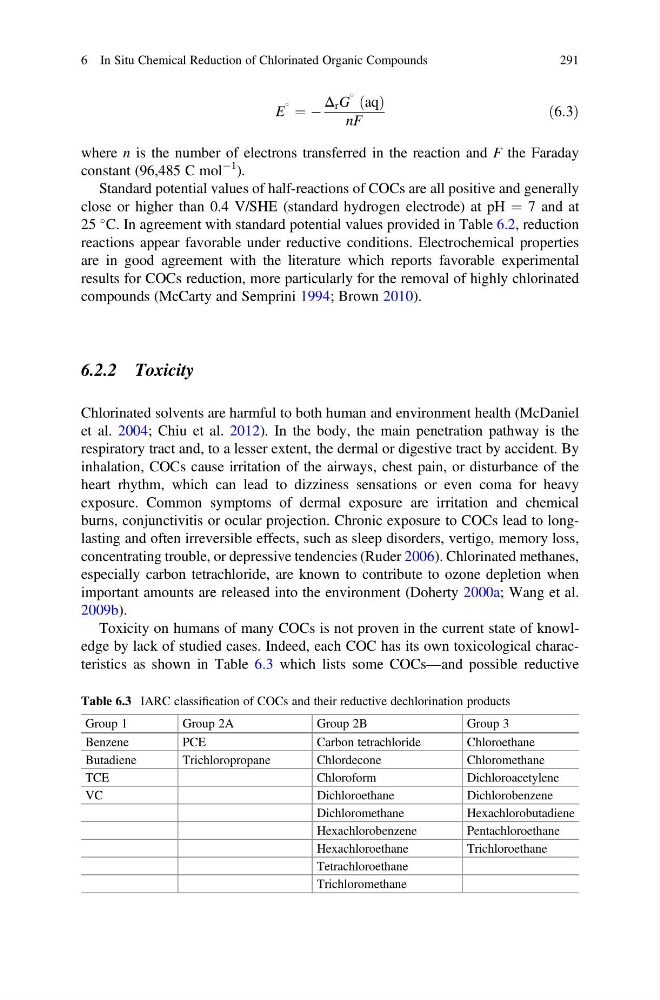
Toxicity on humans of many COCs is not proven in the current state of knowledge by lack of studied cases. Indeed, each COC has its own toxicological characteristics as shown in Table 6.3 which lists some COCs—and possible reductive
Table 6.3 IARC classification of COCs and their reductive dechlorination products
Group 1
Group 2A
Group 2B
Group 3
Benzene
PCE
Carbon tetrachloride
Chloroethane
Butadiene
Trichloropropane
Chlordecone
Chloromethane
TCE
Chloroform
Dichloroacetylene
VC
Dichloroethane
Dichlorobenzene
Dichloromethane
Hexachlorobutadiene
Hexachlorobenzene
Pentachloroethane
Hexachloroethane
Trichloroethane
Tetrachloroethane
Trichloromethane
6 In Situ Chemical Reduction of Chlorinated Organic Compounds
291
¼ À
Δ r G
aq
ð Þ
nF
ð6:3Þ
where n is the number of electrons transferred in the reaction and F the Faraday
constant (96,485 C mol
À1 ).
Standard potential values of half-reactions of COCs are all positive and generally
close or higher than 0.4 V/SHE (standard hydrogen electrode) at pH ¼ 7 and at
25
C. In agreement with standard potential values provided in Table 6.2, reduction
reactions appear favorable under reductive conditions. Electrochemical properties
are in good agreement with the literature which reports favorable experimental
results for COCs reduction, more particularly for the removal of highly chlorinated
compounds (McCarty and Semprini 1994; Brown 2010).
6.2.2 Toxicity
Chlorinated solvents are harmful to both human and environment health (McDaniel
et al. 2004; Chiu et al. 2012). In the body, the main penetration pathway is the
respiratory tract and, to a lesser extent, the dermal or digestive tract by accident. By
inhalation, COCs cause irritation of the airways, chest pain, or disturbance of the
heart rhythm, which can lead to dizziness sensations or even coma for heavy
exposure. Common symptoms of dermal exposure are irritation and chemical
burns, conjunctivitis or ocular projection. Chronic exposure to COCs lead to longlasting and often irreversible effects, such as sleep disorders, vertigo, memory loss,
concentrating trouble, or depressive tendencies (Ruder 2006). Chlorinated methanes,
especially carbon tetrachloride, are known to contribute to ozone depletion when
important amounts are released into the environment (Doherty 2000a; Wang et al.
2009b).
Toxicity on humans of many COCs is not proven in the current state of knowledge by lack of studied cases. Indeed, each COC has its own toxicological characteristics as shown in Table 6.3 which lists some COCs—and possible reductive
Table 6.3 IARC classification of COCs and their reductive dechlorination products
Group 1
Group 2A
Group 2B
Group 3
Benzene
PCE
Carbon tetrachloride
Chloroethane
Butadiene
Trichloropropane
Chlordecone
Chloromethane
TCE
Chloroform
Dichloroacetylene
VC
Dichloroethane
Dichlorobenzene
Dichloromethane
Hexachlorobutadiene
Hexachlorobenzene
Pentachloroethane
Hexachloroethane
Trichloroethane
Tetrachloroethane
Trichloromethane
6 In Situ Chemical Reduction of Chlorinated Organic Compounds
291