

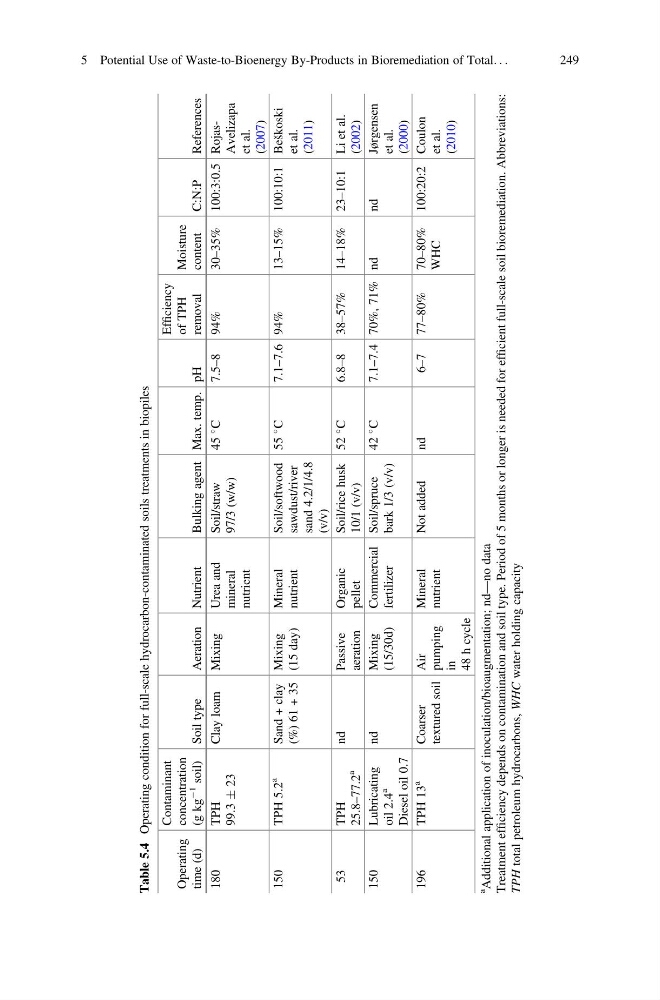
Table 5.4
Operating condition for full-scale hydrocarbon-contaminated soils treatments in biopiles
Operating
time (d)
Contaminant
concentration
(g kg
À1
soil) Soil type
Aeration Nutrient
Bulking agent Max. temp. pH
Efficiency
of TPH
removal
Moisture
content
C:N:P
References
180
TPH
99.3
Æ 23
Clay loam
Mixing
Urea and
mineral
nutrient
Soil/straw
97/3 (w/w)
45
C
7.5–8
94%
30–35% 100:3:0.5 RojasAvelizapa
et al.
(2007)
150
TPH 5.2
a
Sand + clay
(%) 61 + 35
Mixing
(15 day)
Mineral
nutrient
Soil/softwood
sawdust/river
sand 4.2/1/4.8
(v/v)
55
C
7.1–7.6 94%
13–15% 100:10:1 Beškoski
et al.
(2011)
53
TPH
25.8–77.2
a
nd
Passive
aeration
Organic
pellet
Soil/rice husk
10/1 (v/v)
52
C
6.8–8
38–57%
14–18% 23–10:1 Li et al.
(2002)
150
Lubricating
oil 2.4
a
Diesel oil 0.7
nd
Mixing
(15/30d)
Commercial
fertilizer
Soil/spruce
bark 1/3 (v/v)
42
C
7.1–7.4 70%, 71% nd
nd
Jørgensen
et al.
(2000)
196
TPH 13
a
Coarser
textured soil
Air
pumping
in
48 h cycle
Mineral
nutrient
Not added
nd
6–7
77–80%
70–80%
WHC
100:20:2 Coulon
et al.
(2010)
a
Additional application of inoculation/bioaugmentation; nd—no data
Treatment efficiency depends on contamination and soil type. Period of 5 months or longer is needed for efficient full-scale soil bioremediation. Abbreviations:
TPH
total petroleum hydrocarbons, WHC
water holding capacity
5 Potential Use of Waste-to-Bioenergy By-Products in Bioremediation of Total. . .
249
Operating condition for full-scale hydrocarbon-contaminated soils treatments in biopiles
Operating
time (d)
Contaminant
concentration
(g kg
À1
soil) Soil type
Aeration Nutrient
Bulking agent Max. temp. pH
Efficiency
of TPH
removal
Moisture
content
C:N:P
References
180
TPH
99.3
Æ 23
Clay loam
Mixing
Urea and
mineral
nutrient
Soil/straw
97/3 (w/w)
45
C
7.5–8
94%
30–35% 100:3:0.5 RojasAvelizapa
et al.
(2007)
150
TPH 5.2
a
Sand + clay
(%) 61 + 35
Mixing
(15 day)
Mineral
nutrient
Soil/softwood
sawdust/river
sand 4.2/1/4.8
(v/v)
55
C
7.1–7.6 94%
13–15% 100:10:1 Beškoski
et al.
(2011)
53
TPH
25.8–77.2
a
nd
Passive
aeration
Organic
pellet
Soil/rice husk
10/1 (v/v)
52
C
6.8–8
38–57%
14–18% 23–10:1 Li et al.
(2002)
150
Lubricating
oil 2.4
a
Diesel oil 0.7
nd
Mixing
(15/30d)
Commercial
fertilizer
Soil/spruce
bark 1/3 (v/v)
42
C
7.1–7.4 70%, 71% nd
nd
Jørgensen
et al.
(2000)
196
TPH 13
a
Coarser
textured soil
Air
pumping
in
48 h cycle
Mineral
nutrient
Not added
nd
6–7
77–80%
70–80%
WHC
100:20:2 Coulon
et al.
(2010)
a
Additional application of inoculation/bioaugmentation; nd—no data
Treatment efficiency depends on contamination and soil type. Period of 5 months or longer is needed for efficient full-scale soil bioremediation. Abbreviations:
TPH
total petroleum hydrocarbons, WHC
water holding capacity
5 Potential Use of Waste-to-Bioenergy By-Products in Bioremediation of Total. . .
249