

3.6.2 Description of Treatment Units
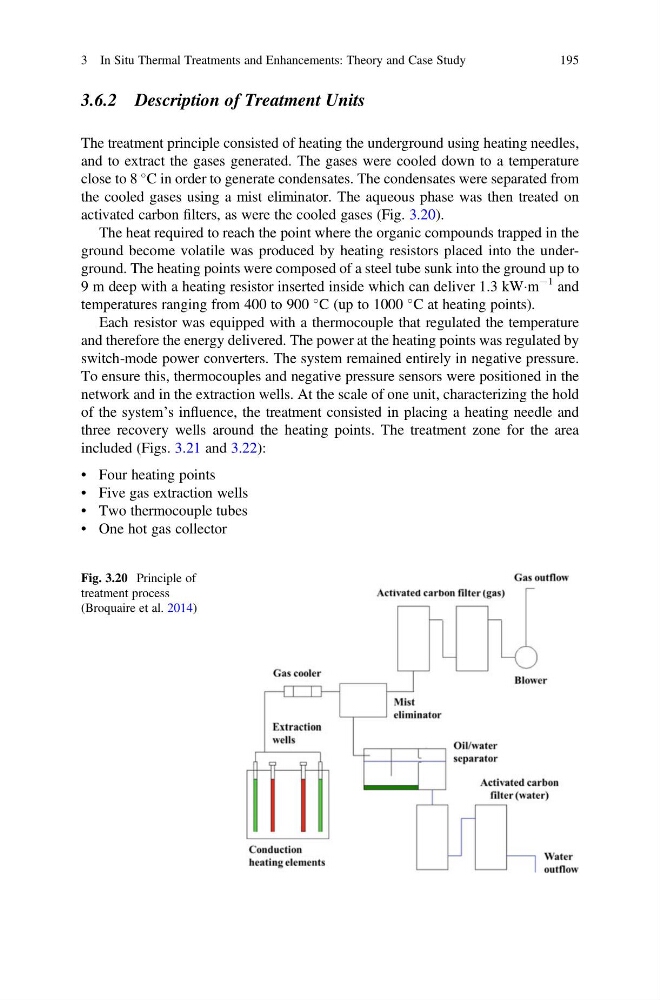
The treatment principle consisted of heating the underground using heating needles,
and to extract the gases generated. The gases were cooled down to a temperature
close to 8
C in order to generate condensates. The condensates were separated from
the cooled gases using a mist eliminator. The aqueous phase was then treated on
activated carbon filters, as were the cooled gases (Fig. 3.20).
The heat required to reach the point where the organic compounds trapped in the
ground become volatile was produced by heating resistors placed into the underground. The heating points were composed of a steel tube sunk into the ground up to
9 m deep with a heating resistor inserted inside which can deliver 1.3 kWÁm
À1 and
temperatures ranging from 400 to 900
C (up to 1000
C at heating points).
Each resistor was equipped with a thermocouple that regulated the temperature
and therefore the energy delivered. The power at the heating points was regulated by
switch-mode power converters. The system remained entirely in negative pressure.
To ensure this, thermocouples and negative pressure sensors were positioned in the
network and in the extraction wells. At the scale of one unit, characterizing the hold
of the system’s influence, the treatment consisted in placing a heating needle and
three recovery wells around the heating points. The treatment zone for the area
included (Figs. 3.21 and 3.22):
• Four heating points
• Five gas extraction wells
• Two thermocouple tubes
• One hot gas collector
Fig. 3.20 Principle of
treatment process
(Broquaire et al. 2014)
3 In Situ Thermal Treatments and Enhancements: Theory and Case Study
195
The treatment principle consisted of heating the underground using heating needles,
and to extract the gases generated. The gases were cooled down to a temperature
close to 8
C in order to generate condensates. The condensates were separated from
the cooled gases using a mist eliminator. The aqueous phase was then treated on
activated carbon filters, as were the cooled gases (Fig. 3.20).
The heat required to reach the point where the organic compounds trapped in the
ground become volatile was produced by heating resistors placed into the underground. The heating points were composed of a steel tube sunk into the ground up to
9 m deep with a heating resistor inserted inside which can deliver 1.3 kWÁm
À1 and
temperatures ranging from 400 to 900
C (up to 1000
C at heating points).
Each resistor was equipped with a thermocouple that regulated the temperature
and therefore the energy delivered. The power at the heating points was regulated by
switch-mode power converters. The system remained entirely in negative pressure.
To ensure this, thermocouples and negative pressure sensors were positioned in the
network and in the extraction wells. At the scale of one unit, characterizing the hold
of the system’s influence, the treatment consisted in placing a heating needle and
three recovery wells around the heating points. The treatment zone for the area
included (Figs. 3.21 and 3.22):
• Four heating points
• Five gas extraction wells
• Two thermocouple tubes
• One hot gas collector
Fig. 3.20 Principle of
treatment process
(Broquaire et al. 2014)
3 In Situ Thermal Treatments and Enhancements: Theory and Case Study
195