

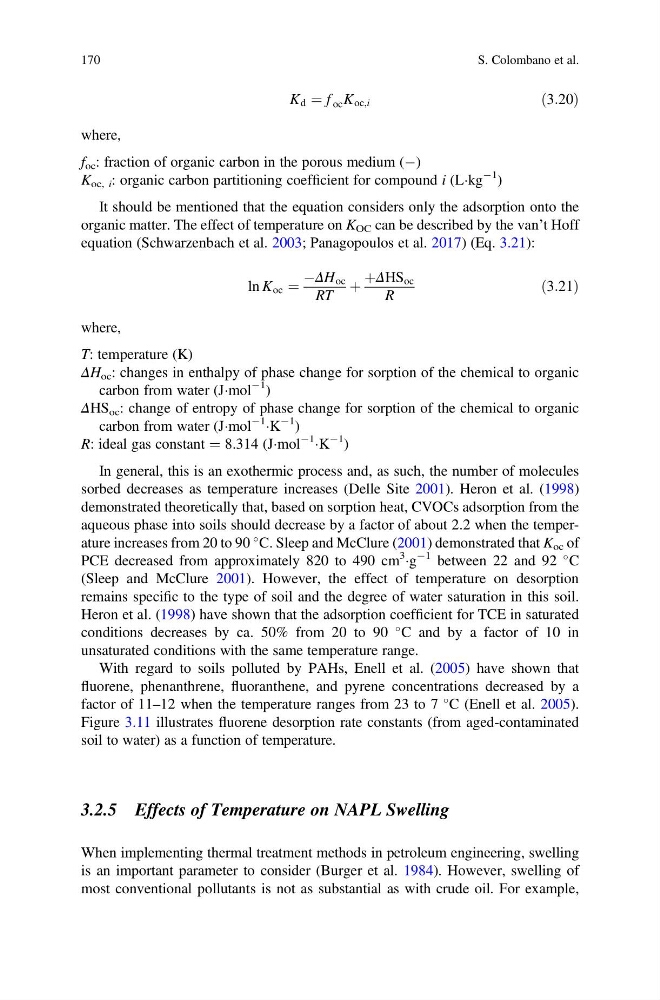
K d ¼ f oc K oc,i
ð3:20Þ
where,
f oc : fraction of organic carbon in the porous medium (À)
K oc, i : organic carbon partitioning coefficient for compound i (LÁkg
À1 )
It should be mentioned that the equation considers only the adsorption onto the
organic matter. The effect of temperature on K OC can be described by the van’t Hoff
equation (Schwarzenbach et al. 2003; Panagopoulos et al. 2017) (Eq. 3.21):
ln K oc ¼
ÀΔH oc
RT
þ
þΔHS oc
R
ð3:21Þ
where,
T: temperature (K)
ΔH oc : changes in enthalpy of phase change for sorption of the chemical to organic
carbon from water (JÁmol
À1 )
ΔHS oc : change of entropy of phase change for sorption of the chemical to organic
carbon from water (JÁmol
À1
ÁK
À1 )
R: ideal gas constant ¼ 8.314 (JÁmol
À1
ÁK
À1 )
In general, this is an exothermic process and, as such, the number of molecules
sorbed decreases as temperature increases (Delle Site 2001). Heron et al. (1998)
demonstrated theoretically that, based on sorption heat, CVOCs adsorption from the
aqueous phase into soils should decrease by a factor of about 2.2 when the temperature increases from 20 to 90
C. Sleep and McClure (2001) demonstrated that K oc of
PCE decreased from approximately 820 to 490 cm
3
Ág
À1 between 22 and 92
C
(Sleep and McClure 2001). However, the effect of temperature on desorption
remains specific to the type of soil and the degree of water saturation in this soil.
Heron et al. (1998) have shown that the adsorption coefficient for TCE in saturated
conditions decreases by ca. 50% from 20 to 90
C and by a factor of 10 in
unsaturated conditions with the same temperature range.
With regard to soils polluted by PAHs, Enell et al. (2005) have shown that
fluorene, phenanthrene, fluoranthene, and pyrene concentrations decreased by a
factor of 11–12 when the temperature ranges from 23 to 7
C (Enell et al. 2005).
Figure 3.11 illustrates fluorene desorption rate constants (from aged-contaminated
soil to water) as a function of temperature.
3.2.5 Effects of Temperature on NAPL Swelling
When implementing thermal treatment methods in petroleum engineering, swelling
is an important parameter to consider (Burger et al. 1984). However, swelling of
most conventional pollutants is not as substantial as with crude oil. For example,
170
S. Colombano et al.
ð3:20Þ
where,
f oc : fraction of organic carbon in the porous medium (À)
K oc, i : organic carbon partitioning coefficient for compound i (LÁkg
À1 )
It should be mentioned that the equation considers only the adsorption onto the
organic matter. The effect of temperature on K OC can be described by the van’t Hoff
equation (Schwarzenbach et al. 2003; Panagopoulos et al. 2017) (Eq. 3.21):
ln K oc ¼
ÀΔH oc
RT
þ
þΔHS oc
R
ð3:21Þ
where,
T: temperature (K)
ΔH oc : changes in enthalpy of phase change for sorption of the chemical to organic
carbon from water (JÁmol
À1 )
ΔHS oc : change of entropy of phase change for sorption of the chemical to organic
carbon from water (JÁmol
À1
ÁK
À1 )
R: ideal gas constant ¼ 8.314 (JÁmol
À1
ÁK
À1 )
In general, this is an exothermic process and, as such, the number of molecules
sorbed decreases as temperature increases (Delle Site 2001). Heron et al. (1998)
demonstrated theoretically that, based on sorption heat, CVOCs adsorption from the
aqueous phase into soils should decrease by a factor of about 2.2 when the temperature increases from 20 to 90
C. Sleep and McClure (2001) demonstrated that K oc of
PCE decreased from approximately 820 to 490 cm
3
Ág
À1 between 22 and 92
C
(Sleep and McClure 2001). However, the effect of temperature on desorption
remains specific to the type of soil and the degree of water saturation in this soil.
Heron et al. (1998) have shown that the adsorption coefficient for TCE in saturated
conditions decreases by ca. 50% from 20 to 90
C and by a factor of 10 in
unsaturated conditions with the same temperature range.
With regard to soils polluted by PAHs, Enell et al. (2005) have shown that
fluorene, phenanthrene, fluoranthene, and pyrene concentrations decreased by a
factor of 11–12 when the temperature ranges from 23 to 7
C (Enell et al. 2005).
Figure 3.11 illustrates fluorene desorption rate constants (from aged-contaminated
soil to water) as a function of temperature.
3.2.5 Effects of Temperature on NAPL Swelling
When implementing thermal treatment methods in petroleum engineering, swelling
is an important parameter to consider (Burger et al. 1984). However, swelling of
most conventional pollutants is not as substantial as with crude oil. For example,
170
S. Colombano et al.